
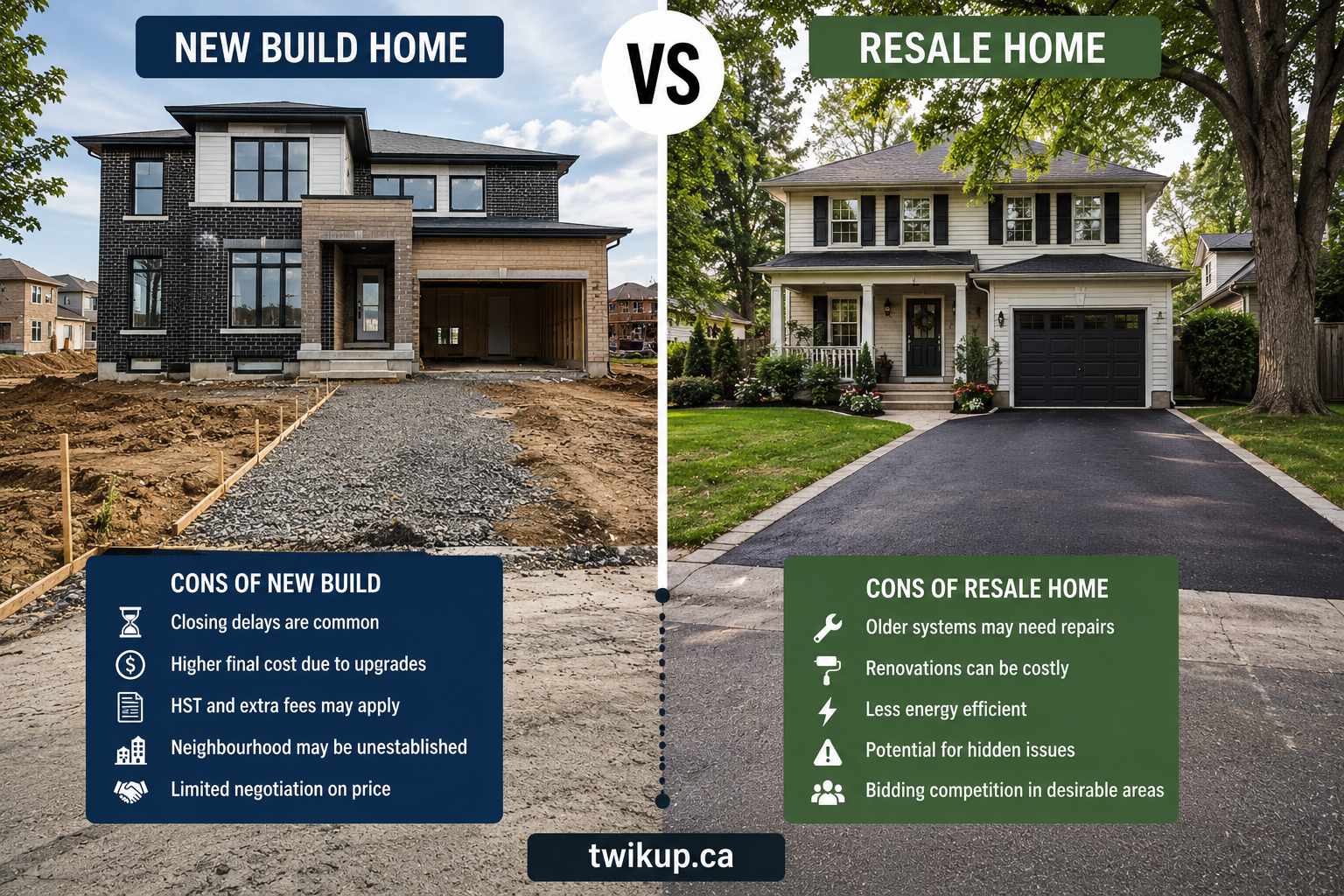
New Build vs Resale Homes in Canada: Which One Should You Buy in 2026?
Buying a home in Canada is not just about choosing the property you like.
It is about choosing the risk you can live with.
Some buyers fall in love with brand-new kitchens, untouched floors, energy-efficient windows, builder warranties, and the idea of being the first person to live in a home.
Others prefer mature neighbourhoods, larger lots, finished basements, established schools, predictable closing dates, and the ability to see exactly what they are buying before they sign.
That is why the debate between new build vs resale home is not really about which one is “better.”
It is about which one is better for your budget, timeline, lifestyle, and tolerance for uncertainty.
This guide is Part 17 of Twikup’s Canadian home-buying series.
Before reading this article, you may also want to read:
- Part 1: Step-by-Step Guide to Buying Your First Home in Canada: 2026 Complete Beginner's Roadmap
- Part 2: Hidden Costs of Buying a Home in Canada: Understanding Down Payments and Closing Costs
- Part 3: How to Choose the Right Neighbourhood in Canada: The Decision That Can Make or Break Your Home Purchase
- Part 4: Condo vs House Ownership in Canada: The Hidden Trade-Offs Most Buyers Don't Discover Until It's Too Late
Quick Answer: Should You Buy a New Build or Resale Home?
Choose a new build if you want modern design, energy efficiency, builder warranty protection, customization, and you can handle possible delays, upgrade costs, HST rules, and an unfinished neighbourhood.
Choose a resale home if you want a faster closing, established area, mature community, visible condition, larger lot, and more certainty about location, neighbours, schools, commute, and monthly costs.
The safest answer for most Canadian buyers in 2026 is this:
Buy a new build only if your finances can survive delays, appraisal changes, extra costs, and a higher final price than the advertised base price. Buy resale if predictability matters more than customization.
New Build vs Resale Home: Key Differences at a Glance
| Feature | New Build / Pre-Construction | Resale Home |
|---|---|---|
| Condition | Brand new, unused | Previously owned |
| Closing timeline | Can be months or years away | Usually 30 to 90 days |
| Customization | Finishes, upgrades, layouts may be selectable | Usually sold as-is |
| Warranty | Builder warranty may apply | No new home warranty unless transferable coverage remains |
| Neighbourhood | Often developing | Already established |
| Taxes | May involve GST/HST rules | Usually no HST on standard resale homes |
| Hidden costs | Upgrades, development charges, levies, assignment fees, utility setup | Repairs, renovations, inspection issues |
| Risk | Delays, cancellations, appraisal gap, changing mortgage rates | Older systems, repair costs, bidding competition |
| Best for | Buyers with flexibility | Buyers needing certainty |
What Is a New Build Home?
A new build is a newly constructed home purchased directly from a builder or developer.
It can include:
- Detached homes
- Semi-detached homes
- Townhouses
- Condo units
- Pre-construction homes
- Newly completed inventory homes
- Custom-built homes
In Canada, many buyers use the term “new build” to mean pre-construction, where you sign a purchase agreement before the home is fully built.
This is where the risk begins.
You are not just buying a home.
You are buying a promise that the home will be completed later, at an agreed price, under agreed terms.
What Is a Resale Home?
A resale home is a property that already exists and has been previously owned.
It may be:
- A detached house
- Condo
- Townhouse
- Duplex
- Semi-detached home
- Older bungalow
- Recently renovated property
With a resale home, you can physically walk through the property, inspect it, check the neighbourhood, review comparable sales, and usually close within a predictable timeline.
That does not mean resale homes are risk-free.
It means the risks are usually more visible.
The Biggest Advantage of a New Build: Everything Feels Fresh
The emotional appeal of a new build is powerful.
You walk into a sales centre or model home and see:
- Clean finishes
- Modern kitchens
- New appliances
- Open layouts
- Large windows
- Energy-efficient systems
- No old carpet
- No previous owner’s renovation mistakes
For many first-time buyers, that feels safer.
But the model home is not always the final home.
The base price may not include the finishes you are imagining.
A $700,000 new build can quickly become $735,000, $760,000, or more after upgrades, lot premiums, appliances, window coverings, fencing, landscaping, and closing adjustments.
The Biggest Advantage of a Resale Home: You Can See What You Are Buying
With resale, the home already exists.
You can check:
- Natural light
- Street noise
- Neighbouring homes
- Parking situation
- Basement condition
- Roof age
- Furnace age
- Water pressure
- Backyard size
- Commute time
- School proximity
- Real property taxes
- Real utility costs
That visibility matters.
A resale home may look older, but it gives you something very valuable: certainty.
Twikup Insight: New Builds Sell the Future. Resale Homes Show the Present.
This is the most important mindset shift.
A new build sells you what life could look like.
A resale home shows you what life already looks like.
That difference affects everything:
- Your budget
- Your mortgage approval
- Your closing timeline
- Your stress level
- Your renovation plans
- Your lifestyle after moving in
A new build may look perfect on paper, but the area may still need roads, schools, parks, grocery stores, transit, and community services.
A resale home may look less exciting online, but the neighbourhood may already have the lifestyle you need.
New Build Pros: Why Buyers Love Them
1. Modern Layouts
New builds are designed for today’s lifestyle.
You may get:
- Open-concept kitchens
- Larger closets
- Home office spaces
- Ensuite bathrooms
- Better insulation
- More efficient heating and cooling
- Modern electrical systems
For families, remote workers, and buyers who dislike old layouts, this is a major benefit.
2. Energy Efficiency
New homes are generally built to newer building codes.
That can mean:
- Better windows
- Improved insulation
- More efficient HVAC systems
- Lower heating loss
- Better ventilation
- New appliances
This does not guarantee low bills, but it can reduce some maintenance and efficiency concerns compared with older properties.
3. Builder Warranty Protection
New homes may come with warranty protection, depending on your province.
In Ontario, for example, new homes are covered through the new home warranty framework administered by Tarion.
Warranty protection can cover certain construction defects and deposit-related protections, but buyers must understand the timelines, limits, and claim process.
Do not assume “new” means “nothing can go wrong.”
New homes can still have:
- Leaks
- Delayed repairs
- Poor workmanship
- Grading problems
- Cracked concrete
- Window issues
- HVAC problems
- Incomplete finishes
Warranty helps, but it does not remove stress.
4. Customization
Depending on when you buy, you may be able to choose:
- Flooring
- Cabinets
- Countertops
- Tiles
- Paint colours
- Fixtures
- Layout options
- Electrical upgrades
This is one of the biggest reasons buyers choose new builds.
But customization can also become a trap.
The builder’s base package may be very basic, and upgrades can be expensive.
5. Less Immediate Renovation Work
With a resale home, you may need to update:
- Flooring
- Paint
- Bathrooms
- Kitchen
- Furnace
- Roof
- Windows
- Appliances
With a new build, you may avoid major renovations in the early years.
But you may still need to pay for:
- Blinds
- Landscaping
- Deck
- Fence
- Basement finishing
- Garage storage
- Appliances
- Air conditioning
- Driveway sealing
New does not mean fully finished.
New Build Cons: What Buyers Often Underestimate
1. The Advertised Price Is Not Always the Final Price
A builder may advertise a base price, but your real cost can rise because of:
- Upgrade packages
- Lot premiums
- Development charges
- Utility connection fees
- Legal fees
- Assignment fees
- Tarion enrolment fees
- Appliance upgrades
- Landscaping
- Fencing
- Window coverings
- HST treatment
- Interim occupancy fees for condos
This is why buyers should never compare a new build base price directly with a resale listing price.
They are not the same thing.
2. Closing Delays Are Common
New builds can be delayed because of:
- Labour shortages
- Permit delays
- Weather
- Supply chain issues
- Financing issues
- Municipal approvals
- Construction backlogs
- Builder scheduling problems
A delay may not sound serious until your rental lease, mortgage approval, school plan, or moving schedule depends on the original date.
If you need to move by a specific month, a resale home may be safer.
3. Your Mortgage Approval Can Change Before Closing
This is one of the biggest risks in pre-construction.
You may sign the purchase agreement today, but close much later.
Between signing and closing:
- Interest rates may change
- Your income may change
- Your debt may increase
- Lending rules may change
- The property appraisal may come in lower
- Your employment situation may change
A pre-approval is not a permanent guarantee.
If the home is worth less at closing than the purchase price, the lender may not finance the full amount you expected.
That can create an appraisal gap.
4. The Neighbourhood May Not Be Ready
Many new subdivisions look attractive in renderings.
But after moving in, buyers may deal with:
- Construction noise
- Dust
- Mud
- Temporary roads
- Limited transit
- Few schools nearby
- No mature trees
- Missing parks
- Longer drives for groceries
- Ongoing construction trucks
- Unfinished sidewalks
This is why Part 3 of Twikup’s real estate series is so important: neighbourhood quality can matter as much as the home itself.
Read: How to Choose the Right Neighbourhood in Canada
5. The Model Home Can Be Misleading
Model homes often include premium upgrades.
The version you can afford may not include:
- The same flooring
- The same countertops
- The same lighting
- The same appliances
- The same ceiling height
- The same kitchen layout
- The same bathroom finishes
Always ask:
Is this included in the base price, or is this an upgrade?
If the answer is unclear, get it in writing.
Resale Home Pros: Why Buyers Still Prefer Existing Homes
1. Faster and More Predictable Closing
Most resale homes close within 30 to 90 days.
That helps buyers who need to:
- Move quickly
- Start a new job
- Enrol children in school
- End a rental lease
- Sell another home
- Avoid construction uncertainty
If timing matters, resale usually wins.
2. Established Neighbourhoods
Resale homes are often located in mature areas with:
- Schools
- Parks
- Grocery stores
- Transit
- Mature trees
- Sidewalks
- Community centres
- Medical clinics
- Known traffic patterns
You can visit the area at different times of day and see how it actually functions.
That is difficult with a new subdivision that is still being built.
3. Larger Lots
In many Canadian cities, older homes often have larger lots than newer builds.
This can mean:
- Bigger backyards
- Wider driveways
- More privacy
- More distance from neighbours
- Better outdoor space for kids or pets
New builds may offer modern interiors, but resale homes often offer more land.
4. Room for Negotiation
In some markets, resale buyers may negotiate:
- Price
- Closing date
- Appliances
- Repairs
- Conditions
- Fixtures
- Furniture
- Seller credits
With builders, negotiation may be more limited.
Builders may offer incentives, upgrades, or bonuses, but they often avoid reducing the official sale price because it can affect comparable values in the development.
5. You Can Inspect Before Buying
A home inspection can reveal:
- Roof issues
- Foundation cracks
- Electrical problems
- Plumbing issues
- Moisture damage
- Attic insulation problems
- Furnace age
- AC condition
- Window problems
A resale home inspection is not perfect, but it gives you more information before closing.
With pre-construction, many problems are only discovered after possession.
Resale Home Cons: What Buyers Must Watch For
1. Repairs Can Be Expensive
Older homes may need:
- Roof replacement
- Furnace replacement
- New windows
- Electrical updates
- Plumbing repairs
- Basement waterproofing
- Insulation upgrades
- Driveway repairs
A lower purchase price does not always mean lower total cost.
2. Renovations Take Time and Money
A resale home may need cosmetic updates.
Common projects include:
| Renovation | Potential Cost Range |
|---|---|
| Painting | Low to moderate |
| Flooring | Moderate |
| Kitchen update | Moderate to high |
| Bathroom renovation | Moderate to high |
| Basement finishing | High |
| Roof replacement | High |
| Window replacement | High |
Even small updates can add up quickly.
Before buying resale, create a repair budget for the first 12 to 24 months.
3. Older Layouts May Not Match Modern Life
Some resale homes have:
- Small kitchens
- Closed-off rooms
- Fewer bathrooms
- Smaller closets
- Low basement ceilings
- Less natural light
- Limited office space
You may save money compared with a new build, but spend later trying to modernize the home.
4. Competition Can Be Higher in Desirable Areas
Established neighbourhoods are often popular.
If the home is close to:
- Good schools
- Transit
- Downtown
- Parks
- Hospitals
- Major employers
You may face more competition.
In hot markets, resale homes can still attract bidding wars.
Cost Comparison: New Build vs Resale Home
Here is a simplified example.
| Cost Category | New Build | Resale |
|---|---|---|
| Purchase price | $750,000 | $750,000 |
| Upgrades | $25,000 | $0 |
| Landscaping/fencing/blinds | $15,000 | $3,000 |
| Repairs | $2,000 | $20,000 |
| HST considerations | Possible | Usually not applicable |
| Closing predictability | Lower | Higher |
| Total first-year surprise costs | Often underestimated | Often inspection-based |
The lesson:
A new build may look cleaner, but the final cost can rise through upgrades and closing adjustments. A resale home may look older, but repair costs are often easier to estimate before closing.
HST and New Builds in Canada: What Buyers Need to Know
One major difference between new builds and resale homes is tax treatment.
In many cases, new homes may involve GST or HST, while standard resale homes are generally exempt from HST.
However, rebates may apply depending on:
- Province
- Purchase price
- Whether you will live in the home
- Whether it is a rental property
- Whether the builder included the rebate in the price
- Whether you qualify as a first-time buyer
- Current federal or provincial rebate rules
This area can be confusing.
Before signing a new build agreement, ask your lawyer:
- Is HST included in the purchase price?
- Is the builder assuming I qualify for a rebate?
- What happens if I do not qualify?
- Do I need to assign the rebate to the builder?
- Are there provincial rebates available?
- Will I owe anything extra on closing?
Never assume the advertised price tells the full tax story.
New Build vs Resale for First-Time Buyers
For first-time buyers, resale is often easier to understand.
Why?
Because the home exists, the closing date is closer, and the full cost is more visible.
But a new build can still work if:
- You have strong savings
- You can handle delays
- You understand the contract
- You have a real estate lawyer review everything
- You are not relying on a fragile pre-approval
- You have extra cash beyond the down payment
- You are comfortable living in a developing area
If you are still learning the basics, start with Twikup’s beginner guide:
Step-by-Step Guide to Buying Your First Home in Canada
New Build vs Resale for Families
Families often care about:
- Schools
- Daycare
- Parks
- Commute
- Yard space
- Safety
- Noise
- Community
- Nearby doctors
- Grocery access
A new build may offer more bedrooms and modern space, but a resale home may offer better-established family infrastructure.
Before choosing a new subdivision, check:
- Are schools already built?
- Is school bus service confirmed?
- Are parks completed?
- Is childcare available nearby?
- Are grocery stores close?
- How long is the real commute during rush hour?
- Will construction continue for years?
A beautiful house in an unfinished area may create daily stress.
New Build vs Resale for Investors
Investors need to be especially careful with new builds.
A pre-construction property may look attractive because you can secure today’s price and close later.
But risks include:
- Falling resale values
- Appraisal gaps
- Rental market changes
- Higher carrying costs
- Condo fee increases
- Assignment restrictions
- Delayed occupancy
- Cash flow problems
- Mortgage qualification changes
A resale investment property may offer immediate rental income, but may require repairs and higher maintenance.
For investors, the decision should be based on numbers, not emotion.
Ask:
If rent is lower than expected and costs are higher than expected, does this property still work?
New Build Condos vs Resale Condos
If you are comparing condos, read this first:
Condo vs House Ownership in Canada
New build condos can come with additional risks:
- Interim occupancy fees
- Delayed registration
- Changing condo fees
- Smaller layouts
- Assignment restrictions
- Appraisal risk
- Investor-heavy buildings
- Unfinished amenities
- Construction deficiencies
Resale condos allow you to review:
- Existing condo fees
- Reserve fund status
- Status certificate
- Building condition
- Rules
- Past special assessments
- Actual amenities
- Real noise levels
For condos, resale often gives buyers more information.
Questions to Ask Before Buying a New Build
Before signing, ask:
- What is included in the base price?
- What upgrades cost extra?
- Are appliances included?
- Is air conditioning included?
- Are window coverings included?
- Is fencing included?
- Is landscaping included?
- Are development charges capped?
- What happens if closing is delayed?
- What deposit protection applies?
- What warranty coverage applies?
- Can the builder change materials or layouts?
- Are there assignment restrictions?
- Is HST included?
- What rebates are assumed?
- What happens if my financing changes before closing?
- Can I review the contract with a lawyer before signing?
If the builder pressures you to sign quickly, slow down.
A rushed signature can become an expensive mistake.
Questions to Ask Before Buying a Resale Home
Before making an offer, ask:
- How old is the roof?
- How old is the furnace?
- How old is the air conditioner?
- Are there foundation issues?
- Has the basement ever leaked?
- Were renovations done with permits?
- What are average utility bills?
- What are property taxes?
- Are there rental items like hot water tanks?
- Are appliances included?
- Why is the seller moving?
- How long has the home been on the market?
- Are there comparable sales nearby?
- What repairs are urgent?
- What repairs can wait?
A resale home can be a great purchase, but only if you understand its condition.
The 2026 Buyer Framework: Which One Fits You?
Choose a New Build If:
- You do not need to move immediately
- You want modern finishes
- You value energy efficiency
- You have extra savings
- You can handle delays
- You understand HST and rebates
- You are comfortable with construction nearby
- You want customization
- You have a lawyer review the agreement
Choose a Resale Home If:
- You need a predictable closing date
- You want an established neighbourhood
- You care about mature schools and amenities
- You want to inspect the property before buying
- You prefer larger lots
- You want more negotiation flexibility
- You are comfortable budgeting for repairs
- You want to avoid pre-construction uncertainty
Red Flags When Buying a New Build
Be cautious if:
- The builder has poor reviews
- The contract has uncapped development charges
- Closing dates are vague
- The sales team avoids answering tax questions
- Upgrade costs are not transparent
- The deposit structure feels aggressive
- The builder discourages legal review
- The neighbourhood has no confirmed amenities
- The project has weak sales activity
- The builder has cancelled projects before
A good builder should welcome informed buyers.
Red Flags When Buying a Resale Home
Be cautious if:
- The seller avoids inspection conditions
- There are signs of water damage
- The basement smells musty
- Renovations look poorly done
- Electrical panels look outdated
- The roof is near end-of-life
- The furnace is very old
- The listing price seems too good to be true
- The home has been repeatedly relisted
- The neighbourhood has major issues you only notice at night
Visit the home and area more than once.
A Sunday afternoon showing does not reveal everything.
Twikup Insight: The Best Home Is Not Always the Newest Home
Many buyers assume newer means better.
That is not always true.
A new build can be beautiful but poorly located.
A resale home can be older but better positioned.
In real estate, location and long-term usability often beat shiny finishes.
A kitchen can be renovated.
A bad commute is harder to fix.
A bathroom can be updated.
A weak neighbourhood choice can affect your lifestyle for years.
That is why your decision should start with life fit, not just property age.
Simple Decision Test
Ask yourself these five questions:
1. Do I need to move soon?
If yes, resale may be safer.
2. Can I handle a delayed closing?
If no, avoid pre-construction.
3. Do I have extra cash beyond my down payment?
If no, be careful with new builds and older resale homes.
4. Do I care more about modern finishes or established location?
Modern finishes point toward new build.
Established location points toward resale.
5. Would I rather deal with construction delays or repair costs?
New builds usually bring timing and builder risk.
Resale homes usually bring condition and repair risk.
Choose the risk you understand better.
Final Verdict: New Build vs Resale Home in Canada
A new build is best for buyers who want modern design, customization, warranty protection, and are financially prepared for delays, upgrades, tax complexity, and changing closing conditions.
A resale home is best for buyers who want certainty, established neighbourhoods, faster closing, visible condition, and more control over timing.
The wrong choice is not buying new or resale.
The wrong choice is buying without understanding the trade-offs.
In 2026, Canadian buyers should be especially careful with affordability, financing, appraisal risk, closing costs, and neighbourhood quality.
Before choosing, read the full Twikup home-buying series:
- Part 1: Step-by-Step Guide to Buying Your First Home in Canada
- Part 2: Hidden Costs of Buying a Home in Canada
- Part 3: How to Choose the Right Neighbourhood in Canada
- Part 4: Condo vs House Ownership in Canada
Key Takeaways
- New builds offer modern design, customization, and warranty protection.
- Resale homes offer faster closings, established neighbourhoods, and more visible condition.
- New builds can have hidden costs through upgrades, HST rules, development charges, and delays.
- Resale homes can have hidden costs through repairs, renovations, and aging systems.
- First-time buyers should be careful with pre-construction because financing can change before closing.
- Families should compare neighbourhood readiness, not just bedroom count.
- Investors should focus on cash flow, appraisal risk, and rental demand.
- The best choice depends on timeline, budget, lifestyle, and risk tolerance.
FAQ: New Build vs Resale Homes in Canada
Is a new build cheaper than a resale home?
Not always. A new build may have a lower advertised base price, but upgrades, HST treatment, development charges, landscaping, appliances, and closing adjustments can increase the final cost.
Is HST charged on resale homes in Canada?
Standard resale residential homes are generally exempt from HST. New homes may involve GST/HST, but rebates may apply depending on eligibility and province.
Are new builds safer because they come with warranties?
They can offer warranty protection, but warranties have limits and processes. Buyers should still inspect the home, document issues, and understand coverage deadlines.
Is resale better for first-time buyers?
Often, yes. Resale homes give first-time buyers more certainty because the home already exists, the closing date is closer, and the neighbourhood is easier to evaluate.
What is the biggest risk with pre-construction homes?
The biggest risks are delayed closing, changing mortgage qualification, appraisal gaps, rising final costs, and uncertainty about the finished neighbourhood.
What is the biggest risk with resale homes?
The biggest risks are repair costs, hidden defects, older systems, poor renovations, and buying in a location that does not fit your lifestyle.
Should I buy a new build in 2026?
Only if you have flexible timing, extra savings, strong financing, legal review, and a clear understanding of all builder charges and HST rules.
Should I buy a resale home in 2026?
A resale home may be better if you want a faster move, established area, visible condition, and more predictable closing process.
Sources and Helpful References
Canada Revenue Agency (CRA) – GST/HST New Housing Rebate https://www.canada.ca/en/revenue-agency/services/tax/businesses/topics/gst-hst-businesses/gst-hst-rebates/new-housing-rebate.html (Information on GST/HST rebates available for eligible purchasers of new or substantially renovated homes in Canada.) Tarion – Ontario New Home Warranty Program https://www.tarion.com/homeowners/the-new-home-warranty (Overview of warranty protection, deposit coverage, delayed closing compensation, and construction defect coverage for new homes in Ontario.) CMHC Housing Market Outlook https://www.cmhc-schl.gc.ca/professionals/housing-markets-data-and-research/market-reports/housing-market/housing-market-outlook (Canada Mortgage and Housing Corporation's forecasts for home prices, housing starts, affordability, and housing market trends.) Provincial New Home Warranty Providers Directory https://www.tarion.com/homeowners (Ontario buyers can review Tarion coverage. Buyers in other provinces should consult their provincial warranty providers for applicable protections.) Local Real Estate Boards & Municipal Property Tax Resources Buyers should consult their local real estate board and municipal government websites for the latest property tax rates, assessment information, zoning regulations, and neighbourhood-specific housing data.