
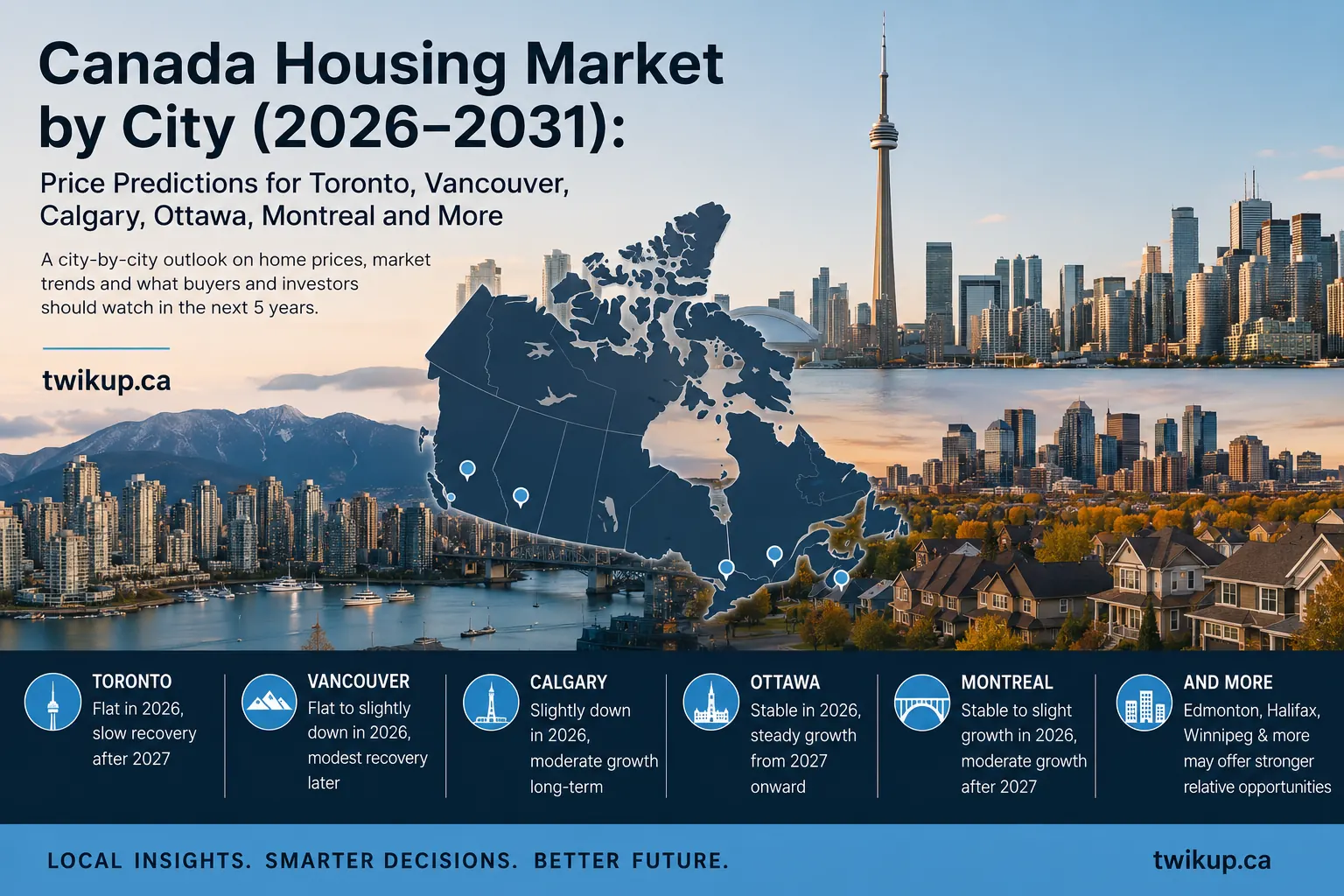
Canada Housing Market by City (2026–2031): Price Predictions for Toronto, Vancouver, Calgary, Ottawa, Montreal and More
Canada’s housing market is no longer moving as one national story. From 2026 to 2031, the biggest question may not be “Will Canadian home prices rise?” but “Which cities will recover first, and which markets will stay under pressure?”
After several years of high interest rates, affordability stress, slower buyer activity and changing immigration targets, Canada’s real estate market is entering a more fragmented phase. Some cities may see flat or weaker prices in the short term, while others could benefit from affordability, population growth, stable employment and limited supply.
In our previous article, we covered the national outlook in detail:
Canada Real Estate Price Prediction 2026–2031: Will Home Prices Rise or Fall in the Next 5 Years?
This city-by-city guide goes deeper into the markets buyers, sellers and investors are watching most closely: Toronto, Vancouver, Calgary, Ottawa, Montreal, Edmonton, Halifax, Winnipeg and other Canadian cities.
Important note: Real estate forecasts are uncertain. Home prices can change based on interest rates, job growth, immigration levels, housing supply, taxes, lending rules and local buyer confidence. This article is for educational purposes only and should not be treated as financial advice.
Canada Housing Market Outlook 2026–2031: The Big Picture
The Canadian housing market is expected to stabilize in 2026, but a major nationwide boom is not the base-case forecast.
CMHC expects home prices to stabilize in 2026, with only slight increases possible, while significant growth is unlikely in the following years. CMHC also expects housing starts to decline due to high construction costs and weak demand. CMHC
CREA’s 2026–2027 forecast also points to modest price growth. CREA forecasts the national average home price to remain close to the $700,000 range, with the average price edging up to about $695,094 in 2027. CREA
RBC expects resale activity to improve in 2026, but still remain below pre-pandemic averages because affordability challenges, labour market uncertainty and reduced immigration targets may limit the recovery. RBC Economics
The most important takeaway is this:
Canada may see a mild recovery nationally, but city-level performance will vary sharply.
Quick City-by-City Price Prediction Summary
| City | 2026 Outlook | 2027–2031 Prediction | Risk Level |
|---|---|---|---|
| Toronto / GTA | Flat to slightly down | Slow recovery | High |
| Vancouver | Flat to slightly down | Modest recovery | High |
| Calgary | Flat / selective weakness | Moderate long-term growth | Medium |
| Ottawa | Stable | Slow, steady growth | Low to medium |
| Montreal | Stable to modest growth | Moderate growth | Medium |
| Edmonton | Modest growth | Stronger relative growth | Medium |
| Halifax | Stable to moderate growth | Moderate growth | Medium |
| Winnipeg | Stable | Slow, affordable growth | Low to medium |
| Saskatoon / Regina | Modest growth | Affordable-market upside | Medium |
Toronto Housing Market Prediction 2026–2031
Toronto remains Canada’s most watched real estate market, but it may not be the strongest performer in the early part of the forecast period.
The GTA has been under pressure from high prices, elevated inventory and weaker condo demand. TRREB forecasted the 2026 GTA average home price range between $1 million and $1.03 million, while noting ongoing affordability pressure and elevated inventory. TRREB
Toronto 2026 prediction
Toronto prices may remain flat or slightly lower in 2026, especially in the condo segment. Buyers still have more negotiating power than they did during the pandemic boom, and many investors are cautious because rents, mortgage payments and condo fees do not always support positive cash flow.
Toronto 2027–2031 prediction
From 2027 onward, Toronto could gradually recover because of long-term population demand, limited land supply and its role as Canada’s largest employment market. However, the recovery may be slow rather than explosive.
Detached and semi-detached homes in desirable neighbourhoods may recover earlier than investor-heavy condos.
Toronto price direction
Best-case scenario: Gradual recovery beginning in 2027
Base-case scenario: Flat 2026, slow growth after 2027
Risk scenario: Condo weakness continues longer than expected
Vancouver Housing Market Prediction 2026–2031
Vancouver remains one of Canada’s most expensive and supply-constrained housing markets. However, high prices also mean affordability is a major barrier.
BCREA forecasts B.C. residential sales to fall 2.1% in 2026, then rise 7.7% in 2027, suggesting a slower 2026 followed by a better recovery year. BCREA
Vancouver 2026 prediction
Vancouver prices may remain flat or slightly down in 2026. Buyers are still cautious, and affordability remains stretched even if mortgage rates improve.
Vancouver 2027–2031 prediction
Long term, Vancouver should remain supported by limited land, lifestyle demand, immigration and wealth concentration. But price growth may be modest unless borrowing costs fall significantly or incomes rise faster.
Vancouver price direction
Best-case scenario: Modest recovery after 2027
Base-case scenario: Flat 2026, slow gains later
Risk scenario: Affordability keeps demand weak
Calgary Housing Market Prediction 2026–2031
Calgary was one of Canada’s strongest housing markets during the post-pandemic period, helped by affordability, interprovincial migration and a strong labour market. But the 2026 outlook is more balanced.
CREB says lower migration is arriving at the same time supply is rising, which could weigh on Calgary’s housing market in 2026. Higher supply is expected to affect apartment-style and row-style homes more than detached homes. CREB
Calgary 2026 prediction
Calgary may see flat prices overall, with some softness in condos and townhomes. Detached homes may remain more stable because supply is tighter in that segment.
Calgary 2027–2031 prediction
From 2027 to 2031, Calgary could still outperform Toronto and Vancouver on percentage growth because its prices remain more affordable. However, Calgary’s future depends heavily on employment, migration, oil and gas activity, and whether supply continues to rise faster than demand.
Calgary price direction
Best-case scenario: Short pause, then moderate growth
Base-case scenario: Flat 2026, steady gains later
Risk scenario: Too much new supply weakens condo prices
Ottawa Housing Market Prediction 2026–2031
Ottawa is usually less volatile than Toronto or Vancouver because of government employment, a stable professional workforce and a less speculative buyer base.
The Ottawa Real Estate Board reported that May 2026 average residential sale price was $721,270, down 0.9% year over year, while overall pricing remained relatively stable. OREB
Ottawa 2026 prediction
Ottawa may remain mostly stable in 2026. Some property types may soften slightly, but the market is not showing the same level of stress as investor-heavy condo markets in Toronto.
Ottawa 2027–2031 prediction
Ottawa could see slow, steady growth from 2027 onward. Family homes in established communities may perform better than small condos.
Ottawa price direction
Best-case scenario: Stable 2026, steady growth after
Base-case scenario: Low single-digit growth over time
Risk scenario: Weak federal hiring or affordability pressure slows demand
Montreal Housing Market Prediction 2026–2031
Montreal has a different profile from Toronto and Vancouver. Prices are lower, affordability is better, and the market is less dependent on ultra-high-priced detached homes.
Montreal sales slowed in 2026 as buyer caution increased, while market conditions continued to evolve. QPAREB/APCIQ remains a key source for Quebec market data. APCIQ
Montreal 2026 prediction
Montreal may see stable to modest price growth in 2026. Higher listings can reduce pressure, but affordability compared with Toronto and Vancouver may continue to support demand.
Montreal 2027–2031 prediction
From 2027 to 2031, Montreal may deliver moderate growth, especially if the city continues attracting students, professionals, immigrants and interprovincial movers looking for a lower-cost major city.
Montreal price direction
Best-case scenario: Moderate growth from 2027 onward
Base-case scenario: Stable 2026, gradual appreciation
Risk scenario: Higher listings slow short-term price gains
Edmonton Housing Market Prediction 2026–2031
Edmonton may be one of the more interesting affordability-driven markets in Canada.
Compared with Toronto, Vancouver and even Calgary, Edmonton still offers a lower entry price. That makes it attractive for first-time buyers, investors and families priced out of more expensive cities.
Edmonton 2026 prediction
Edmonton may see modest growth in 2026, supported by affordability and Alberta’s broader economic base.
Edmonton 2027–2031 prediction
From 2027 to 2031, Edmonton could outperform many expensive markets on percentage growth, especially if migration into Alberta remains positive.
Edmonton price direction
Best-case scenario: Stronger relative growth than Toronto/Vancouver
Base-case scenario: Modest but steady appreciation
Risk scenario: Economic slowdown or excess supply limits gains
Halifax Housing Market Prediction 2026–2031
Halifax became much more expensive after the pandemic as remote workers, retirees and interprovincial migrants moved into Atlantic Canada.
Halifax 2026 prediction
Halifax may remain stable in 2026. Prices are no longer as cheap as they once were, but the city still benefits from lifestyle demand, universities, healthcare employment and regional growth.
Halifax 2027–2031 prediction
Halifax may see moderate growth from 2027 to 2031, but affordability could become a bigger issue if incomes do not keep pace with prices.
Halifax price direction
Best-case scenario: Moderate long-term growth
Base-case scenario: Stable to low growth
Risk scenario: Affordability pressure slows buyer demand
Winnipeg Housing Market Prediction 2026–2031
Winnipeg is not usually a headline-grabbing real estate market, but that can be a strength. It remains one of Canada’s more affordable major cities.
Winnipeg 2026 prediction
Winnipeg may see stable prices in 2026, supported by affordability and local demand.
Winnipeg 2027–2031 prediction
From 2027 to 2031, Winnipeg may offer slow but steady growth. It is unlikely to see the same volatility as Toronto or Vancouver, but it may also avoid the sharp corrections seen in overheated markets.
Winnipeg price direction
Best-case scenario: Steady affordable-market growth
Base-case scenario: Low single-digit appreciation
Risk scenario: Slower population growth limits upside
Saskatoon and Regina Housing Market Prediction 2026–2031
Saskatchewan markets may benefit from affordability, natural resources, immigration and lower home prices compared with Canada’s largest cities.
2026 prediction
Saskatoon and Regina may see modest growth in 2026, especially if buyers continue searching for more affordable Canadian markets.
2027–2031 prediction
From 2027 to 2031, these markets could see stronger percentage growth than more expensive cities, but from a lower price base.
Price direction
Best-case scenario: Affordable-market outperformance
Base-case scenario: Modest growth
Risk scenario: Job-market weakness or population slowdown
Which Canadian Cities Could Perform Best from 2026 to 2031?
The best-performing cities may not be the most expensive ones.
Cities with the strongest long-term setup may have:
- Better affordability than Toronto and Vancouver
- Stable employment
- Positive migration
- Limited oversupply
- Growing rental demand
- Infrastructure and population growth
Based on those factors, cities like Calgary, Edmonton, Ottawa, Montreal, Winnipeg, Saskatoon and select Atlantic Canada markets may offer better risk-adjusted opportunities than simply chasing Canada’s most expensive cities.
Which Cities Have the Highest Risk?
The highest-risk areas are not necessarily bad markets. They are markets where prices are more sensitive to affordability, investor demand and mortgage rates.
Higher-risk markets include:
- Toronto condos
- Vancouver condos
- Investor-heavy pre-construction markets
- Areas with high inventory
- Markets where prices rose much faster than local incomes
- Cities where new supply is arriving faster than buyer demand
Toronto and Vancouver may remain strong long-term wealth markets, but short-term price growth could be limited if affordability remains stretched.
TwikUp Insight: The Next 5 Years Will Reward Selective Buyers
TwikUp Insight: The next phase of Canadian real estate may reward buyers who study local fundamentals instead of following national headlines.
From 2026 to 2031, the strongest opportunities may appear in cities where three things overlap:
- Homes are still relatively affordable
- Population and employment are growing
- New supply is not overwhelming demand
Toronto and Vancouver may continue to matter because of long-term scarcity and economic importance. But for first-time buyers and investors, cities like Calgary, Edmonton, Ottawa, Montreal and Winnipeg may offer a better balance between price, income and future growth potential.
Should Buyers Wait or Buy in 2026?
The answer depends on the city and property type.
In Toronto and Vancouver, buyers may still have room to negotiate in 2026, especially in condo-heavy segments. In Calgary, buyers should watch supply levels carefully. In Ottawa and Montreal, waiting may not bring a major discount if prices remain stable. In affordable markets like Edmonton or Winnipeg, the risk of waiting may be missing gradual price growth.
A good buying decision should be based on:
- Monthly affordability
- Job stability
- Mortgage stress-test qualification
- Emergency savings
- Local inventory
- Property type
- Long-term holding period
Buying only because prices “might rise” is risky. Buying because the home fits your budget and long-term plan is safer.
Should Sellers Wait Until 2027?
Sellers in weaker markets may benefit from waiting if they are not under pressure to sell. If rates fall and buyer confidence improves, 2027 could bring stronger demand.
However, sellers in stable or affordable markets may still find qualified buyers in 2026, especially if the property is priced realistically.
The key is local market data. A detached home in Ottawa, a condo in downtown Toronto and a townhouse in Calgary may all behave differently.
Canada Housing Market 2026–2031: Final Prediction
Canada’s housing market is likely entering a slower, more selective growth cycle.
The 2026–2031 period may not look like the rapid price gains of the pandemic years. Instead, buyers and investors should expect a more balanced market where location, affordability, supply and employment matter more than national averages.
Final city outlook
| City | 2026–2031 Prediction |
|---|---|
| Toronto | Slow recovery after near-term weakness |
| Vancouver | Modest recovery, affordability-limited |
| Calgary | Balanced market, long-term growth potential |
| Ottawa | Stable, defensive growth |
| Montreal | Moderate growth, better affordability |
| Edmonton | Strong affordability-driven upside |
| Halifax | Moderate growth with affordability risk |
| Winnipeg | Stable, slow appreciation |
| Saskatoon / Regina | Affordable-market upside |
The national story may be stabilization. The city story is fragmentation.
Some Canadian housing markets may move sideways. Some may recover slowly. Some affordable cities may outperform. For buyers, the winning strategy from 2026 to 2031 may be simple: stop asking only where prices are highest, and start asking where value, income and future demand still make sense.
Sources and Helpful References
- CMHC — Housing Market Outlook 2026
- CREA — Canadian Housing Market Forecast
- RBC Economics — Canadian Housing Market Forecast Update
- TRREB — GTA Housing Market Forecast 2026
- BCREA — Housing Forecast
- CREB — Calgary 2026 Housing Market Forecast
- Ottawa Real Estate Board — 2026 Market Updates
- APCIQ / QPAREB — Quebec Real Estate Statistics