
Quick Answer
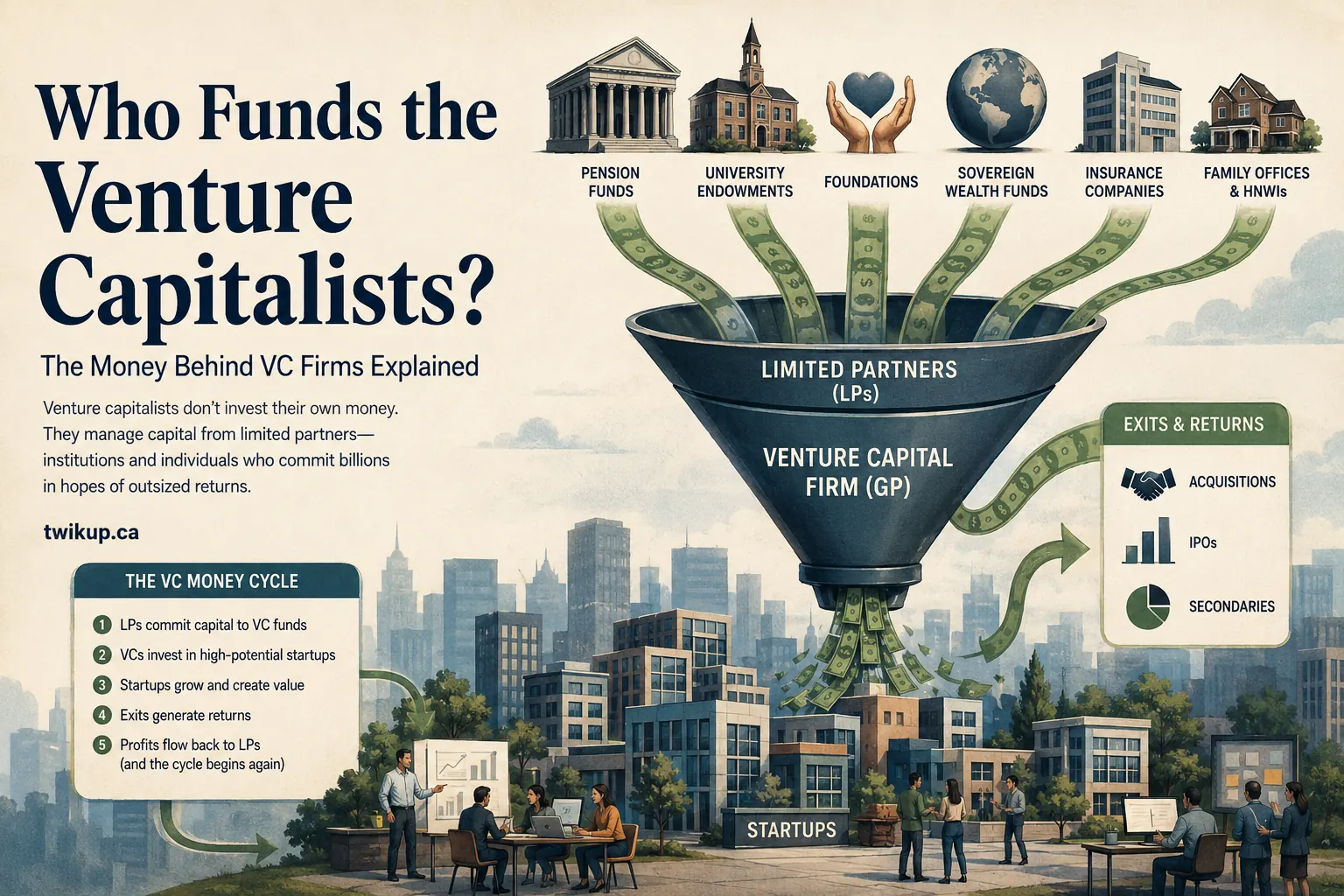
Venture capital firms are primarily funded by outside investors known as limited partners (LPs). These investors can include pension funds, university endowments, foundations, sovereign wealth funds, insurance companies, family offices, corporations, funds of funds and high-net-worth individuals.
The venture capital firm acts as the general partner (GP). It raises money from LPs, pools that capital into a venture fund, invests in startups and tries to generate returns through acquisitions, IPOs or other liquidity events.
The simplest way to understand the venture capital system is:
Limited Partners → VC Funds → Startups → Exits → Returns to Limited Partners
This structure explains something many founders misunderstand: venture capitalists are investors, but they are also fund managers accountable to their own investors.
Twikup Insight
The person sitting across from a founder may control millions of dollars, but that does not necessarily mean the money belongs to them.
Behind many venture capital funds are pension plans, university endowments, foundations, sovereign wealth funds, family offices and other institutions looking for long-term investment returns.
This creates an important chain of accountability.
Founders must convince venture capitalists.
Venture capitalists must deliver returns to limited partners.
Limited partners must justify how they allocate capital to their own beneficiaries, institutions or stakeholders.
Understanding this chain helps explain why VCs care so much about market size, valuation, ownership, follow-on funding, board rights, growth potential and exits.
A VC is not simply asking whether your startup is a good business.
The bigger question is:
Can this startup become valuable enough to generate a meaningful return for our fund and, ultimately, our investors?
Key Takeaways
- Most venture capitalists invest money raised from outside investors called limited partners.
- Common LPs include pension funds, endowments, foundations, sovereign wealth funds, insurance companies and family offices.
- The VC firm usually acts as the general partner and manages the fund.
- VC firms typically earn money through management fees and carried interest.
- Most venture funds operate over long periods, often around 10 years or longer.
- Fund size can significantly influence which startups a VC considers investable.
- VCs must eventually return capital to their LPs, which helps explain the pressure for large exits.
- A VC can genuinely like a founder or company and still decide not to invest.
- Once founders understand how venture funds work, many confusing investor decisions become easier to explain.
Who Actually Funds Venture Capitalists?
When people imagine venture capital, they often picture wealthy investors writing large cheques to ambitious startup founders.
Sometimes that happens.
But the modern venture capital industry is generally more complex.
Most established VC firms raise money from outside investors and combine that capital into an investment fund.
These outside investors are called limited partners, commonly shortened to LPs.
LPs can include:
- Pension funds
- University endowments
- Charitable foundations
- Sovereign wealth funds
- Insurance companies
- Family offices
- Corporations
- Funds of funds
- High-net-worth individuals
The VC firm then manages the capital.
In a typical venture capital structure, the people managing the fund are known as general partners, or GPs.
The relationship can be summarized simply:
| Participant | Primary Role |
|---|---|
| Limited Partners | Provide capital to the venture fund |
| General Partners | Manage the fund and select investments |
| Startups | Receive capital in exchange for equity or other investment rights |
| Acquirers and Public Markets | Can eventually provide liquidity through exits |
| LPs and GPs | Receive distributions if investments generate returns |
This means the VC firm is effectively an intermediary between large pools of capital and startup companies.
Where Does the Money Ultimately Come From?
Follow the money far enough and the answer becomes surprisingly interesting.
Imagine a pension fund investing in a venture capital fund.
The capital managed by that pension fund may represent retirement savings belonging to thousands or even millions of workers.
The VC firm invests part of that institutional capital into startups.
One startup becomes extremely successful.
Years later, the startup is acquired or goes public.
The VC fund sells some or all of its ownership.
Profits flow back to the fund.
The fund distributes returns to its limited partners.
The pension fund receives its share of those distributions.
The full capital chain could look like this:
Workers → Pension Fund → Venture Capital Fund → Startup → Exit → Investment Returns → Pension Fund
The same basic principle can apply to universities, foundations, wealthy families, governments and insurance companies.
So the money funding a technology startup may indirectly originate from sources that seem completely disconnected from Silicon Valley or the startup ecosystem.
What Is a Limited Partner?
A limited partner is an investor that commits capital to an investment fund but generally does not manage the fund's everyday investment decisions.
LPs choose which VC firms they want to back.
The VC firm's general partners then decide which startups receive investment.
This separation is important.
A pension fund investing $100 million into a venture fund does not normally select every startup that receives part of that money.
Instead, it evaluates the VC firm itself.
The LP may consider:
- The VC firm's previous investment performance
- Experience of the investment team
- Fund strategy
- Target industries
- Geographic focus
- Stage of investment
- Portfolio construction
- Access to promising startups
- Risk management
- Governance standards
- Reporting capabilities
- Previous distributions to investors
In other words, VC firms have to pitch investors too.
Before a founder ever walks into a room and pitches a VC, that VC firm may have spent months or years convincing institutions and wealthy investors to provide the capital it manages.
What Is a General Partner?
The general partner, or GP, manages the venture capital fund.
Depending on the structure of the firm, general partners and their investment teams may be responsible for:
- Raising the fund
- Finding potential startup investments
- Meeting founders
- Conducting due diligence
- Negotiating investment terms
- Making investment decisions
- Supporting portfolio companies
- Taking board seats
- Managing follow-on investments
- Helping companies raise additional funding
- Planning potential exits
- Reporting fund performance to LPs
General partners usually invest some of their own money into the fund as well.
This is often called the GP commitment.
The idea is to create greater alignment between the people managing the money and the investors providing most of the capital.
How Does a Venture Capital Fund Actually Work?
Consider a simplified example.
A venture capital firm decides to raise a $200 million fund.
The firm approaches institutional investors, family offices and other potential LPs.
Eventually, it receives commitments such as:
- Pension Fund: $60 million
- University Endowment: $30 million
- Sovereign Wealth Fund: $40 million
- Family Offices: $25 million
- Fund of Funds: $25 million
- Other Investors and GP Commitment: $20 million
Total fund commitments:
$200 million
The VC firm can now invest according to the strategy described when it raised the fund.
It might invest in 25 companies.
Some startups fail.
Some survive but produce limited returns.
A few perform well.
Perhaps one or two become exceptionally valuable.
Those major winners can potentially generate a large percentage of the fund's overall returns.
This helps explain why venture capitalists frequently search for companies capable of becoming extremely large.
Why Do Pension Funds Invest in Venture Capital?
Pension funds manage money intended to fund future retirement obligations.
Because those obligations can extend decades into the future, pension funds generally invest across different asset classes.
These can include:
- Public stocks
- Government bonds
- Corporate bonds
- Real estate
- Infrastructure
- Private equity
- Venture capital
Venture capital is generally considered a higher-risk and less liquid investment category.
However, successful venture investments can potentially generate substantial returns.
For large pension funds, allocating a portion of their portfolio to private markets can provide diversification and exposure to companies before they become publicly traded.
But pension funds usually do not simply give money to any new VC firm.
Institutional investors may carefully evaluate the fund manager's experience, performance, strategy and ability to generate returns.
This is one reason raising a first-time venture fund can be extremely difficult.
Why Do University Endowments Invest in VC?
University endowments manage donated capital intended to support an institution over very long periods.
Investment returns may help fund:
- Scholarships
- Research
- Faculty positions
- Campus operations
- Financial aid
- New facilities
Because endowments often have long investment horizons, they may be able to tolerate investments that cannot easily be sold for several years.
Venture capital can fit into this type of long-term investment strategy.
However, access matters.
Some of the most successful VC firms can be highly selective about accepting new limited partners.
This creates another important dynamic in venture capital:
Founders compete to access top VC firms, while investors may also compete to access top-performing VC funds.
What Are Sovereign Wealth Funds?
Sovereign wealth funds are state-owned investment funds that manage capital on behalf of countries or governments.
Their money can originate from:
- Natural resource revenues
- Trade surpluses
- Foreign exchange reserves
- Government assets
- National savings programs
Some sovereign wealth funds manage hundreds of billions of dollars.
They may invest across public markets, real estate, infrastructure, private equity and venture capital.
In recent years, sovereign investment funds have also become increasingly visible in sectors such as:
- Artificial intelligence
- Technology
- Financial services
- Climate technology
- Biotechnology
- Infrastructure
- Advanced manufacturing
Some sovereign funds invest directly in companies.
Others become LPs in venture funds.
Some do both.
What Are Family Offices?
A family office manages investments and financial affairs for a wealthy family.
Some serve a single family.
Others manage money for several families.
Family offices have become increasingly important participants in private markets.
They may:
- Invest in VC funds
- Invest directly into startups
- Participate in later funding rounds
- Co-invest alongside VC firms
- Provide capital to emerging fund managers
Family offices can sometimes be more flexible than large institutional investors.
A large pension fund may have complex approval procedures and strict investment requirements.
A family office may be able to make decisions more quickly.
However, family office investment strategies vary enormously.
Some are extremely conservative.
Others actively pursue high-risk startup opportunities.
What Is a Fund of Funds?
A fund of funds adds another layer to the venture capital system.
Instead of investing primarily in startups, a fund of funds invests in multiple venture capital funds.
The structure looks like this:
Institutional Investors → Fund of Funds → VC Funds → Startups
Why add another layer?
Diversification.
Imagine a smaller pension fund wants exposure to venture capital but does not have the expertise or resources to evaluate dozens of VC firms.
Instead of selecting individual funds, it can invest through a fund of funds.
The fund-of-funds manager then allocates capital across multiple venture firms.
The investor gains broader exposure to different:
- Managers
- Industries
- Investment stages
- Geographies
- Strategies
The trade-off is another layer of fees.
How Do VC Firms Make Money?
VC firms generally make money through two primary mechanisms:
1. Management Fees
Management fees help pay for the operations of the venture firm.
These expenses can include:
- Employee salaries
- Office expenses
- Legal costs
- Accounting
- Technology
- Research
- Deal sourcing
- Travel
- Portfolio support
A commonly discussed traditional VC compensation structure is known as “2 and 20.”
This generally refers to:
- Approximately 2% management fees
- Approximately 20% carried interest
However, actual fund economics vary considerably depending on the fund, strategy, size, investment period and negotiations with LPs.
2. Carried Interest
Carried interest, often called carry, represents the VC firm's share of investment profits under the fund's agreed terms.
Consider a highly simplified example.
A VC fund raises:
$100 million
Years later, after investments and exits, the portfolio produces:
$400 million
The original invested capital and other agreed obligations must be accounted for according to the fund agreement.
A percentage of eligible profits may then go to the general partners as carried interest.
This potential upside is one reason investment performance matters enormously to VC firms.
Management fees can help operate the business.
Exceptional investment returns can create significant carried interest.
Why Are Venture Funds Usually So Long?
Startup investing takes time.
A company founded today may need years to:
- Build a product
- Find product-market fit
- Hire employees
- Expand internationally
- Raise additional funding
- Increase revenue
- Become profitable
- Get acquired
- Go public
For that reason, traditional venture funds often operate for approximately 10 years, sometimes with extensions.
A simplified lifecycle could look like this:
Years 1–5: Investment Period
The VC firm finds and invests in new startups.
Years 5–10: Growth and Exit Period
The firm supports portfolio companies, makes selected follow-on investments and searches for opportunities to generate liquidity.
Years 10+: Extensions, If Necessary
Some investments may take longer to exit.
This long timeline explains why venture capital is often described as an illiquid asset class.
LPs cannot necessarily request all their money back whenever they want.
Do LPs Give VC Firms All the Money Immediately?
Usually, no.
When an LP commits $50 million to a VC fund, the entire amount may not be transferred on the first day.
Instead, the VC firm can issue capital calls.
Suppose a pension fund commits $50 million.
The VC firm identifies new investments and needs additional capital.
It might call 10% of the commitment.
The pension fund transfers $5 million.
Later, the fund may issue additional capital calls.
This process continues according to the fund agreement and investment needs.
For LPs, managing these commitments is important because they need enough liquidity available when capital calls arrive.
Why Does Fund Size Matter So Much to Founders?
One of the most overlooked parts of fundraising is understanding the size of the VC fund being pitched.
Imagine two venture firms.
Fund A manages $50 million.
Fund B manages $5 billion.
A startup that could eventually sell for $200 million might produce an excellent outcome for Fund A.
The exact same company may have little financial impact on Fund B.
This creates one of the most important principles in venture capital:
A good business is not automatically a good venture investment for every fund.
Large funds generally need large outcomes.
Very large funds may need companies capable of reaching multibillion-dollar valuations.
This is why founders should research:
- Fund size
- Typical cheque size
- Investment stage
- Target ownership
- Industry focus
- Geographic focus
- Previous investments
- Follow-on strategy
before approaching investors.
Understanding this can also help explain why investors sometimes say no even when they genuinely like your startup.
Why Do VCs Care So Much About Startup Valuation?
Because the price a VC pays affects its potential return.
Imagine a venture fund invests $10 million into two different companies.
In Startup A, the investment buys 20% ownership.
In Startup B, the same investment buys 5%.
Both companies eventually sell for $500 million.
Ignoring dilution and other complexities, the outcomes would be dramatically different.
A 20% position could be worth $100 million.
A 5% position could be worth $25 million.
This is why valuation negotiations matter.
Founders naturally want higher valuations because they can reduce immediate dilution.
Investors want enough ownership and upside to justify the risk of investing.
If you want to understand this relationship more deeply, read Your Startup Isn’t Worth What You Think — Here’s How Investors Actually Value It.
What Does “Returning the Fund” Mean?
This is one of the most important concepts founders can understand.
Imagine a VC firm manages a $100 million fund.
It invests $5 million into a startup.
Years later, that investment becomes worth $100 million.
One company has now potentially generated proceeds equivalent to the original size of the entire fund.
This is often described as a company or investment having the potential to return the fund.
Why does this matter?
Because venture capital returns can follow a power-law pattern.
Many startups may fail.
Several may produce modest returns.
A small number of major winners can drive a significant portion of overall fund performance.
This helps explain why VCs often ask:
“Can this become a billion-dollar company?”
They are not necessarily saying every good company must become a unicorn.
They are asking whether the potential outcome is large enough to justify the investment risk and materially affect fund performance.
Why Can a VC Like Your Startup and Still Say No?
Because liking a startup is only one part of the investment decision.
A VC may decline because:
- The startup is outside the fund's investment thesis.
- The market appears too small.
- The valuation is too high.
- The VC already invested in a competitor.
- The fund is nearing the end of its investment period.
- The firm does not have sufficient reserves.
- The expected exit is too small.
- The investment committee rejected the deal.
- The VC cannot obtain enough ownership.
- The startup requires more capital than the fund can support.
- The fund is prioritizing existing portfolio companies.
This is one reason founders should avoid interpreting every rejection as a judgment on their ability or company.
Sometimes the startup and the VC fund simply do not fit.
What Happens When VC Firms Struggle to Raise Money?
Founders are not the only people who experience difficult fundraising markets.
VC firms must raise new funds from LPs.
Imagine the following chain of events:
- IPO activity slows.
- Startup acquisitions decline.
- VC funds generate fewer exits.
- Less money is distributed back to LPs.
- LPs become more cautious about new commitments.
- VC firms struggle to raise new funds.
- Less capital becomes available for startups.
- VCs become more selective.
This can create a funding slowdown throughout the startup ecosystem.
The capital chain looks like this:
Fewer Exits → Fewer LP Distributions → Slower VC Fundraising → Less Startup Capital → Tougher Investment Decisions
This is why startup fundraising conditions can change dramatically even when innovation continues.
What Is the Denominator Effect?
The denominator effect is another reason LP behaviour can affect startup funding.
Imagine a pension fund wants 10% of its portfolio allocated to private investments.
Then public stock markets fall sharply.
The value of the pension fund's public investments declines.
Its private investments may not immediately fall by the same amount because private assets are valued less frequently.
Suddenly, private investments represent a larger percentage of the total portfolio.
The pension fund may now appear overallocated to private markets.
As a result, it may reduce new commitments to VC funds.
The startups have not necessarily changed.
The VC firms may not have changed.
But the LP's portfolio allocation has changed.
This demonstrates how events far outside the startup ecosystem can eventually influence how much capital is available to founders.
What Happens After a VC Invests in a Startup?
Once the investment closes, the relationship changes.
The VC firm is no longer evaluating whether to become an investor.
It is now responsible for managing an investment on behalf of its fund and LPs.
Depending on the investment terms, the VC may receive:
- Equity ownership
- Information rights
- Voting rights
- Board representation
- Protective provisions
- Pro-rata rights
- Liquidation preferences
The VC may begin closely tracking:
- Revenue
- Cash burn
- Runway
- Hiring
- Growth
- Customer acquisition
- Profitability
- Future fundraising needs
Raising millions of dollars can feel like reaching the finish line.
In reality, it often marks the beginning of a more demanding stage.
Twikup explores that transition in You Raised Millions — Here’s What Happens Next and Where Many Founders Go Wrong.
Why Do VCs Want Board Seats?
A board seat can give an investor greater visibility and influence over major company decisions.
Board members may become involved in discussions about:
- Executive hiring
- CEO performance
- Budgets
- Fundraising
- Acquisitions
- Strategy
- Major spending decisions
- Company sales
- Leadership changes
From the VC's perspective, this oversight can be part of protecting and supporting an investment made with LP capital.
From the founder's perspective, it means raising institutional capital can change how control works inside the company.
A founder may still own substantial equity while no longer having complete control over every major decision.
For a deeper explanation, read Your Board Can Fire You: What Every Founder Should Know After Raising Capital.
Why Are Exits So Important?
The value of a startup investment on paper is not the same as cash returned to investors.
Imagine a VC fund invested in a startup valued at $100 million.
Several years later, a new funding round values the company at $2 billion.
The investment looks extremely successful.
But unless the VC can sell shares or otherwise generate liquidity, much of that gain remains unrealized.
LPs ultimately care about receiving distributions.
Common liquidity events include:
- Acquisitions
- IPOs
- Secondary share sales
- Share buybacks
Without exits, money can remain locked inside portfolio companies for years.
This is why healthy exit markets are so important to the venture capital ecosystem.
Why Does the VC Funding Model Affect Startup Strategy?
Once founders understand where VC money comes from, many investor behaviours become easier to explain.
VCs Push for Large Markets
Small outcomes may not generate meaningful returns for large funds.
VCs Care About Growth
Rapid growth can increase the probability of achieving a venture-scale outcome.
VCs Care About Ownership
A tiny ownership position may generate insufficient returns even if the startup succeeds.
VCs Reserve Money for Follow-On Rounds
Successful startups often require multiple funding rounds.
VCs Care About Exits
Without liquidity, paper valuations do not become cash distributions.
VCs Care About Governance
They are managing investments on behalf of outside investors.
The system is designed around generating investment returns.
Understanding that reality can help founders approach fundraising with clearer expectations.
The Full Venture Capital Money Cycle
Here is the complete system in simple terms:
Step 1: Capital Is Created or Accumulated
Workers save for retirement, universities receive donations, governments accumulate reserves and families build wealth.
↓
Step 2: Institutions Allocate Capital
Pension funds, endowments, foundations, sovereign funds and family offices decide how to invest.
↓
Step 3: LPs Commit Capital to VC Funds
VC firms raise investment funds.
↓
Step 4: VCs Select Startups
General partners search for companies capable of generating significant returns.
↓
Step 5: Startups Use the Capital
Companies hire employees, build products, acquire customers and expand.
↓
Step 6: Successful Companies Create Liquidity
Startups may be acquired, go public or provide other opportunities for shareholders to sell.
↓
Step 7: VC Funds Receive Proceeds
Investment returns flow back into the venture fund.
↓
Step 8: LPs Receive Distributions
The fund distributes eligible proceeds according to the partnership agreement.
↓
Step 9: Successful VCs Raise New Funds
Strong performance can help VC firms attract LP commitments for their next fund.
Then the cycle begins again.
What Founders Should Ask Before Taking VC Money
Founders spend enormous amounts of time preparing for questions from investors.
They should also ask questions.
Consider asking:
- What is the size of your current fund?
- When was the fund raised?
- How much capital has already been deployed?
- What is your typical initial investment?
- How much capital do you reserve for follow-on rounds?
- What ownership percentage do you target?
- What stage do you primarily invest in?
- How do you make investment decisions?
- Who sits on the investment committee?
- Do you usually take board seats?
- How do you support companies during difficult periods?
- What happens if a portfolio company misses its growth targets?
- Can I speak with founders you backed who succeeded?
- Can I speak with founders whose companies struggled?
The last two questions can be especially revealing.
Almost every VC can maintain strong relationships with successful founders.
How an investor behaves when a company struggles may tell you far more.
Frequently Asked Questions
Who gives venture capitalists their money?
Most VC firms raise money from limited partners such as pension funds, university endowments, foundations, sovereign wealth funds, family offices, corporations, insurance companies and wealthy individuals.
Do venture capitalists invest their own money?
Some VC partners invest personal capital into their funds through a GP commitment. However, most capital in many institutional VC funds comes from outside limited partners.
How do VC firms make money?
VC firms generally earn management fees for operating the fund and carried interest representing an agreed share of investment profits.
How long does a VC fund last?
Many traditional venture capital funds are structured for approximately 10 years, although the exact term varies and extensions may be available.
Why do pension funds invest in startups?
Pension funds may allocate part of their portfolios to venture capital to diversify investments and seek long-term returns. They usually gain startup exposure by investing as LPs in professionally managed VC funds.
Why do VCs need startups to become extremely large?
Venture funds often depend on a relatively small number of successful investments to generate a significant share of overall returns. Larger funds may therefore need particularly large outcomes to materially affect fund performance.
Can a VC run out of money?
A VC fund has limited committed capital. Funds must manage new investments, operating costs and reserves for follow-on rounds. A firm can also struggle to raise its next fund if LP demand declines.
Why would a VC reject a profitable company?
A profitable business may still be unsuitable for venture capital if its potential market, growth rate or exit opportunity is not large enough to generate the returns required by the VC's fund model.
What happens to VC money after a startup is sold?
Proceeds generally flow back to the venture fund and are distributed according to the fund's partnership agreement, including returns to LPs and potentially carried interest for the GP.
Are VC firms themselves startups?
Not usually in the traditional sense, but new VC firms face some similar challenges. They need to establish a strategy, build a reputation, attract investors, compete for opportunities and prove they can generate results.
Final Takeaway
Venture capitalists may be the people writing cheques to startups, but they are rarely the beginning of the money trail.
Behind them can be pension funds managing retirement savings, universities investing endowments, foundations preserving charitable capital, governments managing national wealth, insurance companies investing premiums and wealthy families seeking long-term returns.
Those investors become limited partners.
Limited partners provide capital to VC funds.
General partners invest that capital into startups.
Startups attempt to create enormous value.
Successful exits return money to the fund.
The fund distributes proceeds back to its investors.
Understanding this system reveals one of the most important truths about startup fundraising:
Founders are not simply raising money from venture capitalists. They are entering a much larger financial system built around capital, ownership, risk, governance, growth and eventual returns.
That is why VCs ask difficult questions.
That is why valuation matters.
That is why fund size matters.
That is why board rights matter.
And that is why a VC can genuinely believe in a founder and still decide not to invest.
If you want to understand the complete journey from early startup funding to venture capital, growth rounds and eventual exits, explore Twikup’s Complete Startup Fundraising Roadmap: From Idea to IPO.