
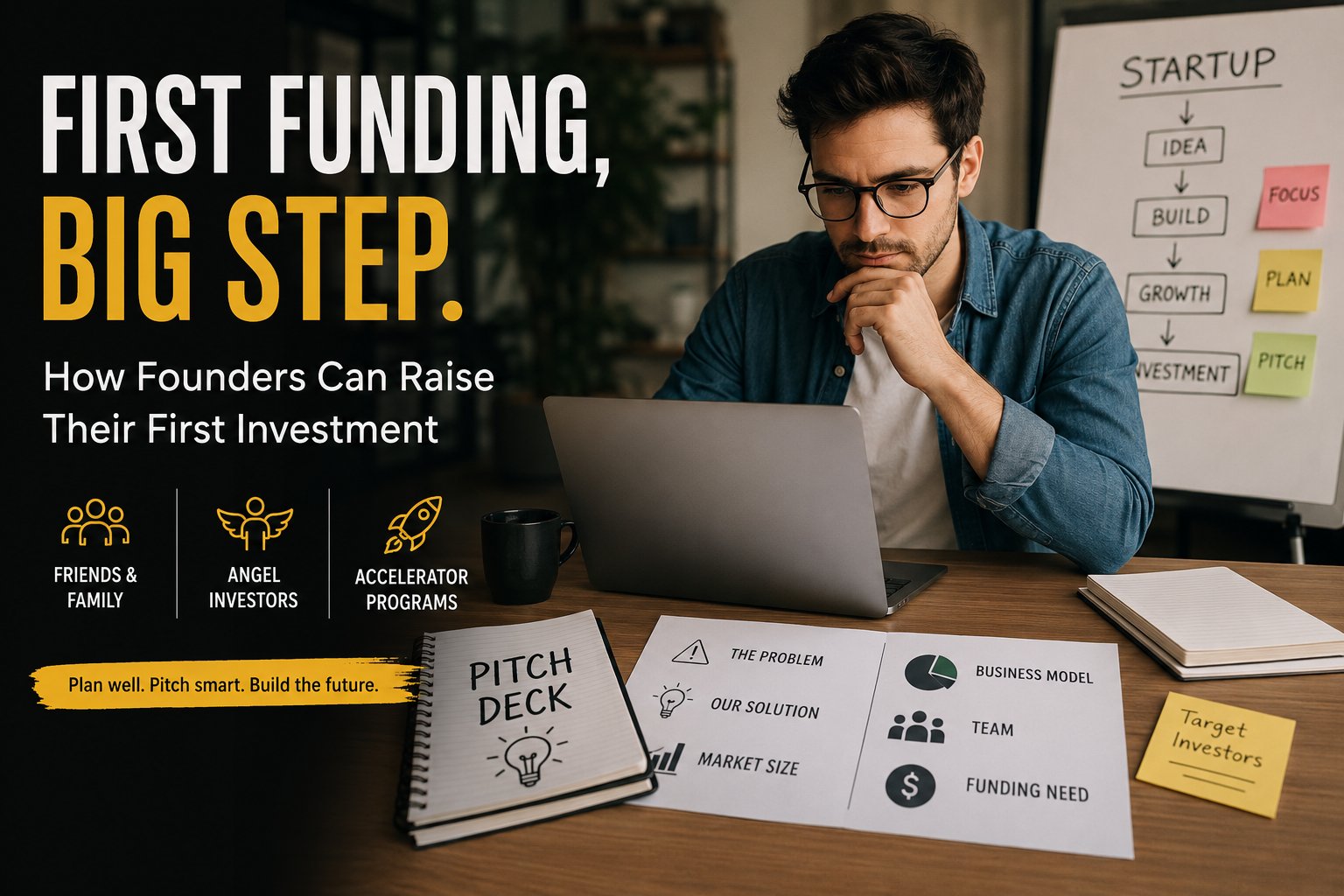
How First-Time Founders Can Raise Their First Investment
Quick Answer
First-time founders usually raise their first investment from friends and family, angel investors, accelerators, grants, startup loans, or early-stage funding programs before approaching venture capital firms. To raise successfully, founders need more than a good idea. They need customer validation, a clear pitch deck, a realistic financial plan, and a strong explanation of how the money will create measurable business progress.
Key Takeaways
- Most first-time founders do not start with venture capital.
- Early funding often comes from friends and family, angel investors, accelerators, grants, or startup loans.
- Investors want proof that the founder can execute, not just a big idea.
- A strong pitch deck, financial model, and investor list are essential.
- SAFE agreements and convertible notes are often used to delay valuation discussions.
- Canadian founders should also explore non-dilutive funding options such as NRC IRAP, BDC financing, Futurpreneur, grants, and accelerator programs.
- The first round should help the startup reach clear milestones before the next raise.
Why Raising a First Investment Is So Difficult
Securing a first investment round is one of the hardest milestones in a startup’s journey.
Many new founders believe fundraising begins with venture capital firms. In reality, most startups are not ready for institutional venture capital at the idea stage. Venture capital firms usually want to see evidence of market demand, founder execution, customer traction, revenue potential, or a product that is already showing signs of growth.
For first-time founders, the biggest challenge is trust.
Investors are asking themselves:
- Can this founder execute?
- Is the problem real?
- Is the market large enough?
- Will customers actually pay?
- Can this startup grow beyond a small business?
- Will this investment create a meaningful return?
That is why early fundraising is not just about pitching. It is about becoming investable.
How to Prepare Before Raising Your First Investment
Before contacting investors, founders should prepare the basic fundraising materials that help explain the business clearly.
At minimum, founders should build three core assets.
1. A Strong Pitch Deck
A pitch deck is usually a 10 to 15 slide presentation that explains the startup in a simple and compelling way.
A strong pitch deck usually includes:
- Problem
- Solution
- Market opportunity
- Product
- Business model
- Traction
- Competition
- Go-to-market strategy
- Team
- Funding ask
- Use of funds
- Future milestones
The goal of a pitch deck is not to answer every possible question. The goal is to make investors interested enough to take the next meeting.
2. A Realistic Financial Model
A financial model shows how the startup expects to generate revenue, manage costs, and use capital.
For early-stage founders, the model does not need to be perfect. But it should show that the founder understands the business drivers.
A basic model should include:
- Revenue assumptions
- Customer acquisition costs
- Gross margin
- Operating expenses
- Hiring plan
- Cash runway
- Funding requirement
- Expected milestones over 18 to 24 months
Investors do not expect early projections to be exact. But they do expect the assumptions to make sense.
3. A Targeted Investor List
Many founders make the mistake of pitching everyone.
A better approach is to build a targeted investor list based on:
- Industry focus
- Startup stage
- Geography
- Cheque size
- Previous investments
- Founder background
- Strategic fit
For example, a fintech founder should not waste time pitching investors who only fund consumer apps or biotech startups.
Fundraising is more efficient when founders approach investors who already understand their market.
What Investors Want to See Before Writing a Cheque
Investors rarely fund ideas alone.
They usually look for a combination of signals that reduce risk.
These signals may include:
- A founder with strong domain knowledge
- Evidence that customers care about the problem
- A working MVP or prototype
- Early users or revenue
- A large and growing market
- Clear competitive advantage
- Strong storytelling
- Realistic use of funds
- Ability to attract talent
- Founder resilience
The earlier the startup, the more investors focus on the founder.
At the pre-seed stage, investors are often betting on the founder’s judgment, speed, clarity, and ability to learn quickly.
The Most Common Sources of First Startup Funding
Not every funding source is right for every founder.
Some funding options provide mentorship. Some provide speed. Some avoid dilution. Some come with more pressure.
Here is a practical comparison.
| Funding Source | Typical Use | Dilution? | Best For |
|---|---|---|---|
| Personal Savings | Building MVP, early testing | No | Founders who can self-fund initial validation |
| Friends and Family | Prototype, early launch, first hires | Sometimes | Founders with trusted personal networks |
| Angel Investors | Pre-seed or seed capital | Yes | Startups with early traction or strong founder-market fit |
| Accelerators | Mentorship, capital, network | Usually | Founders who need structure and investor access |
| Startup Grants | R&D, innovation, hiring, market validation | No | Canadian founders eligible for government or innovation funding |
| Startup Loans | Working capital, early operations | No equity dilution | Founders who can manage repayment risk |
| Revenue-Based Financing | Growth capital tied to revenue | Usually no equity | Startups with predictable revenue |
| Venture Capital | Larger seed or Series A rounds | Yes | Startups with high-growth potential and traction |
Friends and Family Funding
Many startups receive their first external funding from people who already know and trust the founder.
This can include:
- Parents
- Relatives
- Friends
- Former colleagues
- Personal mentors
- Small business owners in the founder’s network
Friends and family funding is often used to:
- Build a prototype
- Test customer demand
- Launch the first version of a product
- Pay for early marketing
- Register the company
- Cover basic technology or legal costs
Typical amounts can range from a few thousand dollars to over $100,000, depending on the founder’s network and the business type.
However, founders should be careful.
Money from personal relationships can create emotional pressure. Every investment should be documented clearly, even if the investor is a close relative or friend.
Founders should explain:
- Is this a loan or an investment?
- Will the investor receive equity?
- What are the risks?
- What happens if the startup fails?
- When could the investor potentially see a return?
A casual conversation is not enough. Even early money should be handled professionally.
Angel Investors
Angel investors are individuals who invest their own money into startups.
They are often former founders, executives, operators, or professionals who want exposure to early-stage companies.
Angel investors can be valuable because they may offer:
- Faster decisions
- Industry advice
- Introductions
- Early credibility
- Flexible cheque sizes
- Founder-friendly terms
Unlike venture capital firms, angels do not need to follow a fund mandate. This means they may be more willing to invest at an early stage.
Angels often care about:
- Founder quality
- Market opportunity
- Early traction
- Product potential
- Exit possibility
- Trust in the founder
For first-time founders, one strong angel investor can make the rest of the round easier.
A respected angel can also help attract other investors.
Accelerators and Incubators
Accelerators help startups move faster through structured support.
They often provide:
- Seed funding
- Mentorship
- Investor introductions
- Demo days
- Product guidance
- Legal and fundraising education
- Peer founder community
Programs such as Y Combinator and Founder Institute are well-known globally. In Canada, founders may also explore organizations such as MaRS, DMZ, Invest Ottawa, Communitech, Creative Destruction Lab, and local university-linked incubators.
Accelerators are especially useful for founders who need:
- Fundraising readiness
- Investor network access
- Pitch refinement
- Product feedback
- Market validation
- Credibility
However, not every accelerator is equal.
Before joining, founders should ask:
- What is the equity requirement?
- How strong is the mentor network?
- Do alumni actually raise funding?
- Is the program relevant to my industry?
- Will this improve my odds of growth?
A good accelerator can compress years of learning into months. A weak one can become a distraction.
Government Grants and Non-Dilutive Funding
First-time founders often overlook non-dilutive funding.
Non-dilutive funding means capital that does not require giving up company ownership.
For Canadian startups, this can be especially important.
Examples include:
- Government grants
- Innovation funding
- Research and development support
- Hiring grants
- Export development programs
- Startup loans
- Tax credit programs
- University entrepreneurship grants
- Pitch competitions
Programs such as NRC IRAP support eligible Canadian small and medium-sized businesses working on technology innovation. BDC provides financing and advisory services to Canadian entrepreneurs. Futurpreneur offers startup financing and mentorship for young entrepreneurs in Canada.
These options can help founders reduce dilution before raising equity capital.
For example, a founder who uses a grant or startup loan to build an MVP may later raise equity at a higher valuation because the business has already made progress.
Revenue-Based Financing
Revenue-based financing can be useful for startups that already generate predictable revenue.
Instead of selling equity, the company receives capital and repays it through a percentage of future revenue.
This may work well for:
- SaaS companies
- E-commerce brands
- Subscription businesses
- Digital products
- Agencies with recurring contracts
- Startups with stable monthly revenue
The advantage is that founders may avoid giving up equity.
The disadvantage is that repayment pressure can hurt cash flow if revenue slows down.
Revenue-based financing is usually not ideal for idea-stage startups with no revenue.
Why Most First-Time Founders Should Not Start With Venture Capital
Venture capital is powerful, but it is not always the right first step.
VC firms usually look for companies that can become very large. They need investments that can potentially return the fund.
That means venture capital is usually best suited for startups with:
- Large markets
- Scalable business models
- Strong growth potential
- Defensible products
- Early traction
- A path to major revenue or exit
Many good businesses are not venture-scale businesses.
A local service company, small e-commerce brand, consulting business, or niche platform may be profitable and valuable, but not necessarily a fit for venture capital.
Before raising VC money, founders should ask:
- Can this business become 10x or 100x larger?
- Is the market big enough?
- Can growth happen quickly?
- Do I want investor pressure?
- Am I comfortable with dilution?
- Will venture capital actually help?
Raising VC money too early can create pressure before the business is ready.
SAFE Agreements and Convertible Notes Explained
One of the hardest parts of early fundraising is valuation.
At the idea or pre-seed stage, the startup may have little revenue. That makes it difficult to decide what the company is worth.
To avoid long valuation negotiations, founders often use instruments that convert into equity later.
Two common options are:
- SAFE agreements
- Convertible notes
What Is a SAFE?
SAFE stands for Simple Agreement for Future Equity.
A SAFE allows an investor to invest money today and receive equity later when the company raises a priced round.
Y Combinator provides widely used SAFE financing documents for startups, especially in the U.S. startup ecosystem.
What Is a Convertible Note?
A convertible note is a loan that can convert into equity during a future financing round.
Convertible notes may include:
- Interest rate
- Maturity date
- Discount
- Valuation cap
SAFE vs Convertible Note
| Feature | SAFE | Convertible Note |
|---|---|---|
| Debt? | Usually no | Yes |
| Interest? | Usually no | Usually yes |
| Maturity date? | Usually no | Usually yes |
| Converts later? | Yes | Yes |
| Common use | Early-stage startup rounds | Early-stage or bridge rounds |
| Simpler structure | Usually | More complex |
Founders should always speak with a startup lawyer before using any fundraising document.
This is especially important for Canadian startups because legal norms, tax treatment, securities rules, and investor expectations can differ by jurisdiction.
How Much Should a First-Time Founder Raise?
Founders should not raise a random amount.
The best approach is to raise enough capital to reach the next meaningful milestone.
That milestone may be:
- Building an MVP
- Getting first customers
- Reaching monthly recurring revenue
- Hiring one or two key team members
- Completing product development
- Running customer acquisition tests
- Securing partnerships
- Preparing for a seed round
Many early-stage startups plan for 18 to 24 months of runway, but the exact amount depends on the business model.
A software startup may need capital for product development and engineering. A consumer brand may need inventory, marketing, and distribution. A marketplace may need supply and demand growth.
The question investors care about is simple:
What will this money unlock?
If the answer is vague, the fundraising story becomes weak.
What Should Be in the Use of Funds Section?
The use of funds section tells investors how the startup will spend the money.
A weak use of funds section says:
“We will use the money for growth.”
A stronger version says:
“We are raising $300,000 to reach 10,000 active users, launch our paid product, hire one full-time engineer, and run six months of customer acquisition experiments.”
A practical use of funds section may include:
| Category | Example Use |
|---|---|
| Product | Build MVP, improve app, launch key features |
| Engineering | Hire developer, improve infrastructure |
| Sales | Build pipeline, close early customers |
| Marketing | Test acquisition channels |
| Operations | Legal, accounting, compliance |
| Customer Research | Interviews, surveys, testing |
| Hiring | First key employees or contractors |
Investors want to see discipline.
They want to know that the founder understands priorities.
Typical First-Time Fundraising Journey
Most successful fundraising journeys follow a progression.
Idea
↓
Customer Research
↓
Problem Validation
↓
Prototype or MVP
↓
Early Users
↓
Pitch Deck
↓
Friends and Family / Angels / Grants / Accelerator
↓
First Investment Round
↓
Product and Traction Milestones
↓
Seed Round or Institutional Funding
Founders who skip validation often struggle.
Founders who prove demand before fundraising usually have a stronger story.
Common Fundraising Mistakes First-Time Founders Make
1. Raising Too Early
A pitch deck alone is rarely enough.
Investors want evidence. That evidence could be user interviews, waitlists, revenue, pilot customers, product usage, or early partnerships.
2. Pitching the Wrong Investors
A pre-seed SaaS startup should not pitch a late-stage biotech fund.
Founder time is limited. Investor targeting matters.
3. Asking for Too Much Money Without a Plan
A large funding ask without clear milestones can make founders look unrealistic.
4. Overvaluing the Startup Too Early
An inflated valuation may feel good at first, but it can create problems in the next round if the company does not grow fast enough.
5. Ignoring Dilution
Founders should understand how much ownership they are giving up and how future rounds may dilute them further.
6. Weak Follow-Up
Fundraising rarely happens in one meeting.
Founders should follow up with updates, traction, customer wins, product progress, and clear next steps.
7. Hiding Risks
Investors know startups are risky.
Founders build more trust when they acknowledge risks and explain how they plan to manage them.
Twikup Insight
Many first-time founders think investors fund ideas.
In reality, investors fund execution.
Two founders can pitch the same idea, but the one who has spoken to customers, tested the problem, built early traction, and explained a disciplined plan will usually look far more investable.
A strong pitch deck may get attention.
But customer evidence gets confidence.
The best fundraising strategy is not to look fundable. It is to become fundable before the first investor meeting.
Canadian Startup Funding Context
Canadian founders should not rely only on angel investors or venture capital.
Canada has a broader funding ecosystem that includes:
- Federal innovation programs
- Provincial grants
- Startup loans
- BDC financing
- Futurpreneur financing and mentorship
- NRC IRAP support
- University incubators
- Regional innovation hubs
- Tax credits
- Accelerator programs
This matters because non-dilutive or lower-dilution funding can help founders build early traction before selling equity.
For example, a Canadian technology founder may combine:
- Personal savings
- A small startup loan
- A grant or innovation program
- Accelerator support
- Angel investment
This blended approach can be more founder-friendly than giving away too much equity too early.
When Should Founders Approach Investors?
Founders should approach investors when they can clearly answer these questions:
- What problem are you solving?
- Who has this problem?
- How do you know they care?
- What have you built?
- What traction do you have?
- Why is now the right time?
- Why are you the right founder?
- How will the business make money?
- How much are you raising?
- What milestone will the money unlock?
You do not need perfection.
But you do need clarity.
What Happens After Raising the First Round?
Raising money is not the finish line.
It is the start of a new level of accountability.
After securing initial capital, founders are usually expected to achieve measurable progress.
Common post-funding milestones include:
- Building and improving the product
- Acquiring early customers
- Increasing revenue
- Hiring key team members
- Improving retention
- Testing marketing channels
- Building investor updates
- Preparing for the next round
The ability to turn capital into progress often determines whether the next fundraising round becomes easier or harder.
Investors remember founders who execute.
Final Thoughts
First-time fundraising is not about convincing investors to believe in a dream.
It is about showing them that the startup has a real problem, a credible founder, early evidence, and a practical plan for growth.
The first investment may come from friends and family, angels, accelerators, grants, loans, or a combination of sources. The best funding path depends on the startup’s stage, business model, market, and founder goals.
For most founders, the smartest move is to raise enough money to reach the next milestone, not simply to raise the biggest round possible.
Successful fundraising is rarely about finding investors.
It is about becoming investable.
FAQ: First-Time Startup Fundraising
How do first-time founders raise their first investment?
First-time founders usually raise from friends and family, angel investors, accelerators, grants, startup loans, or early-stage funding programs. Venture capital usually comes later once the startup has stronger traction.
Do founders need revenue before raising money?
Not always. Some startups raise before revenue if they have strong customer validation, a compelling market, a capable team, or a working prototype. However, revenue can significantly improve investor confidence.
How much should a founder raise in the first round?
Founders should raise enough to reach the next meaningful milestone, such as launching an MVP, gaining customers, or reaching revenue targets. Many early-stage plans are built around 18 to 24 months of runway.
What is a SAFE agreement?
A SAFE is a Simple Agreement for Future Equity. It allows an investor to provide capital today and receive equity later during a future priced financing round.
What is a convertible note?
A convertible note is a debt instrument that can convert into equity in a future financing round. It usually includes terms such as interest, maturity date, discount, or valuation cap.
Should founders raise from friends and family?
Friends and family funding can help founders start early, but it should be handled carefully. Founders should clearly explain the risks and document the terms professionally.
Do investors sign NDAs before hearing a pitch?
Most professional investors do not sign NDAs before reviewing a startup pitch. Founders should avoid sharing highly sensitive technical details in early conversations.
What percentage of equity should founders give away in the first round?
There is no universal rule. It depends on the amount raised, valuation, investor demand, and startup stage. Founders should avoid giving away too much ownership too early.
Can Canadian startups get funding without giving up equity?
Yes. Canadian startups may explore grants, innovation funding, startup loans, tax credits, and government-supported programs before or alongside equity fundraising.
When should a startup approach venture capital firms?
A startup should usually approach VC firms when it has a large market opportunity, scalable business model, strong growth potential, and enough traction to support a venture-scale investment case.
Continue Reading the Series
If you are joining this startup investing series for the first time, continue with the next article:
Part 2: What Investors Look For Before Funding a Startup https://twikup.ca/money/investing/what-investors-look-for-before-funding-a-startup
Helpful References
-
Y Combinator: SAFE Financing Documents https://www.ycombinator.com/documents
-
Y Combinator: The YC Deal https://www.ycombinator.com/deal
-
BDC: Financing for Canadian Entrepreneurs https://www.bdc.ca/en/financing
-
NRC IRAP: Support for Technology Innovation https://nrc.canada.ca/en/support-technology-innovation
-
Futurpreneur Canada: Startup Financing and Mentorship https://futurpreneur.ca/en/
-
Futurpreneur Canada: Core Startup Program https://futurpreneur.ca/en/offering/core-startup/