
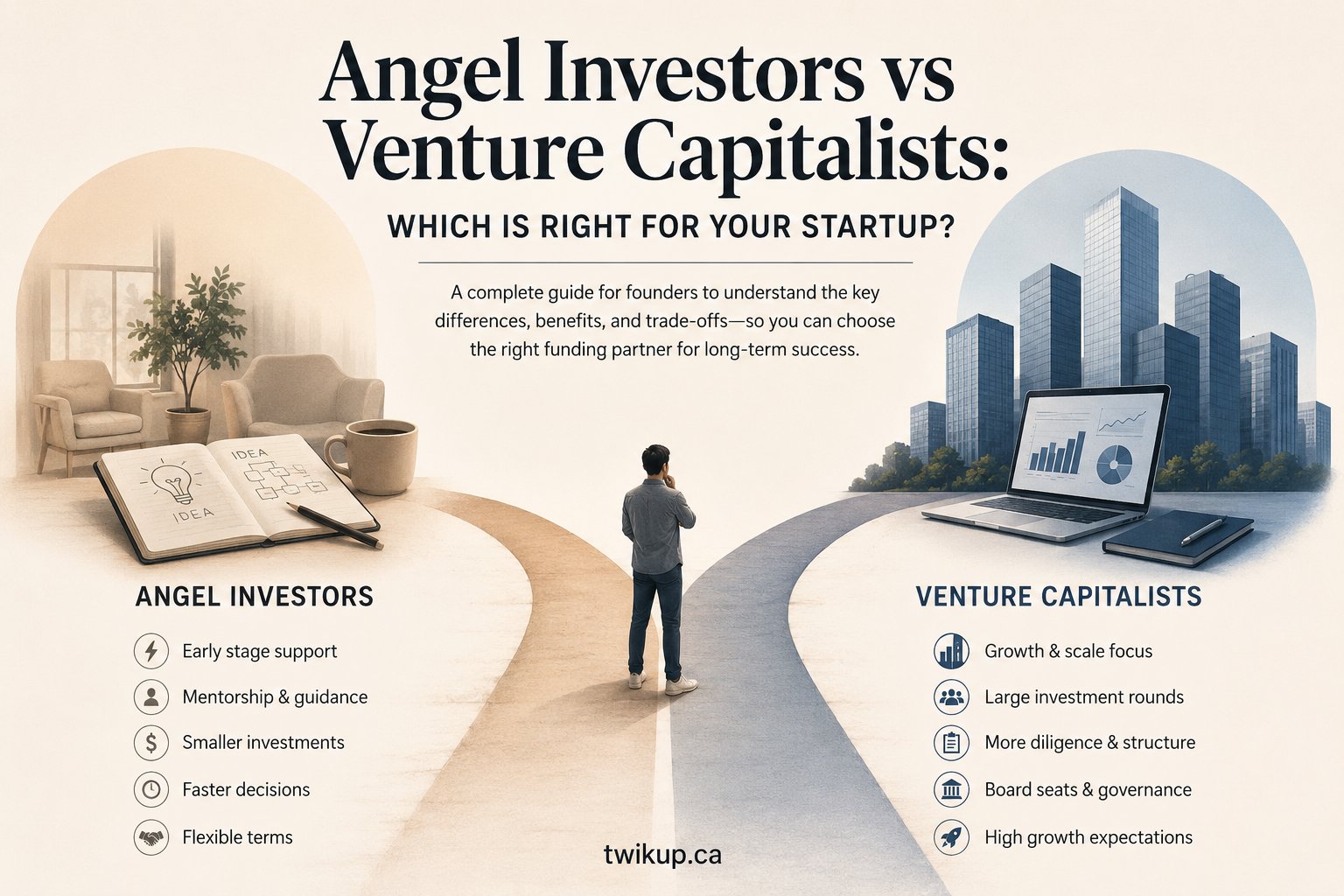
Angel Investors vs Venture Capitalists: Which Is Right for Your Startup?
Raising capital is one of the biggest decisions any startup founder will make. While many entrepreneurs focus on how much money they can raise, experienced founders know that who you raise money from is often more important than how much you raise.
An investor becomes more than just a source of capital. They can influence strategic decisions, introduce key customers, help recruit executives, participate in future fundraising rounds, and sometimes even determine the long-term direction of your company.
This is why understanding the difference between angel investors and venture capitalists (VCs) is essential before accepting your first investment.
Many first-time founders assume that venture capital is the ultimate goal because they frequently hear about billion-dollar startups backed by firms like Sequoia, Andreessen Horowitz, or Accel. In reality, however, most successful startups never raise venture capital.
For thousands of businesses, an experienced angel investor can provide exactly the right amount of funding, flexibility, and mentorship needed to grow sustainably.
The best funding choice depends on factors such as:
- Your startup stage
- Revenue growth
- Business model
- Capital requirements
- Desired growth speed
- Long-term vision
- Founder ownership goals
Choosing the wrong investor can lead to unnecessary dilution, unrealistic growth expectations, or losing strategic control of your company.
This guide explains how angel investors and venture capitalists differ, their advantages and disadvantages, and how to decide which type of investor is best suited for your startup in 2026.
Quick Answer
Angel investors are typically wealthy individuals who invest their own money into early-stage startups. They usually invest between $25,000 and $500,000, move relatively quickly, and often provide mentorship alongside capital.
Venture capitalists (VCs) manage investment funds on behalf of institutions and investors. They generally invest $1 million or more, focus on startups with significant growth potential, conduct extensive due diligence, and expect rapid scaling with high returns.
Neither option is universally better.
The right investor depends entirely on your company's current stage, funding requirements, and long-term business objectives.
Key Takeaways
- Angel investors usually fund startups during the idea, prototype, or early revenue stage.
- Venture capital firms typically invest after startups demonstrate product-market fit and measurable growth.
- Angel investors invest their own money, while venture capitalists invest funds belonging to limited partners.
- VC funding usually involves larger investments but also greater expectations and increased founder dilution.
- Angels often provide hands-on mentorship and industry introductions.
- Venture capital firms usually offer structured support, hiring assistance, strategic guidance, and access to future funding rounds.
- Not every startup is suitable for venture capital.
- Many successful companies grow into profitable businesses using only angel funding or even bootstrapping.
Why Choosing the Right Investor Matters
Fundraising is often viewed as a financial transaction.
In reality, it is a long-term partnership.
Investors may remain involved with your company for five, seven, or even ten years. During that period, they can influence hiring decisions, fundraising strategy, product direction, acquisitions, and exit planning.
The wrong investor can create unnecessary pressure to pursue rapid growth when a sustainable business model may be more appropriate.
Conversely, choosing an experienced investor who understands your market can dramatically accelerate growth.
Before deciding between angel funding and venture capital, founders should ask themselves several important questions:
- How much capital do I truly need?
- Can my business become profitable without massive investment?
- Am I building a billion-dollar company or a profitable niche business?
- Am I comfortable giving up board seats and decision-making power?
- Do I need mentorship more than capital?
- Can I realistically generate venture-scale returns?
The answers to these questions often determine which funding path makes the most sense.
What Is an Angel Investor?
An angel investor is an individual who uses their personal wealth to invest directly in startups.
Unlike venture capital firms, angel investors are investing their own money, giving them greater flexibility in how they evaluate opportunities.
Many angel investors are:
- Successful entrepreneurs
- Former startup founders
- Corporate executives
- Technology professionals
- Industry experts
- High-net-worth individuals
Because they have personally built businesses, many angels understand the challenges faced by founders and often provide valuable mentorship beyond financial investment.
How Angel Investors Typically Invest
Angel investments commonly occur during:
- Idea stage
- Prototype stage
- Minimum Viable Product (MVP)
- Pre-seed funding
- Seed funding
- Early customer validation
Investment amounts generally range from:
| Stage | Typical Investment |
|---|---|
| Idea Stage | $25,000–$100,000 |
| MVP | $50,000–$250,000 |
| Seed | $100,000–$500,000 |
| Angel Syndicate | Up to $2 million |
Some angel investors invest independently, while others participate in angel syndicates, where multiple investors pool capital into a single startup.
This allows founders to raise larger rounds while still working primarily with angel investors.
Advantages of Angel Investors
Faster Decisions
Because angels invest their own money, investment decisions are often made much faster than institutional funding.
Many angel rounds close within a few weeks rather than several months.
Founder-Friendly Terms
Angel investors generally request:
- Smaller ownership stakes
- Fewer legal requirements
- Limited governance provisions
- Simpler investment agreements
This allows founders to retain more flexibility during the company's early growth.
Valuable Mentorship
Experienced angel investors frequently become trusted advisors.
They may help founders:
- Avoid expensive mistakes
- Build pricing strategies
- Hire leadership teams
- Introduce early customers
- Prepare for future fundraising
The value of an experienced mentor can sometimes exceed the value of the investment itself.
Better Alignment During Early Growth
Unlike institutional investors managing billion-dollar funds, angel investors often understand that early-stage startups require experimentation.
They may be more patient as founders search for product-market fit.
Potential Downsides of Angel Investors
Angel funding is not perfect.
Some challenges include:
- Limited follow-on capital
- Smaller funding rounds
- Variable investment experience
- Fewer operational resources
- Inconsistent involvement
Not every angel investor has startup experience.
Some may provide exceptional advice.
Others may unintentionally create distractions by becoming overly involved in day-to-day decisions.
Founders should evaluate angel investors just as carefully as investors evaluate startups.
What Is a Venture Capitalist?
A venture capitalist (VC) is a professional investor who manages money collected from institutional investors, pension funds, family offices, corporations, and wealthy individuals.
Rather than investing personal savings, venture capital firms deploy capital from professionally managed investment funds.
Their objective is straightforward:
Invest in a portfolio of startups where a small number of exceptional companies generate returns large enough to offset the many investments that fail.
This is why venture capital firms prioritize businesses capable of becoming extremely large companies.
How Venture Capital Firms Operate
Most VC firms raise funds that remain active for approximately ten years.
During this period, they:
- Source startup opportunities
- Evaluate founders
- Conduct due diligence
- Invest capital
- Support portfolio companies
- Help raise additional rounds
- Exit through acquisition or IPO
Unlike angel investors, venture capital firms usually have structured investment committees that approve each investment.
As a result, funding decisions often require significantly more analysis and documentation.
Typical VC Investment Stages
Most venture capital firms invest during:
- Seed
- Series A
- Series B
- Growth Stage
- Expansion Stage
Although some funds now invest earlier, many still prefer startups that have already demonstrated:
- Strong customer traction
- Revenue growth
- Product-market fit
- Scalable operations
- Large addressable markets
Startups without measurable traction often struggle to secure institutional venture funding. # Angel Investors vs Venture Capitalists: Key Differences Founders Must Understand
Angel investors and venture capitalists both invest in startups, but they are not the same type of investor.
The biggest difference is simple:
Angel investors usually invest their own money. Venture capitalists invest other people's money through a professionally managed fund.
That one difference changes almost everything — decision-making speed, investment size, risk tolerance, legal process, control rights, follow-on capital, and expectations from the founder.
A founder who does not understand these differences may choose the wrong funding path and create problems later.
Angel Investors vs Venture Capitalists: Comparison Table
| Category | Angel Investors | Venture Capitalists |
|---|---|---|
| Who they are | Individual investors | Professional investment firms |
| Money source | Personal wealth | Institutional fund capital |
| Typical stage | Idea, MVP, pre-seed, seed | Seed, Series A, Series B, growth |
| Investment size | Smaller cheques | Larger cheques |
| Decision speed | Faster | Slower |
| Due diligence | Lighter | More detailed |
| Legal process | Simpler | More complex |
| Founder dilution | Usually lower | Usually higher |
| Board control | Usually limited | More likely |
| Growth expectation | Flexible | Very high |
| Follow-on capital | Limited | Stronger |
| Best for | Early validation | Rapid scaling |
| Risk appetite | Often high | Selective and structured |
| Main value | Mentorship + early capital | Capital + network + scale support |
Both investor types can be valuable, but they serve different purposes.
Angel investors are often better when the startup is still testing the idea.
Venture capitalists are usually better when the startup already has traction and needs serious capital to scale quickly.
1. Investment Size: Angels Write Smaller Cheques, VCs Write Larger Cheques
One of the clearest differences between angel investors and venture capitalists is cheque size.
Angel investors usually invest smaller amounts because they are investing personal money.
A single angel may invest:
- $10,000
- $25,000
- $50,000
- $100,000
- $250,000
In some cases, wealthy angels or angel syndicates may invest more.
Venture capital firms usually invest larger amounts because they manage pooled capital.
A VC firm may invest:
- $500,000
- $1 million
- $3 million
- $5 million
- $10 million or more
This matters because the amount of money you raise should match the stage of your startup.
If you only need $150,000 to build your MVP, hiring engineers, test customer demand, and validate your pricing, angel funding may be enough.
If you need $5 million to expand into multiple markets, hire a sales team, build infrastructure, and compete aggressively, venture capital may be more suitable.
Founder Reality Check
More money is not always better.
Raising too much money too early can create pressure to grow before the company is ready.
It can also increase dilution and force the founder into a venture-scale growth path.
Before raising capital, ask:
- What exactly will this money help us achieve?
- How many months of runway do we need?
- Will this funding increase valuation before the next round?
- Are we raising for survival or growth?
- Can we reach the next milestone with less money?
The best founders do not raise the biggest round possible.
They raise the right amount at the right time.
2. Startup Stage: Angels Usually Come Earlier Than VCs
Angel investors often invest when the startup is still very early.
This may include:
- Idea stage
- Prototype stage
- MVP stage
- First customer stage
- Pre-revenue stage
- Early revenue stage
At this point, the startup may not have strong financial data. The founder may only have a strong problem, early customer conversations, a small prototype, or a clear market insight.
Angels are often willing to take this early risk because they invest based on:
- Founder quality
- Market understanding
- Personal conviction
- Industry experience
- Early signals
- Trust
Venture capitalists usually need more proof.
They often look for:
- Strong traction
- Revenue growth
- User growth
- Product-market fit
- Large market opportunity
- Strong retention
- Scalable business model
- Repeatable customer acquisition
Some VC firms invest at pre-seed, but even then, they usually expect a startup that can become very large.
Simple Rule
If you are still proving the idea, angel investors may be a better fit.
If you are already proving growth, venture capital may be a better fit.
3. Equity Expectations: VC Usually Means More Dilution
Both angel investors and venture capitalists usually receive ownership in exchange for investment.
This means the founder gives up a percentage of the company.
Angel rounds usually involve smaller dilution because the cheque size is smaller.
VC rounds usually involve larger dilution because the investment amount is bigger and the firm is taking institutional risk.
For example:
| Scenario | Investment | Valuation | Investor Ownership |
|---|---|---|---|
| Angel round | $100,000 | $2 million | 5% |
| Angel syndicate | $500,000 | $5 million | 10% |
| VC seed round | $2 million | $10 million | 20% |
| Series A round | $5 million | $20 million | 25% |
These are simplified examples, but they show the main point:
The larger the round, the more ownership founders usually give up.
Dilution is not always bad.
If a VC investment helps the company grow from a $10 million company to a $500 million company, the founder may own a smaller percentage of a much larger business.
But dilution becomes dangerous when founders give up too much ownership before the company has real traction.
Twikup Insight
Founders should not only ask, “How much money am I raising?”
They should also ask:
“What milestone will this money help me reach, and will that milestone increase the company’s value?”
Good dilution buys growth.
Bad dilution only buys time.
If investment capital does not help the startup become more valuable, the founder may lose ownership without improving the company’s future.
4. Control and Decision-Making: Angels Are Usually More Flexible
Angel investors usually have limited control rights.
They may provide advice, mentorship, introductions, and informal guidance, but they often do not demand board seats or heavy governance rights in very early rounds.
Venture capital firms are different.
Because they invest larger amounts and manage other people's money, they usually require more structure.
VCs may ask for:
- Board seats
- Information rights
- Protective provisions
- Pro-rata rights
- Approval rights
- Founder vesting terms
- Reporting obligations
- Anti-dilution protection
- Liquidation preferences
This does not mean VC terms are always bad.
Many of these terms are normal in professional startup financing.
But founders must understand them before signing.
A founder who accepts VC money is not just accepting capital.
They are accepting a more formal governance structure.
What This Means for Founders
Angel funding may allow the founder to keep more flexibility during the early experimental stage.
VC funding may provide stronger support but usually comes with higher expectations and more oversight.
If you want full independence, VC funding may not be the right path.
If you want to build a fast-scaling company and are comfortable with investor governance, VC funding may be valuable.
5. Speed of Funding: Angels Can Move Faster
Angel investors often move faster than venture capital firms.
This is because an angel investor can make a decision independently.
If they like the founder, understand the market, and believe in the opportunity, they may invest quickly.
VC firms usually take longer.
Their process may include:
- Partner meetings
- Market analysis
- Customer calls
- Financial review
- Product review
- Competitive research
- Legal diligence
- Investment committee approval
- Term sheet negotiation
This can take weeks or months.
For founders with limited runway, timing matters.
If the startup needs quick capital to build an MVP or close early customers, angel funding may be more practical.
If the startup is raising a larger institutional round, the founder should prepare for a longer process.
Founder Tip
Do not start fundraising when you are desperate.
Start before you urgently need the money.
Investors can sense pressure.
A founder with six to nine months of runway usually negotiates better than a founder with six weeks of runway.
6. Risk Appetite: Angels May Back Earlier Ideas
Angel investors are often more willing to invest in uncertainty.
They may back a founder before the numbers are strong.
This is especially true if the angel has personal experience in the industry.
For example, a former restaurant technology founder may invest in a new food-tech startup because they understand the pain point before the financial metrics are obvious.
VCs also take risk, but their risk is more structured.
They usually want to see evidence that the startup can become very large.
This may include:
- Fast-growing revenue
- High customer retention
- Large market size
- Strong founder-market fit
- Competitive advantage
- Scalable distribution
- Clear path to future funding
VCs do not just ask, “Can this company succeed?”
They ask:
“Can this company become big enough to return our fund?”
That is a very different question.
7. Mentorship and Network: Different Types of Support
Angel investors often provide personal, founder-level mentorship.
They may help with:
- Early product decisions
- Pricing
- Sales calls
- Customer introductions
- Hiring first employees
- Avoiding common founder mistakes
- Preparing for future fundraising
The best angels are often operators who have built companies themselves.
Their advice can be practical, direct, and highly useful.
Venture capital firms provide a different kind of support.
They may help with:
- Hiring executives
- Raising future rounds
- PR and media
- Enterprise customer introductions
- Strategic partnerships
- Financial planning
- Board governance
- Expansion strategy
- Exit planning
VC support is often more structured and scalable.
However, the quality of support varies widely from firm to firm.
Some VC firms are deeply helpful.
Others provide capital but limited operational support.
Important Founder Question
Before accepting any investment, ask:
“What specific help can this investor provide besides money?”
A good investor should be able to explain clearly how they can help.
Vague promises like “we have a great network” are not enough.
Ask for examples.
8. How Angel Investors Make Money
Angel investors make money when the startup becomes more valuable and eventually creates liquidity.
This may happen through:
- Acquisition
- Secondary sale
- IPO
- Buyback
- Future financing event
Because angel investors enter early, they may receive a low entry valuation.
If the company succeeds, their returns can be significant.
For example:
An angel invests $50,000 at a $2 million valuation.
If the company later exits at $100 million, that early investment could become very valuable, depending on dilution and deal terms.
However, angel investing is very risky.
Many startups fail.
This is why angels often invest in multiple companies, knowing that only a few may generate major returns.
9. How Venture Capitalists Make Money
Venture capital firms make money by investing in startups that can generate large exits.
VC firms usually manage funds backed by limited partners.
These limited partners may include:
- Pension funds
- Endowments
- Family offices
- Corporations
- Wealthy individuals
- Institutional investors
The VC firm invests that capital into startups.
If the startups succeed, the fund earns returns.
VCs typically make money through:
- Management fees
- Carried interest
- Gains from exits
Because of this fund model, VCs need some companies to become extremely successful.
A small profitable company may be great for the founder but not attractive enough for a VC fund.
This is why venture capital is not suitable for every business.
10. The Biggest Difference: Lifestyle Business vs Venture-Scale Business
This is one of the most important points for founders.
Not every good business should raise venture capital.
Some startups are better as profitable, founder-controlled companies.
These may include:
- Agencies
- Local marketplaces
- Niche SaaS tools
- Consulting-led software businesses
- Profitable e-commerce brands
- Regional service businesses
- Content businesses
- Education businesses
These companies can be excellent businesses, but they may not be venture-scale.
A venture-scale business usually has:
- Huge market potential
- Fast growth
- High margins
- Repeatable customer acquisition
- Ability to expand globally
- Potential for a very large exit
If your company can become a strong $5 million or $20 million annual revenue business, angel funding or bootstrapping may be enough.
If your company has the potential to become a $500 million or billion-dollar business, VC funding may make more sense.
Twikup Insight
Founders often confuse a good business with a VC-backable business.
They are not the same.
A company can be profitable, valuable, and life-changing for the founder without being attractive to venture capital.
Before chasing VC money, founders should honestly ask:
“Am I building a company that needs venture capital, or am I building a company that only looks more impressive when I say I raised money?”
Raising VC is not the trophy.
Building a durable company is the trophy.
11. Common Myths About Angel Investors and VCs
Myth 1: VC Funding Means Your Startup Is Successful
Raising venture capital does not mean the startup has succeeded.
It means investors believe the company has potential.
The real test comes after funding:
- Can the company grow?
- Can it retain customers?
- Can it generate revenue?
- Can it control burn?
- Can it raise the next round?
- Can it eventually become profitable or exit?
Funding is not the finish line.
It is fuel.
Myth 2: Angel Investors Are Always Easier to Work With
Many angel investors are founder-friendly, but not all.
Some angels may lack startup experience.
Some may give too much advice.
Some may not understand how future funding rounds work.
Some may create cap table complications if terms are poorly structured.
Founders should evaluate angels carefully.
A small cheque from the wrong angel can create long-term problems.
Myth 3: VCs Only Care About Money
VCs are financial investors, but the best ones care deeply about company building.
Strong VC firms can help founders think bigger, hire better, enter new markets, and prepare for future rounds.
However, their model does require large outcomes.
This means their advice may push the company toward aggressive growth.
That advice can be helpful for venture-scale startups.
It can be harmful for businesses that should grow more carefully.
Myth 4: More Investors Means More Credibility
A crowded cap table is not always a strength.
Too many small investors can create communication problems, legal complexity, and future fundraising friction.
Future investors may worry if the cap table is messy.
It is usually better to have a smaller number of high-quality investors than a long list of passive investors who add little value.
Myth 5: The Highest Valuation Is Always Best
A high valuation may look attractive, but it can create pressure.
If the valuation is too high too early, the startup may struggle to justify it in the next round.
This can lead to:
- Flat rounds
- Down rounds
- Investor hesitation
- Founder dilution
- Employee morale issues
A fair valuation that allows the company to grow into the next round is often better than an inflated valuation that creates unrealistic expectations.
12. When Angel Investors Usually Make More Sense
Angel investors may be the better choice when:
- You are still validating the idea
- You need a smaller amount of capital
- You want mentorship from operators
- You want to move quickly
- You want fewer governance requirements
- You are not ready for institutional VC
- You want to preserve flexibility
- You are building a business that may not need massive funding
Angel funding is often ideal for founders who need early support without immediately entering the venture capital path.
13. When Venture Capital Usually Makes More Sense
Venture capital may be the better choice when:
- You are targeting a very large market
- You already have strong traction
- You need significant capital to grow
- You can scale quickly
- You have repeatable customer acquisition
- You are comfortable with dilution
- You are prepared for board oversight
- You want to raise future funding rounds
- You are building a venture-scale company
VC funding can be powerful when the startup is ready for it.
But taking VC before the company is ready can create pressure that damages the business.
14. Decision Framework: Angel or VC?
Use this simple framework before choosing your funding path.
| Question | If Your Answer Is Yes | Better Fit |
|---|---|---|
| Are you still testing the idea? | Yes | Angel |
| Do you need less than $500,000? | Yes | Angel |
| Do you need mentorship more than large capital? | Yes | Angel |
| Do you want faster decision-making? | Yes | Angel |
| Are you building a huge market company? | Yes | VC |
| Do you need millions to scale? | Yes | VC |
| Do you already have strong traction? | Yes | VC |
| Are you comfortable with board oversight? | Yes | VC |
| Do you want to raise future institutional rounds? | Yes | VC |
This framework is not perfect, but it helps founders avoid one major mistake:
Choosing an investor based on prestige instead of business need.
15. The Smartest Funding Path for Many Startups
Many startups do not need to choose between angels and VCs immediately.
A common path looks like this:
- Founder savings or bootstrapping
- Friends and family
- Angel investors
- Angel syndicate
- Pre-seed fund
- Seed VC
- Series A VC
- Growth capital
This path allows founders to raise capital gradually as the company becomes stronger.
The key is to match the investor type to the startup stage.
Early uncertainty often fits angel investors.
Proven growth often fits venture capital.
Final Takeaway for Part 1
Angel investors and venture capitalists both help startups grow, but they are designed for different moments in a company's journey.
Angel investors are often best for early-stage founders who need capital, mentorship, flexibility, and speed.
Venture capitalists are often best for startups that have traction, large market potential, and a clear need for significant capital to scale quickly.
The wrong funding source can create pressure, dilution, and strategic misalignment.
The right funding source can accelerate growth, open doors, and help founders build a stronger company.
The smartest question is not:
“Can I raise money?”
The smarter question is:
“Which type of money is right for the company I am actually building?”
Continue to Part 2
In Part 2, we will cover:https://twikup.ca/money/investing/angel-investors-vs-venture-capitalists-which-is-right-for-your-startup-part-2
- When to choose angel investors
- When venture capital makes sense
- Pros and cons of both funding options
- Real founder scenarios
- Canadian startup funding landscape
- How to approach angels and VCs
- Mistakes that make investors walk away
- Final decision checklist for founders