
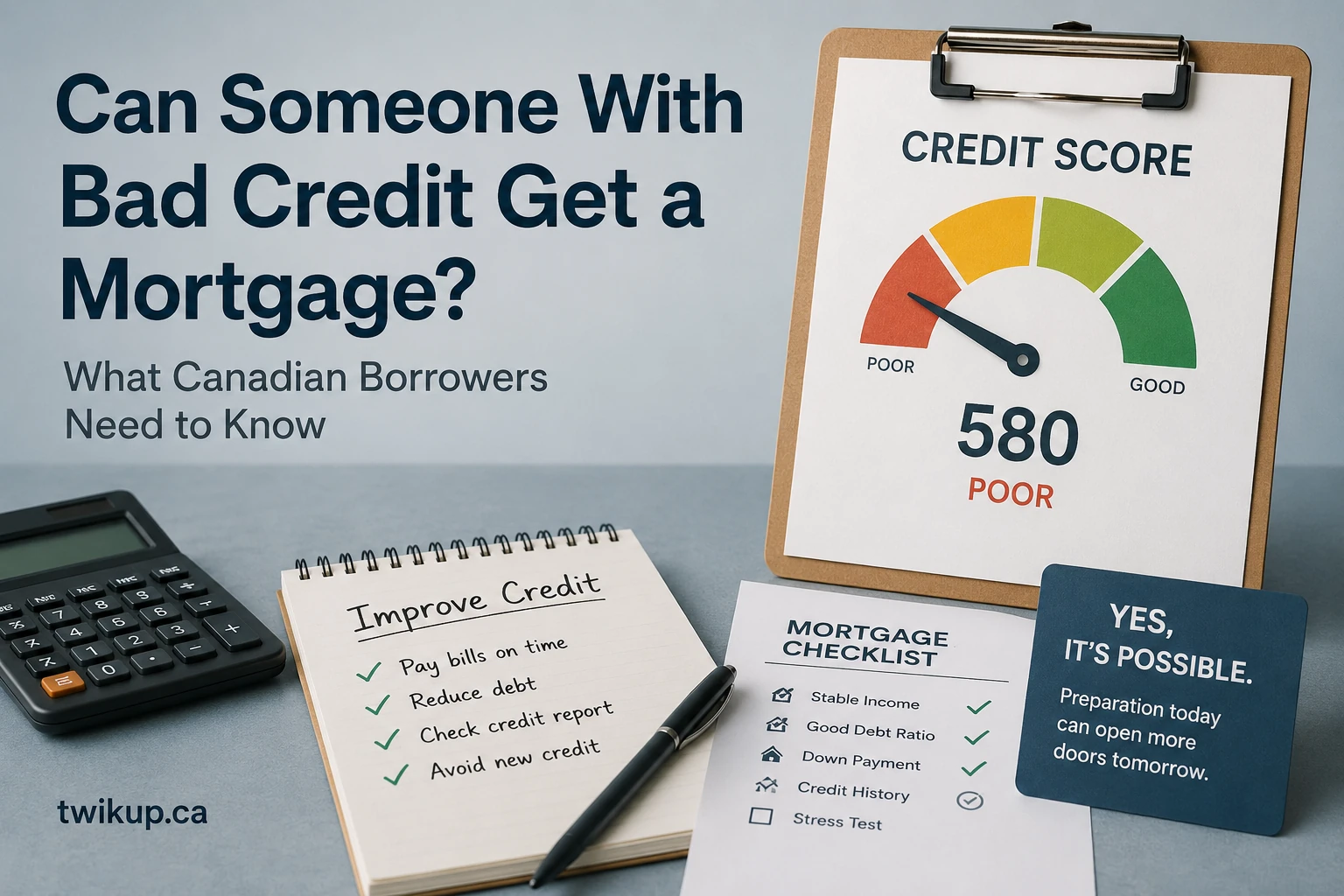
Quick Answer
Yes, someone with bad credit can sometimes get a mortgage in Canada, but approval is usually harder, more expensive, and may require a larger down payment, stronger income, lower debt, a co-signer, or a lender outside the major banks.
Bad credit does not automatically mean “no mortgage.” But it usually means lenders will look more carefully at your full financial picture: credit report, income, debts, down payment, job stability, property type, and whether you can pass the mortgage stress test.
The Government of Canada says lenders check your credit report before approving a mortgage, and if your credit score is not strong, they may refuse the application or require a co-signer.
Twikup Insight
Bad credit is not the real question. The better question is: does your full file prove you can safely carry the mortgage?
A borrower with a weaker credit score but stable income, low debt, clean recent payment history, and a larger down payment may still have options. A borrower with a low score, high credit card balances, missed payments, and little savings may need to rebuild first.
Before applying, start with the basics: check your credit report, reduce revolving debt, avoid new credit applications, and run realistic numbers using mortgage affordability tools. If you are still learning how mortgage payments work, read Twikup’s guide on what a mortgage is and how it works in Canada.
What Counts as “Bad Credit” for a Mortgage?
There is no single government-set credit score that automatically decides mortgage approval in Canada. Each lender has its own underwriting rules.
In general, lenders use your credit history to understand how risky it may be to lend you money. Canada’s Financial Consumer Agency explains that your credit score is a three-digit number based on your credit report, and lenders use it to assess creditworthiness.
Bad credit may include:
- Missed payments
- High credit card balances
- Accounts in collections
- Recent bankruptcy or consumer proposal
- Too many recent credit applications
- Limited or thin credit history
- High debt compared with income
A lower score does not always mean rejection, but it usually means fewer lender options.
Can You Get a Mortgage With Bad Credit?
Yes, but the path usually depends on how weak your credit is and why it happened.
A lender may still consider you if you have:
- Stable employment or business income
- Enough income to support the mortgage
- A larger down payment
- Lower monthly debt payments
- Recent on-time payment history
- A reasonable home price
- A co-signer or stronger joint applicant
- A clear explanation for past credit issues
However, the Government of Canada notes that if you do not have a good credit score, a mortgage lender may refuse approval or require a co-signer.
Why Bad Credit Makes Mortgages Harder
Bad credit creates two problems.
First, it tells the lender that past repayment behaviour may be risky. Second, it may limit access to the most competitive mortgage rates.
Your credit history can affect whether lenders approve you, how much they lend, and what interest rate they charge.
That matters because even a slightly higher mortgage rate can change your monthly payment. To understand the payment impact, compare examples in Twikup’s guide on mortgage payments for $500K, $700K and $1 million homes in Canada.
You Still Need to Pass the Mortgage Stress Test
Bad credit is only one part of the approval process. You also need to prove you can afford the mortgage.
Federally regulated lenders, including banks, require borrowers to pass a mortgage stress test. This means you must qualify at a rate higher than your actual mortgage contract rate.
For uninsured mortgages, OSFI states the minimum qualifying rate is the greater of the mortgage contract rate plus 2%, or 5.25%.
So even if a lender is open to your credit profile, your income and debt ratios still need to work.
Down Payment Rules Matter Even More With Bad Credit
In Canada, minimum down payment rules depend on the home price.
According to the Government of Canada:
- Homes $500,000 or less generally require at least 5% down
- Homes above $500,000 and below $1.5 million require 5% on the first $500,000 and 10% on the portion above $500,000
- Homes $1.5 million or more require at least 20% down
- If your down payment is below 20%, mortgage loan insurance is usually required
The same Government of Canada page also notes that if you are self-employed or have poor credit history, your lender may require a larger down payment.
That is important: bad credit buyers may not always qualify with the minimum down payment.
What Lenders Look at Besides Credit Score
A mortgage approval is not based on credit score alone. Lenders usually review:
1. Income Stability
Full-time employment, consistent salary, strong business income, or reliable pension income can help.
2. Debt Load
High car loans, credit card balances, personal loans, or lines of credit can reduce affordability.
The Government of Canada says monthly housing costs should generally not be more than about 39% of gross monthly income, and total monthly debt load should not be more than 44%.
3. Down Payment
A larger down payment lowers lender risk.
4. Recent Payment Behaviour
A few old credit issues may be less damaging if your recent history is clean.
5. Property Type
Some lenders may be stricter with rural properties, rental properties, condos with issues, or unusual property types.
6. Mortgage Amount
A smaller, more affordable mortgage is easier to approve than a stretched application.
Best Steps Before Applying With Bad Credit
Step 1: Check Your Credit Report
Before shopping for a mortgage, order your credit report and check for errors. The Government of Canada says you can access your credit report online for free from Equifax and TransUnion.
Step 2: Pay Every Bill on Time
Payment history is one of the most important parts of your credit score. The Government of Canada recommends always making payments on time and at least making the minimum payment if you cannot pay the full balance.
Step 3: Lower Credit Card Balances
High credit utilization can hurt your score. Try to reduce balances before applying.
Step 4: Avoid New Credit Applications
Do not apply for new credit cards, car loans, or personal loans right before a mortgage application unless necessary.
Step 5: Save a Larger Down Payment
A larger down payment can improve your file and may open more options.
Step 6: Get Pre-Approved Carefully
During mortgage preapproval, the lender reviews your finances, documents, and usually runs a credit check.
Should You Buy Now or Wait?
If your credit is weak but improving, waiting 6 to 12 months may sometimes be smarter than rushing into a costly mortgage.
You may want to wait if:
- Your credit card balances are high
- You recently missed payments
- You do not have emergency savings
- You need a very high-interest private mortgage
- You cannot pass the stress test comfortably
- Your job or income is unstable
You may consider moving forward if:
- Your income is stable
- Your recent credit history is clean
- Your debts are under control
- Your down payment is strong
- Your payment would still be affordable at higher rates
- The home price fits your long-term plan
For market timing, compare your situation with Twikup’s Canada mortgage rate prediction for 2026–2030 and Canada real estate price prediction for 2026–2031.
Bad Credit Mortgage Options in Canada
1. Traditional Bank Mortgage
Best for borrowers with stronger credit, stable income, and clean debt ratios.
2. Credit Union Mortgage
Some credit unions may consider files differently than major banks, depending on province and borrower profile.
3. Alternative Lender Mortgage
Alternative lenders may consider borrowers with weaker credit, but rates and fees can be higher.
4. Private Mortgage
Private mortgages may be available for difficult cases, but they can be expensive and should be reviewed carefully.
5. Co-Signed Mortgage
A co-signer may help if your credit or income is not strong enough, but it creates financial responsibility for the co-signer.
The Biggest Risk: Getting Approved for the Wrong Mortgage
The goal is not just to “get approved.” The goal is to get a mortgage you can keep.
A bad credit mortgage can become risky if:
- The rate is much higher
- Fees are unclear
- The renewal plan is weak
- The payment leaves no room for emergencies
- You are relying on future income that may not happen
- You do not understand penalties or renewal terms
Mortgage loan insurance protects the lender if you cannot make payments; it does not protect you.
Practical Example
Imagine two buyers both have a low credit score.
Buyer A has high credit card balances, missed payments last month, little savings, and wants to buy at the top of their budget.
Buyer B had older credit issues, but now has 12 months of clean payments, low balances, stable income, and a larger down payment.
Both may have “bad credit,” but Buyer B is likely a much stronger mortgage applicant.
That is why your credit score matters, but your full financial picture matters more.
Final Takeaway
Someone with bad credit can get a mortgage in Canada, but approval is not guaranteed. A weak credit score may lead to rejection, a co-signer requirement, a larger down payment, higher rates, or fewer lender options.
The best move is to prepare before applying: check your credit report, fix errors, pay bills on time, reduce debt, save more down payment, and understand your realistic monthly payment.
A mortgage should help you build stability, not put you under pressure.
Disclaimer
This article is for general educational purposes only and is not financial, legal, mortgage, or investment advice. Mortgage rules, lender policies, rates, and qualification criteria can change. Always confirm details with a licensed mortgage professional, financial advisor, or the relevant government source before making a home-buying decision.
Sources
The information in this article was researched using official Canadian government and regulatory sources:
-
Financial Consumer Agency of Canada (FCAC) — Preparing to Get a Mortgage: Information on credit checks, mortgage qualification, debt-service ratios, co-signers, and Canada’s mortgage stress test. https://www.canada.ca/en/financial-consumer-agency/services/mortgages/preparing-mortgage.html
-
Financial Consumer Agency of Canada (FCAC) — Credit Report and Score Basics: Information on how credit reports and credit scores work and how lenders may use them when assessing borrowers. https://www.canada.ca/en/financial-consumer-agency/services/credit-reports-score/credit-report-score-basics.html
-
Financial Consumer Agency of Canada (FCAC) — Improving Your Credit Score: Official guidance on payment history, credit utilization, credit applications, and steps consumers can take to improve their credit profile. https://www.canada.ca/en/financial-consumer-agency/services/credit-reports-score/improve-credit-score.html
-
Financial Consumer Agency of Canada (FCAC) — Getting Your Credit Report and Credit Score: Information on accessing and reviewing credit reports from Canada’s major credit bureaus. https://www.canada.ca/en/financial-consumer-agency/services/credit-reports-score/order-credit-report.html
-
Financial Consumer Agency of Canada (FCAC) — How Much You Need for a Down Payment: Official information on minimum down payment requirements and mortgage loan insurance in Canada. https://www.canada.ca/en/financial-consumer-agency/services/mortgages/down-payment.html
-
Financial Consumer Agency of Canada (FCAC) — Getting Pre-Approved for a Mortgage: Information about mortgage pre-approval, lender assessments, credit checks, and the mortgage qualification process. https://www.canada.ca/en/financial-consumer-agency/services/mortgages/preapproval-qualify-mortgage.html
-
Financial Consumer Agency of Canada (FCAC) — Buying a Home: Government information on mortgage affordability, home-buying costs, and financial preparation. https://www.canada.ca/en/financial-consumer-agency/services/buying-home.html
-
Office of the Superintendent of Financial Institutions (OSFI) — Minimum Qualifying Rate for Uninsured Mortgages: Official information on Canada’s mortgage stress test and minimum qualifying rate. https://www.osfi-bsif.gc.ca/en/supervision/financial-institutions/banks/minimum-qualifying-rate-uninsured-mortgages
-
Canada Mortgage and Housing Corporation (CMHC) — Mortgage Loan Insurance: Information about mortgage loan insurance, home-buying requirements, and insured mortgage products. https://www.cmhc-schl.gc.ca/consumers/home-buying/mortgage-loan-insurance-for-consumers