
Quick Answer
For most early-stage startups in 2026, SAFE Notes are usually the simpler and founder-friendly fundraising option.
However, Convertible Notes can be better when investors want stronger protections, repayment rights, or a more traditional legal structure.
The best choice depends on:
- Startup stage
- Investor expectations
- Amount being raised
- Future fundraising plans
- Jurisdiction and legal costs
There is no universal winner.
The right answer depends on the situation.
Continue Reading the Series
If you're joining the series for the first time, start here:
-
Part 1: How First-Time Founders Can Raise Their First Investment https://twikup.ca/money/investing/how-first-time-founders-can-raise-their-first-investment
-
Part 2: What Investors Look For Before Funding a Startup https://twikup.ca/money/investing/what-investors-look-for-before-funding-a-startup
-
Part 3: Why Most Startup Pitches Fail Even When the Idea Is Good https://twikup.ca/money/investing/why-most-startup-pitches-fail-even-when-the-idea-is-good
-
Part 4: How to Build a Pitch Deck That Investors Actually Read https://twikup.ca/money/investing/how-to-build-a-pitch-deck-that-investors-actually-read
-
Part 5: How Startup Valuations Actually Work Before Revenue https://twikup.ca/money/investing/how-startup-valuations-actually-work-before-revenue
-
Part 6: How Startup Dilution Works https://twikup.ca/money/investing/how-startup-dilution-works-what-happens-when-investors-buy-equity
-
Part 7: How Startup Cap Tables Work https://twikup.ca/money/investing/how-startup-cap-tables-work-and-why-founders-must-understand-them
-
Part 8: SAFE Notes Explained https://twikup.ca/money/investing/safe-notes-explained-how-startups-raise-money-before-a-valuation
Why This Decision Matters More Than Most Founders Realize
Many founders spend weeks perfecting their pitch deck and financial projections.
Then they casually sign fundraising documents without fully understanding the implications.
That can become an expensive mistake.
The fundraising instrument you choose today can affect:
- Future ownership
- Future dilution
- Investor relationships
- Legal complexity
- Future fundraising rounds
In some cases, it can even determine whether investors are willing to participate at all.
What Is a SAFE Note?
SAFE stands for:
Simple Agreement for Future Equity
Created by startup accelerator Y Combinator, SAFE Notes were designed to make early-stage fundraising faster and simpler.
Instead of immediately receiving shares, investors receive the right to obtain shares in a future financing round.
A SAFE generally includes:
- Investment amount
- Valuation cap
- Discount rate (optional)
- Conversion terms
SAFE Notes:
✅ No interest
✅ No maturity date
✅ No repayment obligation
✅ Simpler legal paperwork
What Is a Convertible Note?
A Convertible Note starts as debt.
The investor lends money to the startup.
Instead of being repaid in cash, the debt usually converts into equity during a future funding round.
Convertible Notes typically include:
- Principal amount
- Interest rate
- Maturity date
- Valuation cap
- Discount rate
Unlike a SAFE, a Convertible Note technically creates a debt obligation.
The Biggest Difference: Debt vs Future Equity
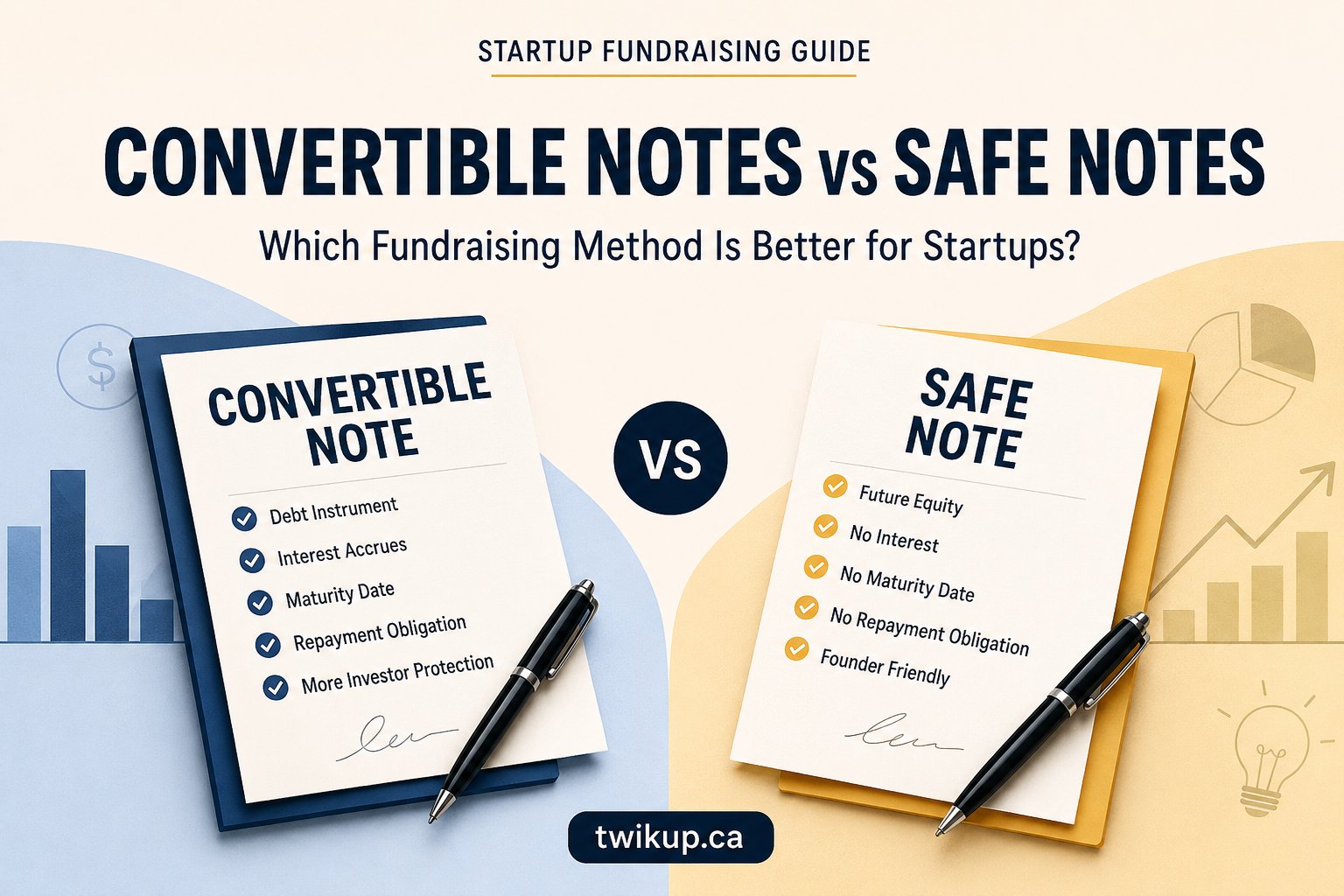
| Feature | SAFE Note | Convertible Note |
|---|---|---|
| Debt? | No | Yes |
| Interest? | No | Usually Yes |
| Maturity Date? | No | Yes |
| Repayment Risk? | No | Potentially |
| Complexity | Low | Moderate |
| Legal Costs | Lower | Higher |
| Founder Friendly | Usually | Sometimes |
| Investor Protection | Lower | Higher |
This single difference often determines which structure gets chosen.
Example: Raising $100,000
Imagine a startup raises:
$100,000
before determining an official valuation.
SAFE Structure
Investor receives future shares when the next funding round occurs.
No interest accumulates.
No repayment schedule exists.
The startup focuses entirely on growth.
Convertible Note Structure
Investor lends $100,000.
Interest accumulates annually.
If conversion doesn't happen before maturity, repayment terms may become relevant.
The legal structure becomes more complex.
Why Many Startups Prefer SAFE Notes
SAFE Notes have become extremely popular among:
- SaaS startups
- AI startups
- Tech startups
- Marketplace businesses
- Seed-stage companies
Reasons include:
Simpler Documents
Less legal work.
Less negotiation.
Lower legal fees.
Faster Fundraising
Deals often close much faster.
Founder Focus
Founders spend more time building products instead of managing debt obligations.
No Maturity Date
There is no ticking clock forcing a conversion event.
Why Some Investors Still Prefer Convertible Notes
Many angel investors and traditional investors still favor Convertible Notes.
Why?
Because they provide additional protection.
Interest Accrual
The investment grows over time.
Maturity Protection
Investors are protected if a startup delays fundraising indefinitely.
Stronger Negotiating Position
Investors may gain leverage if conversion does not occur.
From the investor perspective, this can reduce risk.
Situations Where SAFE Notes Usually Make Sense
SAFE Notes are often ideal when:
- The startup is pre-revenue
- The valuation is difficult to determine
- The raise is relatively small
- The company wants minimal legal costs
- Investors are familiar with startup investing
Common range:
$25,000–$500,000 seed raises.
Situations Where Convertible Notes May Be Better
Convertible Notes may make more sense when:
- Investors demand stronger protections
- The funding amount is large
- Multiple institutional investors are involved
- The startup has a longer fundraising timeline
- Investors are uncomfortable using SAFEs
Common Founder Mistakes
Mistake #1: Thinking SAFE Means No Dilution
SAFE investors eventually convert into equity.
Dilution still happens.
Many founders underestimate how much ownership they will lose.
Before raising capital, understand dilution by reading:
How Startup Dilution Works https://twikup.ca/money/investing/how-startup-dilution-works-what-happens-when-investors-buy-equity
Mistake #2: Ignoring the Cap Table
Multiple SAFEs can create future surprises.
Always model ownership scenarios.
Learn more here:
How Startup Cap Tables Work https://twikup.ca/money/investing/how-startup-cap-tables-work-and-why-founders-must-understand-them
Mistake #3: Accepting Terms You Don't Understand
Many founders focus only on valuation caps.
But conversion mechanics can be equally important.
Never sign fundraising documents without understanding:
- Conversion triggers
- Dilution effects
- Investor rights
- Future fundraising implications
SAFE vs Convertible Notes: Founder Perspective
If your goal is:
- Speed
- Simplicity
- Lower legal costs
- Reduced administrative burden
SAFE Notes often win.
If your investors require:
- Additional protection
- Debt structure
- Maturity safeguards
Convertible Notes may be necessary.
Key Takeaways
✔ SAFE Notes are generally simpler.
✔ Convertible Notes are technically debt.
✔ SAFE Notes have no interest.
✔ Convertible Notes usually accumulate interest.
✔ SAFE Notes have no maturity date.
✔ Convertible Notes usually have maturity deadlines.
✔ Most early-stage startups now favor SAFEs.
✔ Investor preferences often determine which option gets used.
✔ Always model dilution before raising money.
✔ Understand conversion terms before signing anything.
Twikup Insight
Many founders spend enormous effort negotiating valuation while completely ignoring fundraising structure.
In reality, the structure can matter just as much as the valuation.
A founder who raises at a slightly lower valuation using founder-friendly SAFE terms may end up in a stronger long-term position than a founder who accepts a higher valuation with restrictive Convertible Note provisions.
Before signing any fundraising agreement, understand how the instrument affects ownership, control, dilution, and future fundraising flexibility.
The smartest founders don't just ask:
"How much money am I raising?"
They also ask:
"What am I giving away in exchange for that money?"
That question often determines the long-term outcome of the company.
Final Verdict
For most early-stage startups in 2026:
SAFE Notes are usually the preferred fundraising instrument because they are simpler, faster, and less expensive.
However, Convertible Notes remain valuable when investors require stronger protections or when fundraising situations become more complex.
The best founders understand both—and choose the structure that aligns with their company's stage, investors, and future plans.