
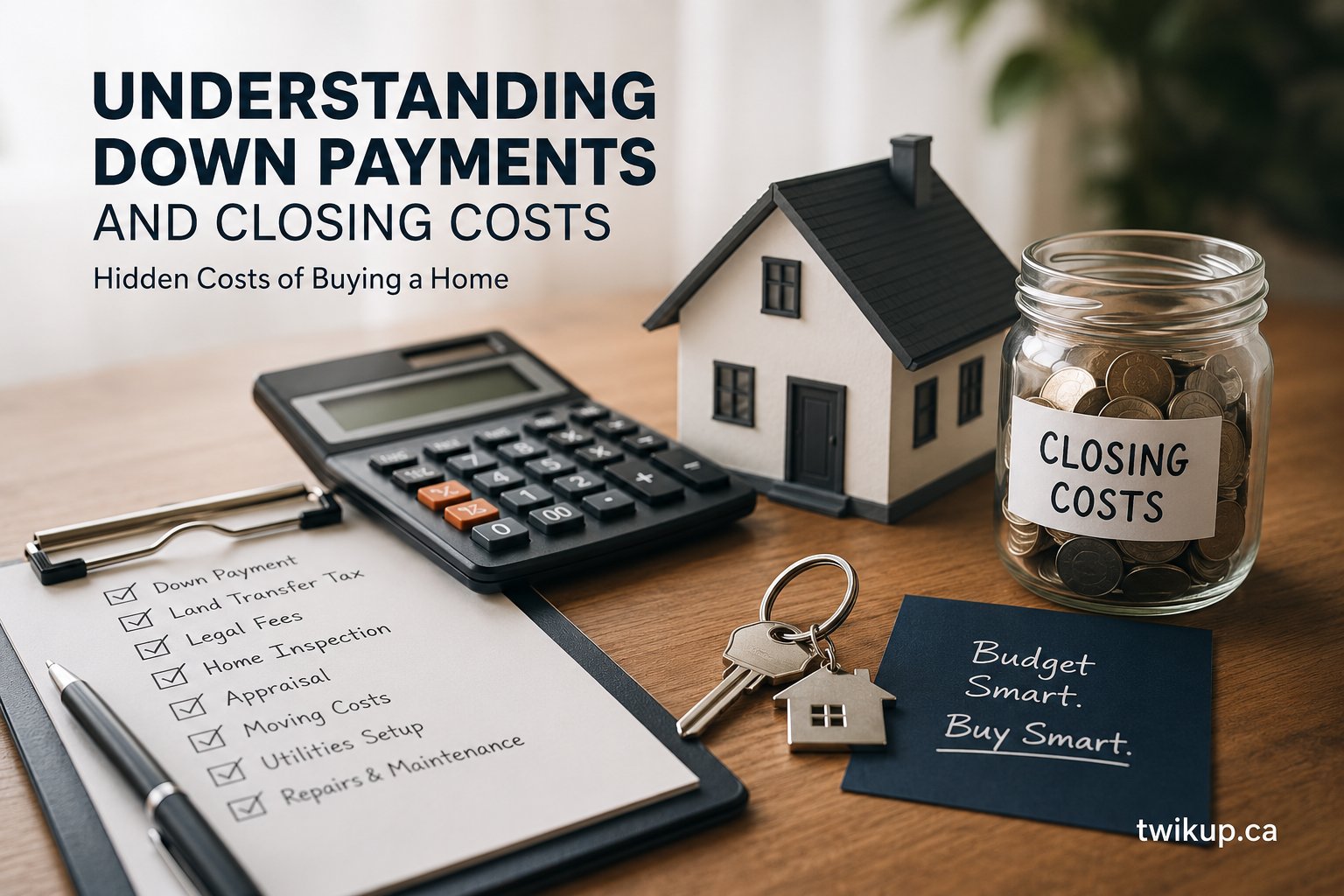
Part 3 of Twikup's First-Time Home Buyer Education Series
Buying a home is one of the biggest financial decisions most Canadians will ever make.
Many buyers spend months saving for a down payment, getting mortgage pre-approval, and searching for the perfect property.
Then reality hits.
A significant number of first-time buyers discover there are thousands of dollars in additional expenses beyond the home's purchase price.
These costs often arrive just days before closing and can create financial stress if they are not planned for in advance.
In this guide, we'll break down the true upfront costs of buying a home in Canada, explain how down payments work, and reveal the hidden expenses many buyers overlook.
Before You Continue
If you're new to this series, start with:
Part 1: Step-by-Step Guide to Buying Your First Home in Canada (2026 Complete Beginner's Roadmap)
Part 2: How to Get Mortgage Pre-Approval in Canada (The Critical Step Most Homebuyers Skip)
These guides explain the home buying process and mortgage pre-approval before you begin calculating your purchase budget.
Quick Answer
When buying a home in Canada, you need more money than just your down payment.
Most buyers should budget:
- Down payment
- Land transfer taxes
- Legal fees
- Home inspection fees
- Title insurance
- Appraisal costs
- Moving expenses
- Utility setup costs
- Emergency repair fund
A good rule of thumb is to keep an additional 1.5% to 4% of the home's purchase price available for closing costs.
What Is a Down Payment?
A down payment is the portion of the home's purchase price that you pay upfront.
The mortgage lender finances the remaining amount.
Example
Home Price: $600,000
Down Payment: $60,000
Mortgage Required: $540,000
The larger your down payment, the smaller your mortgage balance and future interest costs.
Minimum Down Payment Requirements in Canada
The minimum down payment depends on the purchase price of the property.
| Home Price | Minimum Down Payment |
|---|---|
| Up to $500,000 | 5% |
| $500,000 to $1.5 Million | 5% on first $500,000 plus 10% on remaining amount |
| Above $1.5 Million | 20% minimum |
Example
For a $700,000 home:
- First $500,000 = 5% ($25,000)
- Remaining $200,000 = 10% ($20,000)
Minimum Down Payment = $45,000
Why a Larger Down Payment Matters
Many buyers focus only on qualifying for the mortgage.
However, increasing your down payment can provide major long-term benefits.
Lower Monthly Payments
Borrow less money and reduce your monthly mortgage obligations.
Less Interest Paid
A smaller mortgage balance means less interest over the life of the loan.
Better Financial Flexibility
Lower payments create more room in your monthly budget.
Avoid Mortgage Insurance
If your down payment reaches 20% or more, you typically avoid mortgage default insurance premiums.
What Is Mortgage Default Insurance?
If your down payment is less than 20%, Canadian lenders generally require mortgage default insurance.
This protects the lender—not the borrower.
The premium is usually added to your mortgage balance.
Many first-time buyers are surprised to discover that this cost can add several thousand dollars to their total borrowing amount.
The Hidden Costs Most Buyers Forget
The purchase price is only part of the story.
Here are the expenses that frequently catch buyers off guard.
1. Land Transfer Tax
This is often the largest closing cost.
Several provinces charge a land transfer tax when ownership changes hands.
Depending on the property's value and location, the amount can range from a few thousand dollars to tens of thousands.
Some first-time homebuyers may qualify for rebates.
Always verify local rules before purchasing.
2. Legal Fees
A real estate lawyer handles:
- Property transfer
- Mortgage registration
- Title review
- Closing documentation
Legal costs typically range from several hundred to several thousand dollars depending on the transaction.
3. Home Inspection
Skipping an inspection may save money upfront but can become extremely expensive later.
A professional inspection can reveal:
- Roof issues
- Foundation problems
- Water damage
- Electrical concerns
- HVAC defects
This is one of the most valuable investments during the buying process.
4. Title Insurance
Title insurance protects homeowners against certain legal and ownership-related risks.
Many lenders require it.
Although often overlooked, it is a standard closing expense in many transactions.
5. Property Appraisal
Some lenders require an appraisal to confirm the property's market value.
The buyer may be responsible for this cost.
6. Moving Expenses
The cost of moving can quickly add up.
Consider:
- Movers
- Truck rentals
- Storage
- Packing supplies
- Travel expenses
Many buyers underestimate this category.
7. Utility Setup Fees
New homeowners may need to pay:
- Electricity connection fees
- Water account setup fees
- Internet installation
- Gas service activation
These small expenses can add up quickly.
8. Immediate Repairs and Maintenance
Even newly purchased homes often require:
- Paint
- Minor repairs
- Appliance replacements
- Landscaping
- Furniture purchases
A separate emergency fund can prevent financial stress after move-in.
Example: Total Upfront Cost on a $700,000 Home
| Expense | Estimated Cost |
|---|---|
| Down Payment | $45,000 |
| Legal Fees | $1,500 |
| Home Inspection | $600 |
| Title Insurance | $400 |
| Appraisal | $400 |
| Land Transfer Tax | Varies |
| Moving Costs | $2,000 |
| Emergency Repair Fund | $3,000+ |
Total cash required can be significantly higher than the down payment alone.
This is why financial preparation matters.
Common Mistakes First-Time Buyers Make
Spending Every Dollar on the Down Payment
Many buyers leave themselves with no emergency fund.
Ignoring Closing Costs
Unexpected expenses can delay closing or create financial strain.
Underestimating Moving Costs
Moving expenses are frequently higher than expected.
Not Budgeting for Repairs
Even well-maintained homes often need updates.
Buying at the Maximum Mortgage Approval
Approval does not always equal affordability.
Key Takeaways
- The down payment is only one part of the upfront cost of buying a home.
- Closing costs can add thousands of dollars to the transaction.
- Most buyers should reserve an additional 1.5%–4% of the home's purchase price.
- Legal fees, land transfer taxes, inspections, and moving costs are commonly overlooked.
- Maintaining an emergency fund after closing is essential.
Twikup Insight
One of the biggest mistakes first-time buyers make is assuming that mortgage approval means they are financially ready to buy a home.
In reality, successful homeownership starts long before move-in day.
The buyers who experience the least stress are usually the ones who plan for every dollar—not just the down payment.
At Twikup, we believe financial preparation is often more important than finding the perfect property. Understanding your true upfront costs can help you avoid surprises, protect your savings, and start homeownership with confidence.
In Part 4 of this series, we'll cover one of the most important questions every buyer asks:
"How Much House Can You Actually Afford?"
The answer is often very different from what the bank says you can afford.