
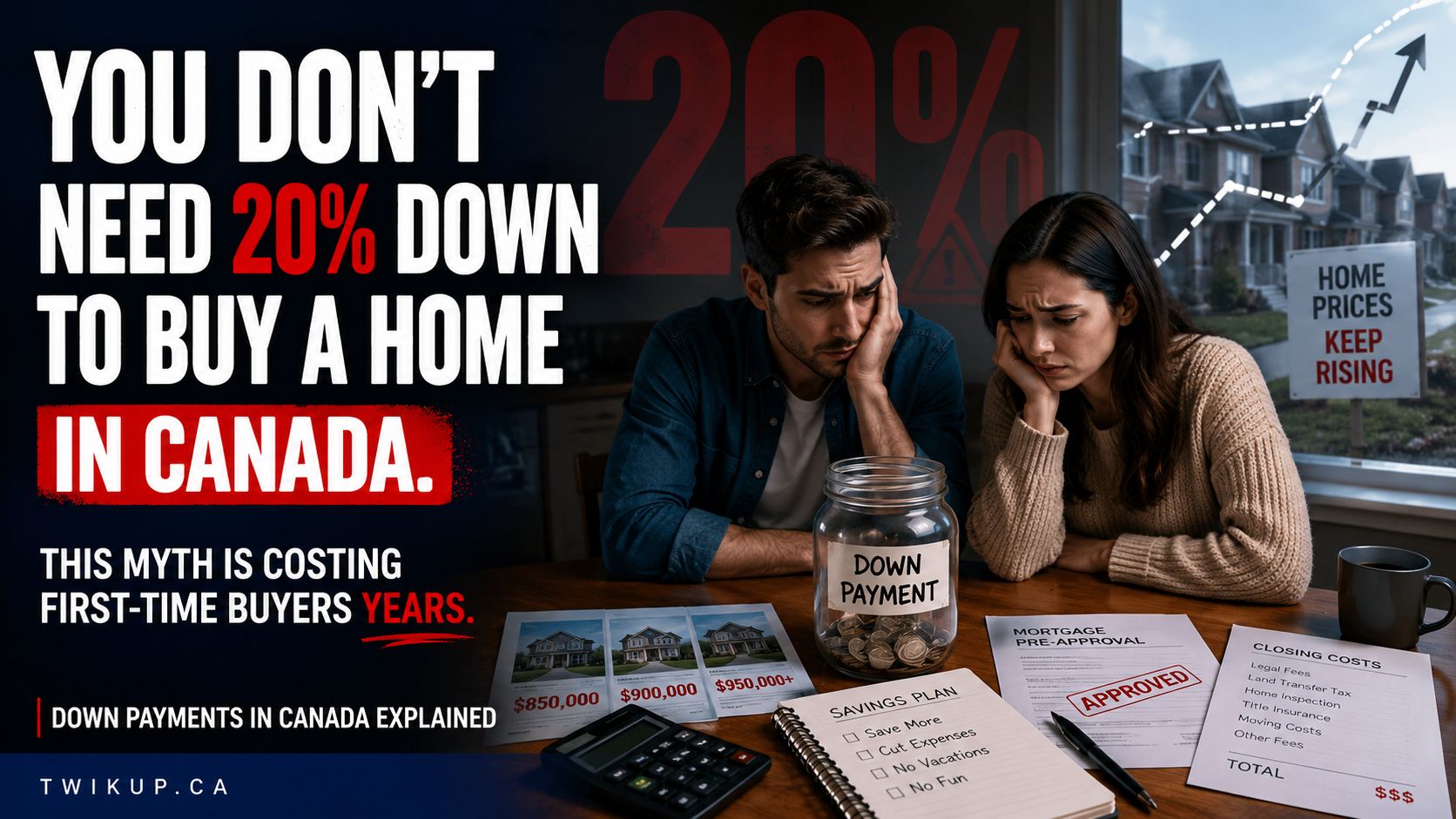
Down Payments in Canada Explained (2026): How Much Do You Really Need to Buy a Home?
Part 5 of Twikup's Canadian Mortgage Education Series
If you're joining this series for the first time, start with these guides:
Part 1: What Is a Mortgage and How Does It Work in Canada? (2026 Guide) https://twikup.ca/money/mortgages/what-is-a-mortgage-and-how-does-it-work-in-canada-2026-guide
Part 2: How Much House Can You Really Afford in Canada? Most Buyers Get This Wrong https://twikup.ca/money/mortgages/how-much-house-can-you-really-afford-in-canada-most-buyers-get-this-wrong
Part 3: How to Get Mortgage Pre-Approval in Canada (2026 Guide) https://twikup.ca/money/mortgages/how-to-get-mortgage-pre-approval-in-canada-2026-guide-the-critical-step-most-homebuyers-skip
Quick Answer
The minimum down payment required in Canada depends on the home's purchase price:
| Home Price | Minimum Down Payment |
|---|---|
| Up to $500,000 | 5% |
| $500,000 to $1.5 Million | 5% on first $500,000 plus 10% on the remaining amount |
| $1.5 Million+ | 20% minimum |
A larger down payment can reduce mortgage costs, lower monthly payments, and eliminate mortgage insurance requirements.
Why Down Payments Matter More Than Most Buyers Realize
Many first-time buyers focus entirely on mortgage rates.
However, the size of your down payment affects:
- Whether you qualify for a mortgage
- Your monthly payment
- Total interest paid over time
- Mortgage insurance costs
- Overall affordability
A larger down payment doesn't just help you get approved—it can save tens of thousands of dollars over the life of your mortgage.
What Is a Down Payment?
A down payment is the portion of a home's purchase price that you pay upfront using your own funds.
The mortgage lender finances the remaining balance.
Example
Home Price: $600,000
Down Payment: $50,000
Mortgage Amount: $550,000
The larger the down payment, the smaller the mortgage you'll need.
Minimum Down Payment Rules in Canada (2026)
Canada has federally regulated minimum down payment requirements.
Homes Up To $500,000
Minimum required:
5%
Example:
| Home Price | Minimum Down Payment |
|---|---|
| $400,000 | $20,000 |
| $500,000 | $25,000 |
Homes Between $500,000 and $1.5 Million
You need:
- 5% on the first $500,000
- 10% on the amount above $500,000
Example:
Home Price: $800,000
Calculation:
- First $500,000 × 5% = $25,000
- Remaining $300,000 × 10% = $30,000
Minimum Down Payment:
$55,000
Homes Above $1.5 Million
Minimum required:
20%
Example:
| Home Price | Down Payment Required |
|---|---|
| $1.6 Million | $320,000 |
| $2 Million | $400,000 |
The Biggest Myth: "You Need 20% Down"
Many Canadians delay buying because they believe they must save 20%.
This is false.
Many buyers purchase homes with:
- 5% down
- 10% down
- 15% down
The tradeoff is mortgage insurance.
What Happens If You Put Less Than 20% Down?
When your down payment is below 20%, your mortgage is considered a high-ratio mortgage.
You'll typically need mortgage default insurance.
This insurance protects the lender—not the borrower.
The insurance premium gets added to your mortgage balance.
Example of Mortgage Insurance Impact
Home Price: $600,000
Down Payment: 5% ($30,000)
Mortgage Amount: $570,000
Mortgage Insurance Premium:
Approximately $22,000+
Instead of borrowing $570,000, you may end up financing roughly $592,000 after insurance is added.
This increases:
- Monthly payments
- Interest costs
- Total borrowing expense
Is It Better To Wait Until You Have 20%?
Not always.
This depends on:
- Home price growth
- Rent costs
- Interest rates
- Your income growth
- Local housing market conditions
Example
If a home worth $600,000 today rises to $700,000 while you're saving for a larger down payment, you may end up chasing a moving target.
Sometimes buying earlier can make financial sense.
Sometimes waiting is smarter.
Every situation is different.
Where Can Your Down Payment Come From?
Canadian lenders typically accept:
Personal Savings
The most straightforward option.
RRSP Home Buyers' Plan (HBP)
Eligible first-time buyers can withdraw funds from an RRSP to help purchase a home.
Tax-Free Savings Account (TFSA)
Many Canadians use TFSA savings for their down payment.
Gifted Funds
Parents or family members can often provide gifted down payment funds.
Lenders generally require a signed gift letter confirming repayment is not expected.
Investments
Stocks, ETFs, GICs, mutual funds, and other investments can also be used once converted into cash.
Hidden Costs Buyers Forget
One of the most common mistakes is spending every dollar on the down payment.
You also need money for closing costs.
These may include:
- Legal fees
- Land transfer tax
- Title insurance
- Home inspection
- Property tax adjustments
- Utility setup fees
- Moving expenses
A common rule is to reserve approximately 1.5%–4% of the home's purchase price for closing costs.
Down Payment Examples Across Canada
Example 1
Home Price: $450,000
Minimum Down Payment:
$22,500
Example 2
Home Price: $750,000
Minimum Down Payment:
$50,000
Example 3
Home Price: $1,000,000
Minimum Down Payment:
$75,000
Example 4
Home Price: $1,600,000
Minimum Down Payment:
$320,000
Common Down Payment Mistakes
1. Emptying Your Entire Savings Account
Always keep an emergency fund.
Homeownership often comes with unexpected expenses.
2. Ignoring Closing Costs
Many buyers save enough for the down payment but not enough to complete the transaction.
3. Assuming 20% Is Mandatory
This myth delays many first-time buyers unnecessarily.
4. Focusing Only on Approval
Getting approved doesn't automatically mean the home is affordable.
Review monthly cash flow carefully.
5. Not Understanding Mortgage Insurance
A smaller down payment can significantly increase long-term borrowing costs.
How Much Down Payment Should You Aim For?
While the minimum may be 5%, many financial professionals suggest aiming for:
- 10% if possible
- 15% if achievable
- 20% if practical
Benefits include:
- Lower monthly payments
- Reduced interest costs
- Greater home equity
- Improved financial flexibility
- No mortgage insurance requirement at 20%+
Key Takeaways
- Canada does not always require a 20% down payment.
- Many homes can be purchased with as little as 5% down.
- Down payment requirements vary based on property value.
- Less than 20% usually means mortgage insurance costs.
- Buyers must budget for closing costs in addition to the down payment.
- The "right" down payment depends on your financial situation, not just the minimum rules.
Twikup Insight
The biggest mistake first-time buyers make is focusing entirely on saving the largest possible down payment while ignoring affordability, cash flow, and future costs.
A buyer who understands mortgage payments, closing costs, emergency savings, and long-term financial flexibility is often in a stronger position than someone who simply saves the largest down payment possible.
At Twikup, we believe successful homeownership is not about buying the most expensive home you qualify for—it's about buying a home you can comfortably afford for years to come.
In the next part of our Mortgage Education Series, we'll explore one of the most misunderstood topics in Canadian real estate:
Fixed vs Variable Mortgage Rates: Which Is Better in 2026?