
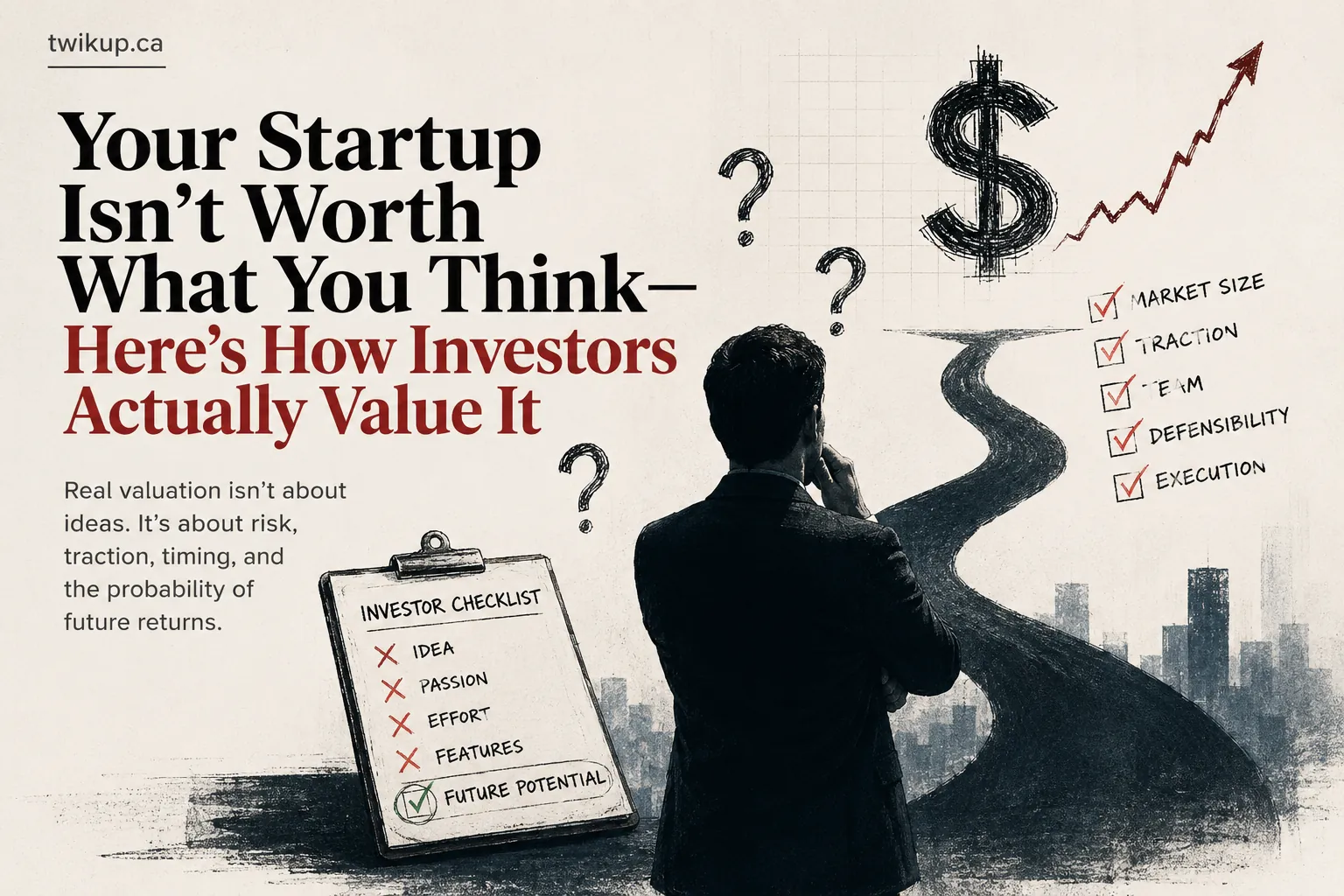
Your Startup Isn't Worth What You Think—Here's How Investors Actually Value It (2026 Founder Guide)
Quick Answer: Most founders overestimate what their startup is worth because they value the idea, while investors value the probability of generating future returns. In early-stage startups, valuation depends less on revenue and more on factors such as market size, traction, team quality, defensibility, execution ability, competitive landscape, and funding risk. A realistic valuation increases your chances of raising capital while preserving long-term founder ownership.
Your Startup Isn't Worth What You Think—Here's How Investors Actually Value It
One of the biggest surprises for first-time founders is discovering that investors don't value startups the same way founders do.
You've spent months—or even years—building your product.
You've hired a team.
You've invested your own savings.
Friends tell you your company could become the next billion-dollar startup.
Then an investor tells you your company is worth one-quarter of what you expected.
It feels unfair.
But from an investor's perspective, it often makes perfect sense.
Startup valuation isn't about rewarding effort.
It's about pricing uncertainty.
Understanding how investors actually think about valuation can dramatically improve your fundraising conversations, help you avoid unnecessary dilution, and increase your credibility during negotiations.
Why Most Founders Overvalue Their Startup
Founders naturally become emotionally attached to what they've built.
That emotional investment often leads to inflated expectations.
Many founders base valuation on:
- Time spent building the company
- Personal financial investment
- Product development costs
- Number of features
- Competitor headlines
- Unicorn success stories
Unfortunately, none of these determine market value.
Investors don't buy your past effort.
They buy future potential—and the likelihood of achieving it.
The Question Investors Actually Ask
Instead of asking:
"How much work has this founder done?"
Investors ask:
"If I invest today, what are the realistic chances this company becomes significantly more valuable?"
That single shift changes everything.
Startup Valuation Is About Risk
Think of valuation as the price of uncertainty.
The lower the risk, the higher the valuation.
The higher the risk, the lower the valuation.
Early-stage companies carry enormous uncertainty.
Questions investors are trying to answer include:
- Can the founders execute?
- Does the market truly need this?
- Can competitors copy it?
- Will customers actually pay?
- Can the company scale?
- How much additional capital will be needed?
- Can the founders build a world-class team?
- Is the market large enough?
Until these questions are answered, investors price risk conservatively.
What Actually Determines Startup Valuation?
Rather than relying on a single formula, investors usually evaluate several dimensions together.
1. Market Size (TAM)
A fantastic company in a tiny market rarely becomes a venture-scale investment.
Investors prefer startups addressing markets capable of producing very large businesses.
Typical questions include:
- How many customers exist?
- How fast is the market growing?
- Is this a global opportunity?
- Can revenue reach hundreds of millions—or even billions?
Large markets create room for exceptional returns.
2. Founder Quality
At the earliest stages, founders are often the biggest investment.
Investors assess:
- Industry expertise
- Domain knowledge
- Technical capability
- Leadership
- Hiring ability
- Adaptability
- Coachability
- Resilience
Many investors would rather back an exceptional founder with an average idea than the reverse.
3. Traction
Traction reduces uncertainty.
Examples include:
- Paying customers
- Revenue growth
- Active users
- Customer retention
- Waitlists
- Strategic partnerships
- Pilot programs
- Enterprise contracts
- Letters of intent (LOIs)
Even modest traction can significantly strengthen valuation discussions because it provides evidence that customers see value.
4. Product-Market Fit
Investors look for signs that customers genuinely need the product.
Indicators include:
- High user retention
- Organic referrals
- Increasing usage
- Positive customer feedback
- Low churn
- Repeat purchases
A startup with strong product-market fit often commands a premium because demand is less speculative.
5. Competitive Advantage
Investors ask:
Why won't a larger company simply copy this?
Potential advantages include:
- Proprietary technology
- Patents
- Strong brand
- Network effects
- Exclusive partnerships
- Regulatory advantages
- High switching costs
- Unique data assets
The harder it is to replicate your business, the stronger your position.
6. Business Model
Revenue quality matters as much as revenue quantity.
Investors evaluate:
- Gross margins
- Customer acquisition cost (CAC)
- Customer lifetime value (LTV)
- Recurring revenue
- Pricing power
- Profit potential
- Scalability
Predictable, repeatable revenue streams generally receive higher valuations.
7. Growth Rate
Rapid growth often has a larger impact than current revenue.
For example:
Startup A
- $2 million annual revenue
- 15% annual growth
Startup B
- $500,000 annual revenue
- 250% annual growth
Many venture investors may find Startup B more attractive because its future upside appears greater.
Twikup Insight 💡
The best founders don't try to "win" the valuation conversation.
They reduce investor uncertainty.
Every new customer, successful product launch, strategic partnership, pilot project, or measurable milestone lowers perceived risk—and stronger valuations often follow naturally.
Focus on building evidence, not just telling a compelling story.
How Investors Estimate Valuation Before Revenue
Pre-revenue startups rarely have traditional financial metrics.
Instead, investors often consider:
- Founder experience
- Prototype quality
- Market opportunity
- Early customer validation
- Competitive landscape
- Technology differentiation
- Capital requirements
- Comparable funding rounds
If you want a deeper explanation of how early-stage companies are priced before generating meaningful revenue, read:
How Startup Valuations Actually Work Before Revenue https://twikup.ca/money/investing/how-startup-valuations-actually-work-before-revenue
This guide explains the practical methods investors commonly use when financial statements alone cannot determine value.
Why Comparable Startups Can Have Different Valuations
Imagine two AI startups.
Both have:
- Similar products
- Similar funding needs
- Similar industries
Yet one receives a $4 million valuation while another secures $12 million.
Why?
Possible differences include:
- Stronger founding team
- Faster growth
- Better customer retention
- Larger market
- Better timing
- Higher-quality investors
- Lower execution risk
- Stronger competitive positioning
Valuation reflects the complete picture—not a single metric.
The Cost of Overvaluing Your Startup
An unrealistic valuation can create serious problems.
It may lead to:
- Longer fundraising cycles
- Fewer investor meetings
- Reduced credibility
- More difficult negotiations
- Missed opportunities
- Future down rounds
- Damaged employee morale
A slightly lower valuation that attracts the right investors is often better than holding out for an unrealistic number and failing to raise capital.
The Cost of Undervaluing Your Startup
The opposite can also hurt founders.
Selling too much equity early may:
- Reduce founder ownership
- Limit future fundraising flexibility
- Affect employee option pools
- Reduce long-term incentives
- Make later financing more complicated
Finding the right balance matters more than chasing the highest possible valuation.
Investors Don't Buy Ideas—They Buy Probability
Founders often think:
"Our idea could become a billion-dollar company."
Investors think:
"What's the probability that this team actually gets there?"
That probability determines valuation.
Every milestone you achieve increases confidence.
Greater confidence often leads to stronger valuations over time.
Valuation Doesn't End After Your First Round
Every funding round becomes a new valuation event.
Investors continuously monitor:
- Revenue growth
- Customer retention
- Team expansion
- Market conditions
- Product innovation
- Competitive position
- Operational execution
A strong first round doesn't guarantee future success.
Execution remains the ultimate driver of value.
Common Valuation Mistakes Founders Make
Avoid these frequent mistakes:
- Pricing based on emotion instead of evidence
- Comparing yourself only to unicorn headlines
- Ignoring market conditions
- Overlooking dilution across multiple funding rounds
- Focusing on valuation while ignoring investor quality
- Assuming product features equal company value
- Treating funding as validation rather than fuel for growth
Raising Capital Starts Long Before Valuation
Many founders focus heavily on valuation while overlooking the fundamentals that influence it.
Investors often decline opportunities because the overall investment case isn't convincing—not simply because of the asking price.
If you're preparing to raise capital, these guides can help strengthen your approach:
Why Investors Say "No" Even When They Like Your Startup https://twikup.ca/money/investing/why-investors-say-no-even-when-they-like-your-startup
You'll learn why promising startups still fail to secure funding and how to avoid the most common red flags.
And before presenting your company to investors, it's worth understanding why otherwise good pitches fail:
Why Most Startup Pitches Fail Even When the Idea Is Good https://twikup.ca/money/investing/why-most-startup-pitches-fail-even-when-they-like-your-startup
Improving your fundraising story can often influence investor confidence just as much as improving the product itself.
Key Takeaways
✅ Startup valuation reflects future potential—not past effort.
✅ Investors primarily price risk and probability.
✅ Market size, founders, traction, growth, defensibility, and execution matter more than development costs.
✅ Strong evidence consistently increases valuation more than ambitious projections.
✅ A realistic valuation can improve fundraising outcomes while protecting long-term founder ownership.
Final Thoughts
Valuation is not a reward for hard work.
It is the market's estimate of future opportunity under uncertainty.
The founders who consistently secure strong valuations aren't necessarily those with the biggest ideas—they're the ones who systematically reduce risk through execution, customer validation, and measurable progress.
Instead of asking, "How can I justify a higher valuation?", consider asking, "What evidence can I build over the next six months that makes investors more confident?"
That shift in mindset can improve not only your next fundraising round, but the long-term value of your company as well.
Frequently Asked Questions (FAQ)
Do investors value startups based on revenue alone?
No. Especially in early-stage investing, revenue is only one factor. Investors also consider the founding team, market opportunity, traction, product-market fit, competitive advantage, and execution potential.
Can a pre-revenue startup have a high valuation?
Yes. If it operates in a large market, has strong founders, meaningful customer validation, proprietary technology, or exceptional growth potential, investors may assign a relatively high valuation despite limited revenue.
Should founders always negotiate for the highest valuation?
Not necessarily. An excessively high valuation can make future fundraising more difficult if the company doesn't meet growth expectations. Many experienced founders prioritize long-term partnerships and sustainable growth over maximizing the initial valuation.
What is the biggest mistake founders make during valuation discussions?
Many founders focus on what they believe the company deserves instead of presenting objective evidence that reduces investor risk. Investors generally value proof of execution more than optimistic projections.