
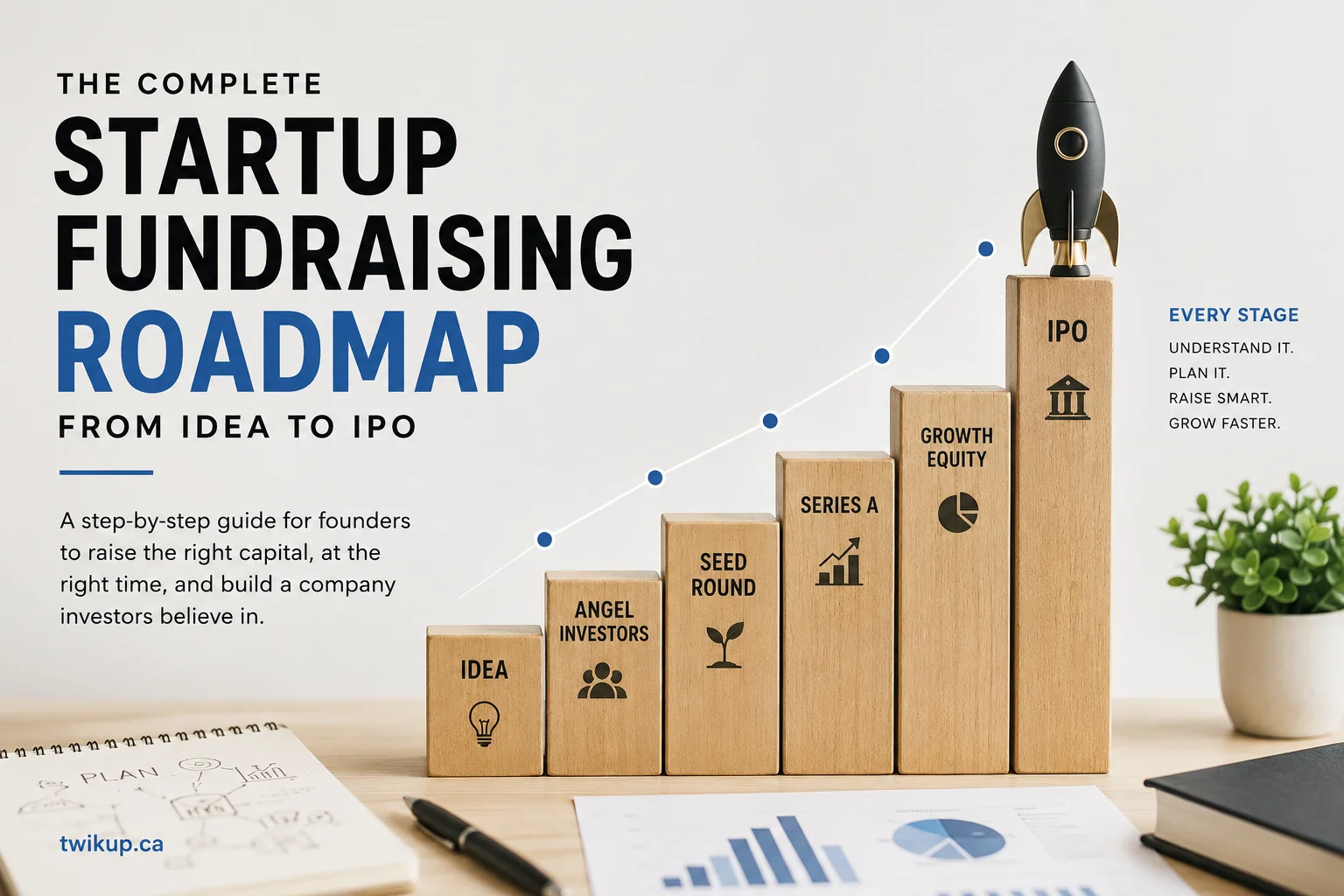
The Complete Startup Fundraising Roadmap: From Idea to IPO
Building a startup is difficult.
Raising money is often even harder.
Many first-time founders focus only on getting their first cheque, but experienced entrepreneurs think much further ahead. Every funding round affects future fundraising, ownership, investor expectations, hiring decisions, exit opportunities, and ultimately whether founders remain in control of their company.
The companies that eventually become billion-dollar businesses rarely stumble into success. They typically follow a structured fundraising path—raising the right capital at the right time while achieving the milestones investors expect at each stage.
This guide brings together the complete fundraising journey, explaining how startups evolve from an idea into companies capable of going public through an IPO or being acquired for billions.
Whether you're launching your first startup or preparing for institutional funding, this roadmap will help you understand the entire journey.
Startup Fundraising Timeline
Idea
↓

Bootstrapping
↓

Friends & Family

↓

Angel Investors

↓

SAFE / Convertible Notes

↓

Pre-Seed

↓

Seed Round

↓

Series A

↓

Series B

↓

Series C+

↓

Growth Equity

↓

IPO or Acquisition
Each stage has different goals, different investors and different expectations.
Let's explore them one by one.
Stage 1 — The Idea Stage
Every successful startup begins with a problem.
Not with funding.
Investors don't invest because someone has an interesting idea.
They invest because someone has identified a valuable problem and has a credible plan to solve it.
Before thinking about raising money, founders should validate:
- Is the problem real?
- Who experiences it?
- How painful is it?
- Will customers pay?
- Is the market large enough?
At this point, founders should spend more time talking to customers than investors.
What investors expect
At this stage:
- Market research
- Customer interviews
- Early validation
- Founder expertise
- Clear vision
Not revenue.
Not profits.
Not perfection.
Stage 2 — Bootstrapping
Many successful startups begin without outside funding.
Bootstrapping means using:
- Personal savings
- Revenue
- Side income
- Consulting income
- Small business earnings
Companies like Mailchimp and Basecamp proved that venture capital isn't the only path to building valuable businesses.
Bootstrapping forces founders to focus on customers instead of investors.
Advantages
- 100% ownership
- Full control
- No dilution
- Faster decisions
- Customer-first mindset
Challenges
- Slower growth
- Limited hiring
- Limited marketing budget
- Higher personal financial risk
Stage 3 — Friends and Family Funding
Once founders have early validation, many raise their first external capital from people who already trust them.
These investors usually back:
- the founder
- the vision
- the commitment
rather than financial metrics.
Amounts typically range from a few thousand dollars to several hundred thousand dollars.
Common mistake
Treating family investments casually.
Always document:
- ownership
- repayment terms
- investment agreements
Professional paperwork avoids future disputes.
Stage 4 — Angel Investors
Once founders have evidence that customers actually want the product, angel investors often become the first professional investors.
Angels typically invest because they believe in:
- founders
- market opportunity
- early traction
rather than mature financial performance.
If you're deciding whether angels or venture capital firms are the better fit, read our detailed comparison:
Angel Investors vs Venture Capitalists: Which Is Right for Your Startup?
Typical milestones
- MVP launched
- Early users
- Customer feedback
- Initial revenue (optional)
- Growing traction
Stage 5 — SAFE Notes & Convertible Notes
Many startups don't know their valuation yet.
Instead of pricing the company immediately, founders often raise money using:
- SAFE Notes
- Convertible Notes
These defer valuation until a future funding round.
Learn more:
SAFE Notes Explained
https://twikup.ca/money/investing/safe-notes-explained-how-startups-raise-money-before-a-valuation
and
Convertible Notes vs SAFE Notes
Stage 6 — Startup Valuation
One of the biggest misconceptions among first-time founders is believing valuation depends on revenue alone.
In reality, early-stage investors evaluate:
- founder quality
- market size
- product
- traction
- competitive advantage
- execution speed
- future potential
Learn more:
How Startup Valuations Actually Work Before Revenue
https://twikup.ca/money/investing/how-startup-valuations-actually-work-before-revenue
Stage 7 — Seed Round
The Seed round is where startups begin scaling.
Investors now expect evidence that customers genuinely want the product.
Typical expectations include:
- user growth
- retention
- revenue
- customer testimonials
- product-market fit signals
Seed funding usually finances:
- hiring
- marketing
- engineering
- product improvements
Stage 8 — Series A
Series A isn't simply a larger Seed round.
It's a transition from building a product to building a scalable business.
Investors now evaluate:
- repeatable growth
- customer acquisition
- unit economics
- revenue growth
- management team
Read:
Seed Round vs Series A: What Changes for Founders?
https://twikup.ca/money/investing/seed-round-vs-series-a-what-changes-for-founders-2026-guide
Stage 9 — Understanding Dilution
Every funding round means selling ownership.
Many founders underestimate how quickly dilution accumulates.
After several rounds, ownership can decrease significantly.
Understanding dilution early helps founders make smarter fundraising decisions.
Read:
How Startup Dilution Works
https://twikup.ca/money/investing/how-startup-dilution-works-what-happens-when-investors-buy-equity
Stage 10 — Cap Tables
A startup's cap table records who owns what.
As investors, employees and founders receive shares, ownership becomes increasingly complex.
A well-maintained cap table is essential for:
- fundraising
- employee stock options
- acquisitions
- IPO preparation
Read:
How Startup Cap Tables Work
https://twikup.ca/money/investing/how-startup-cap-tables-work-and-why-founders-must-understand-them
Stage 11 — Term Sheets
Before investors wire money, both parties negotiate a term sheet.
It defines:
- valuation
- liquidation preference
- board seats
- voting rights
- anti-dilution provisions
- investor protections
Many founders focus only on valuation while overlooking the legal terms that may matter far more.
Read:
Startup Term Sheets Explained
Stage 12 — Scaling Through Series B and Beyond
Series B funding shifts the conversation.
Investors no longer ask:
"Can this startup succeed?"
Instead they ask:
"How large can this become?"
Capital is used for:
- international expansion
- acquisitions
- leadership hiring
- automation
- infrastructure
- enterprise sales
Stage 13 — Becoming a Unicorn
Only a small percentage of startups reach a valuation above $1 billion.
Unicorns achieve this through:
- massive addressable markets
- exceptional execution
- rapid growth
- investor confidence
- scalable business models
Read:
How Unicorn Startups Reach Billion-Dollar Valuations
https://twikup.ca/money/investing/how-unicorn-startups-reach-billion-dollar-valuations
Stage 14 — The Exit
Every investor eventually expects liquidity.
The two most common exits are:
- Acquisition
- Initial Public Offering (IPO)
However, founders don't always become wealthy after an acquisition.
Liquidation preferences, investor rights and ownership percentages can dramatically reduce founder payouts.
Read:
Why Startup Founders Can Get Nothing After Selling Their Company
https://twikup.ca/money/investing/why-startup-founders-can-get-nothing-after-selling-their-company
Common Fundraising Mistakes
Many startups fail to raise capital because they:
- Raise too early
- Raise too much
- Overvalue the company
- Ignore dilution
- Don't understand term sheets
- Build products nobody wants
- Focus on investors instead of customers
- Spend capital inefficiently
- Ignore financial planning
- Lack a compelling narrative
Avoiding these mistakes significantly improves fundraising success.
Complete Founder Checklist
Before approaching investors, ask yourself:
✅ Have we validated the problem?
✅ Do customers genuinely want our solution?
✅ Is our pitch compelling?
✅ Do we understand valuation?
✅ Have we modelled dilution?
✅ Is our cap table clean?
✅ Have we prepared financial projections?
✅ Do we understand SAFE Notes?
✅ Are we ready for investor due diligence?
✅ Have we identified the right type of investors?
Twikup Insight
The founders who consistently raise capital aren't necessarily those with the best ideas.
They're the ones who understand how investors think at every stage of the journey.
Fundraising isn't about convincing investors to believe in your startup.
It's about systematically reducing risk through customer validation, measurable traction, disciplined execution and smart financial decisions.
The earlier founders understand concepts like valuation, dilution, cap tables, term sheets and investor expectations, the more ownership—and control—they're likely to retain over the life of their company.
Think long-term. Every fundraising decision compounds.
Continue Reading the Complete Startup Fundraising Series
If you'd like to dive deeper into any stage of the fundraising journey, explore these detailed guides:
-
How First-Time Founders Can Raise Their First Investment
https://twikup.ca/money/investing/how-first-time-founders-can-raise-their-first-investment -
What Investors Look For Before Funding a Startup
https://twikup.ca/money/investing/what-investors-look-for-before-funding-a-startup -
Why Most Startup Pitches Fail Even When the Idea Is Good
https://twikup.ca/money/investing/why-most-startup-pitches-fail-even-when-the-idea-is-good -
How to Build a Pitch Deck That Investors Actually Read
https://twikup.ca/money/investing/how-to-build-a-pitch-deck-that-investors-actually-read -
How Startup Valuations Actually Work Before Revenue
https://twikup.ca/money/investing/how-startup-valuations-actually-work-before-revenue -
How Startup Dilution Works
https://twikup.ca/money/investing/how-startup-dilution-works-what-happens-when-investors-buy-equity -
How Startup Cap Tables Work
https://twikup.ca/money/investing/how-startup-cap-tables-work-and-why-founders-must-understand-them -
SAFE Notes Explained
https://twikup.ca/money/investing/safe-notes-explained-how-startups-raise-money-before-a-valuation -
Convertible Notes vs SAFE Notes
https://twikup.ca/money/mortgages/convertible-notes-vs-safe-notes-which-fundraising-method-is-better-for-startups-in-2026 -
Startup Term Sheets Explained
https://twikup.ca/money/investing/startup-term-sheets-explained-the-investment-agreement-every-founder-must-understand -
Why Startup Founders Can Get Nothing After Selling Their Company
https://twikup.ca/money/investing/why-startup-founders-can-get-nothing-after-selling-their-company -
Angel Investors vs Venture Capitalists: Which Is Right for Your Startup?
https://twikup.ca/money/investing/angel-investors-vs-venture-capitalists-which-is-right-for-your-startup -
Seed Round vs Series A: What Changes for Founders?
https://twikup.ca/money/investing/seed-round-vs-series-a-what-changes-for-founders-2026-guide -
How Unicorn Startups Reach Billion-Dollar Valuations
https://twikup.ca/money/investing/how-unicorn-startups-reach-billion-dollar-valuations
Final Thoughts
Every startup dreams of becoming the next unicorn, but successful fundraising is rarely about luck. It is built on preparation, disciplined execution, and understanding what each stage demands. From validating your first idea to navigating dilution, negotiating term sheets, scaling through Series A and beyond, and eventually reaching an IPO or acquisition, each milestone builds on the last.
If you approach fundraising as a long-term strategy instead of a series of isolated funding rounds, you'll make better decisions for your company, your investors, and your future as a founder.