
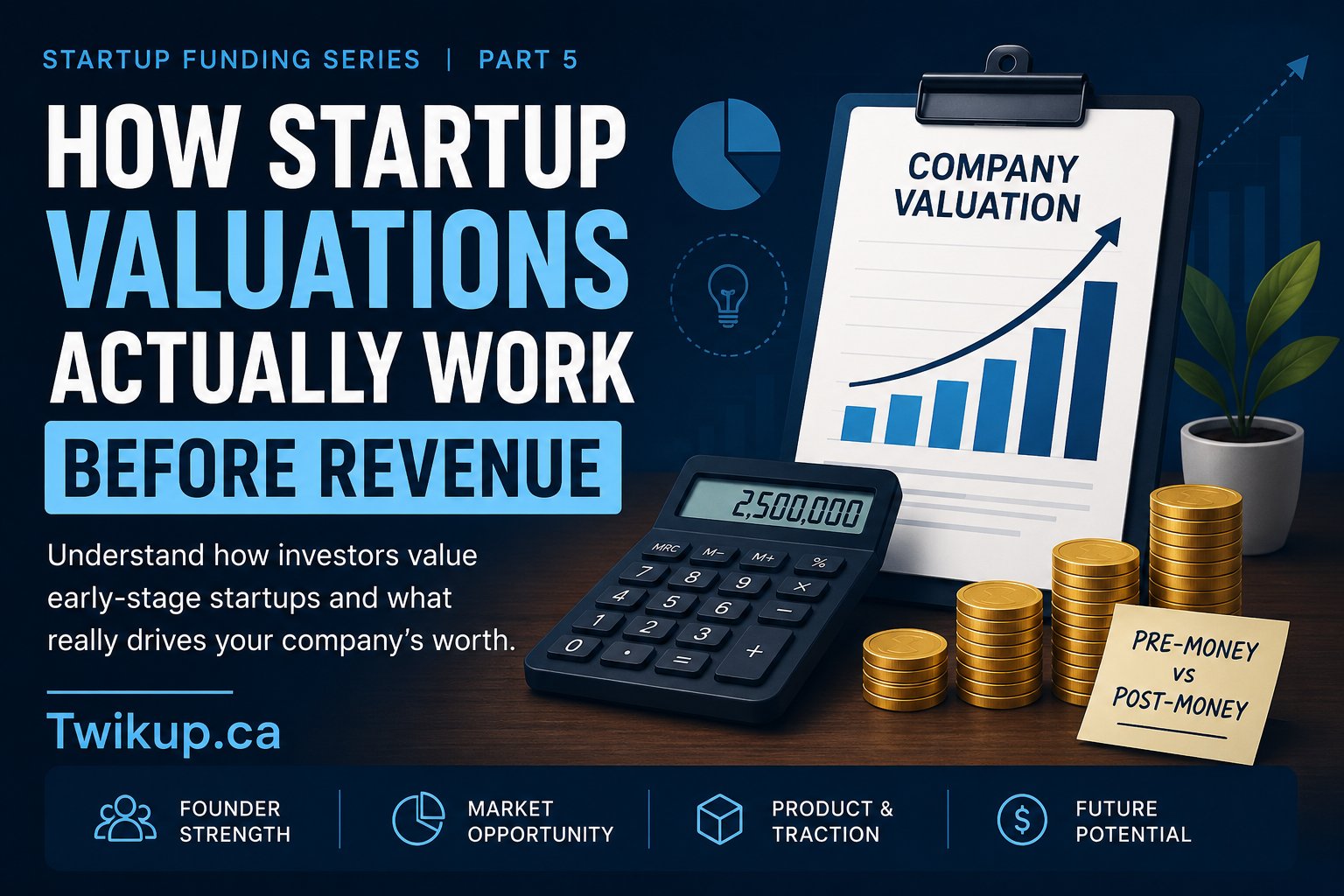
How Startup Valuations Actually Work Before Revenue
Part 5 of TwikUp's Startup Funding Series
After building a pitch deck and beginning investor conversations, many first-time founders encounter a difficult question:
"What is your company worth?"
For early-stage startups that have little or no revenue, answering that question can feel impossible.
Unlike established businesses, startups are often valued based on future potential rather than current financial performance. Investors evaluate the founding team, market opportunity, product traction, and growth prospects when determining how much a company may be worth.
Understanding startup valuations can help founders negotiate more effectively, avoid excessive dilution, and make informed fundraising decisions.
Why Startup Valuation Matters
Valuation directly affects how much ownership founders give away in exchange for investment.
A higher valuation means founders can raise the same amount of capital while giving up less equity.
A lower valuation means investors receive a larger ownership stake for the same investment amount.
For example:
- Startup valuation: $2 million
- Investment raised: $200,000
The investor would receive approximately 10% ownership.
However, if the startup were valued at $1 million, that same $200,000 investment could represent approximately 20% ownership.
This is why valuation discussions are among the most important parts of any fundraising process.
Pre-Money vs Post-Money Valuation
Founders frequently encounter two valuation terms during fundraising.
Pre-Money Valuation
The value of the company before new investment is added.
Example:
- Pre-money valuation: $2 million
- New investment: $500,000
Post-Money Valuation
The value of the company after the investment is added.
Using the example above:
- Pre-money valuation: $2 million
- Investment: $500,000
- Post-money valuation: $2.5 million
The investor would own:
$500,000 ÷ $2.5 million = 20%
Understanding this distinction is essential because misunderstandings can significantly impact founder ownership.
How Investors Value Startups Before Revenue
Early-stage startups rarely have enough financial history for traditional valuation methods.
Instead, investors often focus on qualitative and growth-related factors.
Founder Strength
Many investors back founders as much as ideas.
They evaluate:
- Industry expertise
- Leadership ability
- Execution history
- Technical capability
- Ability to attract talent
Strong founding teams often receive higher valuations.
Market Opportunity
Investors want to know whether the startup is addressing a large market.
Questions commonly include:
- How large is the market?
- Is demand growing?
- Can the business scale internationally?
- Are customers actively seeking solutions?
Large markets generally support larger valuations.
Product Development
The maturity of the product can influence valuation.
For example:
- Idea only
- Prototype
- Minimum viable product (MVP)
- Early customers
- Growing user base
The further along the product is, the lower the perceived risk.
Traction
Even without revenue, traction matters.
Investors may examine:
- User growth
- Downloads
- Waitlists
- Partnerships
- Pilot programs
- Customer engagement
Evidence of demand often increases valuation significantly.
Common Startup Valuation Methods
Although there is no universal formula, investors frequently use several approaches.
Comparable Startup Analysis
Investors compare similar startups that recently raised funding.
Factors include:
- Industry
- Growth stage
- Market size
- Geographic location
This method is one of the most common approaches in venture capital.
Scorecard Method
This approach compares a startup against other funded companies.
Investors score factors such as:
- Team quality
- Market opportunity
- Product strength
- Competitive position
- Growth potential
The resulting score helps adjust valuation.
Venture Capital Method
This method works backward from a future exit value.
For example:
- Expected company value in 7 years: $100 million
- Investor target return: 10x
The investor calculates today's valuation based on expected future outcomes and risk.
Why Valuation Is Not Everything
Many founders become obsessed with obtaining the highest possible valuation.
However, a higher valuation is not always beneficial.
Excessively high valuations can create challenges during future fundraising rounds if growth expectations are not achieved.
This situation can lead to a "down round," where future funding occurs at a lower valuation than the previous round.
Down rounds can negatively affect:
- Founder ownership
- Employee morale
- Investor confidence
- Future fundraising prospects
Sustainable valuations often provide better long-term outcomes than inflated valuations.
How Much Equity Do Founders Usually Give Away?
Although every deal is different, early-stage startups often follow general patterns.
Typical ownership ranges include:
| Funding Stage | Typical Equity Given |
|---|---|
| Friends & Family | 5%–15% |
| Angel Round | 10%–25% |
| Seed Round | 10%–25% |
| Series A | 15%–30% |
Founders should balance raising enough capital with preserving long-term ownership.
Common Valuation Mistakes Founders Make
Many first-time entrepreneurs make similar mistakes.
Valuing the Idea Instead of the Business
A great idea alone rarely justifies a high valuation.
Investors focus on execution potential rather than concepts.
Ignoring Market Comparisons
Valuations that are dramatically higher than similar startups often raise concerns.
Giving Away Too Much Equity
Accepting funding without understanding dilution can create future ownership challenges.
Focusing Only on Price
Terms, investor experience, network access, and strategic value can be equally important.
The Bottom Line
Startup valuations before revenue are rarely based on simple formulas.
Instead, investors evaluate founders, market potential, product development, traction, and future growth opportunities.
For founders, understanding valuation mechanics is critical because fundraising decisions can affect ownership for years to come.
The goal should not simply be achieving the highest valuation possible. The objective is securing the right funding partner at a fair valuation that supports long-term growth.
As TwikUp's startup funding series continues, the next article will explore Angel Investors vs Venture Capital: Which Is Right for Your Startup?
Continue Reading the TwikUp Startup Funding Series
Part 1: How First-Time Founders Can Raise Their First Investment(https://twikup.ca/money/investing/how-first-time-founders-can-raise-their-first-investment)
Part 2: What Investors Look For Before Funding a Startup https://twikup.ca/money/investing/what-investors-look-for-before-funding-a-startup
Part 3: Why Most Startup Pitches Fail Even When the Idea Is Good https://twikup.ca/money/investing/why-most-startup-pitches-fail-even-when-the-idea-is-good
Part 4: How to Build a Pitch Deck That Investors Actually Read https://twikup.ca/money/investing/how-to-build-a-pitch-deck-that-investors-actually-read
For more startup, investing, and business insights, visit TwikUp.ca.