
Part 6 of TwikUp's Startup Funding Series
Building a startup is not only about raising money. It is also about understanding what happens to ownership when investors come on board.
Many first-time founders celebrate receiving investment without fully understanding one important concept: dilution.
Startup dilution is one of the most misunderstood aspects of fundraising. While raising capital can help a business grow faster, it often means founders own a smaller percentage of the company after each funding round.
Understanding dilution can help founders make better fundraising decisions, protect long-term ownership, and avoid unpleasant surprises later.
Continue Reading the Series
If you're joining the series for the first time, start here:
Part 1: How First-Time Founders Can Raise Their First Investment https://twikup.ca/money/investing/how-first-time-founders-can-raise-their-first-investment
Part 2: What Investors Look For Before Funding a Startup https://twikup.ca/money/investing/what-investors-look-for-before-funding-a-startup
Part 3: Why Most Startup Pitches Fail Even When the Idea Is Good https://twikup.ca/money/investing/why-most-startup-pitches-fail-even-when-the-idea-is-good
Part 4: How to Build a Pitch Deck That Investors Actually Read https://twikup.ca/money/investing/how-to-build-a-pitch-deck-that-investors-actually-read
Part 5: How Startup Valuations Actually Work Before Revenue https://twikup.ca/money/investing/how-startup-valuations-actually-work-before-revenue
What Is Startup Dilution?
Startup dilution occurs when new shares are issued to investors, employees, or other stakeholders, reducing the ownership percentage of existing shareholders.
The key point is that founders may own a smaller percentage of the company even though the company itself may be worth significantly more.
Dilution does not necessarily mean founders lose value. In many cases, the company grows because of the new capital received.
However, understanding how dilution works is essential before signing any investment agreement.
A Simple Example of Dilution
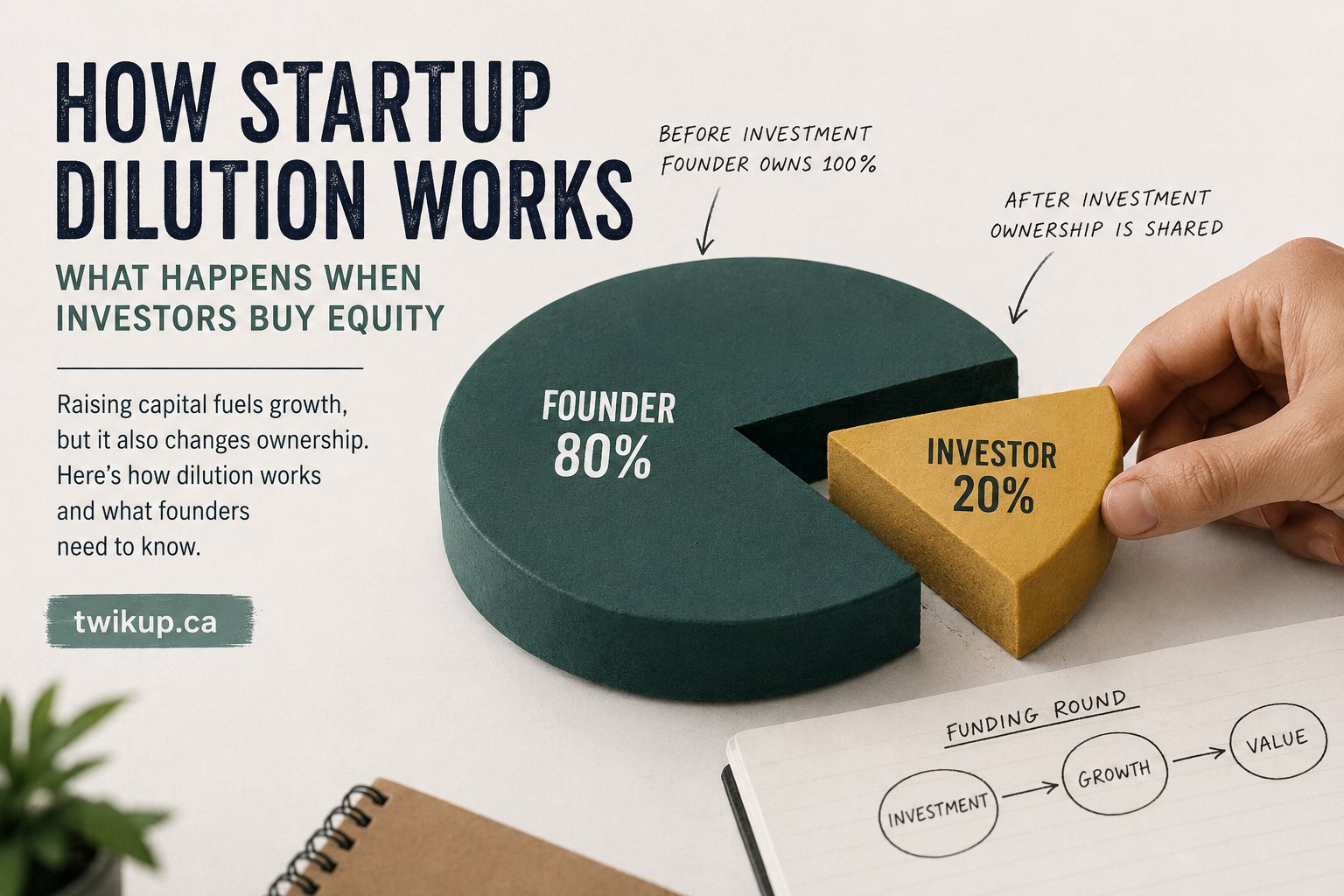
Imagine a founder owns 100% of a startup.
The company raises investment from an angel investor.
Before Investment
| Shareholder | Ownership |
|---|---|
| Founder | 100% |
After Investment
An investor contributes capital in exchange for 20% ownership.
| Shareholder | Ownership |
|---|---|
| Founder | 80% |
| Investor | 20% |
The founder's ownership percentage decreases from 100% to 80%.
This reduction is known as dilution.
Why Founders Accept Dilution
At first glance, giving away ownership may seem undesirable.
However, most startups require funding to grow.
Investment can help businesses:
- Hire employees.
- Build products faster.
- Expand marketing efforts.
- Enter new markets.
- Increase revenue.
- Improve technology.
A smaller share of a much larger company is often more valuable than owning 100% of a company that cannot grow.
Understanding Pre-Money and Post-Money Valuation
Dilution becomes easier to understand when founders know the difference between pre-money and post-money valuation.
Pre-Money Valuation
The value of the company before new investment arrives.
Post-Money Valuation
The value of the company after investment is added.
Example
Suppose:
- Pre-money valuation: $2 million
- New investment: $500,000
Post-money valuation becomes:
$2.5 million
The investor's ownership would be:
$500,000 ÷ $2,500,000 = 20%
The founder would retain approximately 80%.
Understanding this calculation helps founders estimate dilution before negotiations begin.
Dilution Happens During Multiple Funding Rounds
Many founders mistakenly believe dilution occurs only once.
In reality, dilution often happens repeatedly.
A startup may raise:
- Seed funding.
- Angel investment.
- Series A funding.
- Series B funding.
- Series C funding.
Each new round can reduce founder ownership percentages.
For example:
| Funding Stage | Founder Ownership |
|---|---|
| Startup Launch | 100% |
| Seed Round | 80% |
| Series A | 65% |
| Series B | 50% |
| Series C | 35% |
Although ownership decreases, the company may have increased significantly in value.
This is why percentage ownership alone never tells the full story.
Employee Stock Option Pools Create Dilution Too
Investors often encourage startups to create employee stock option plans (ESOPs).
These pools help attract talented employees by offering equity compensation.
While beneficial, option pools also dilute existing shareholders.
Founders should understand:
- How large the option pool will be.
- Whether it is created before or after investment.
- How it affects ownership percentages.
Many first-time founders overlook this detail during fundraising discussions.
Is Dilution Always Bad?
Not necessarily.
The important question is:
What are founders receiving in exchange for dilution?
Good reasons for accepting dilution may include:
- Accelerating growth.
- Reaching profitability faster.
- Expanding internationally.
- Hiring exceptional talent.
- Securing strategic investors.
Dilution becomes problematic when founders give away significant ownership without receiving enough value in return.
Common Dilution Mistakes First-Time Founders Make
Raising Too Much Too Early
Large early rounds can result in unnecessary dilution.
Founders should raise enough capital to reach meaningful milestones rather than maximizing investment amounts.
Accepting Unfavourable Valuations
A lower valuation typically means investors receive a larger ownership stake.
Understanding valuation fundamentals can help founders negotiate more effectively.
Ignoring Future Funding Needs
Many founders focus only on the current funding round.
Future rounds may create additional dilution that significantly changes ownership structures.
Not Understanding Term Sheets
Ownership percentages are only one part of a financing agreement.
Liquidation preferences, voting rights, and anti-dilution provisions can have substantial long-term implications.
Frequently Asked Questions About Startup Dilution
Does dilution mean founders lose money?
Not necessarily.
A founder may own a smaller percentage of a much more valuable company.
Can dilution be avoided completely?
Usually not.
Most venture-backed startups experience dilution during fundraising.
Is owning 100% always better?
Not always.
Owning 100% of a small company may be less valuable than owning 50% of a rapidly growing business.
How much ownership should founders keep?
There is no universal answer.
However, investors generally like to see founders remain significantly invested and motivated over the long term.
Key Takeaways
- Startup dilution occurs when new shares are issued.
- Founders typically experience dilution during funding rounds.
- Dilution does not automatically reduce overall value.
- Understanding pre-money and post-money valuations is critical.
- Employee stock option pools can also dilute ownership.
- Founders should evaluate what they receive in exchange for dilution.
- Long-term ownership planning is an important part of fundraising strategy.
Understanding dilution helps founders look beyond the excitement of investment announcements and focus on the long-term economics of building a successful company.
In the next article, we'll explore startup cap tables, how they work, and why every founder should understand them before raising outside capital.
About TwikUp
TwikUp covers startups, investing, business, technology, immigration, real estate, and personal finance through clear, educational journalism designed to help readers understand complex topics without unnecessary jargon.