
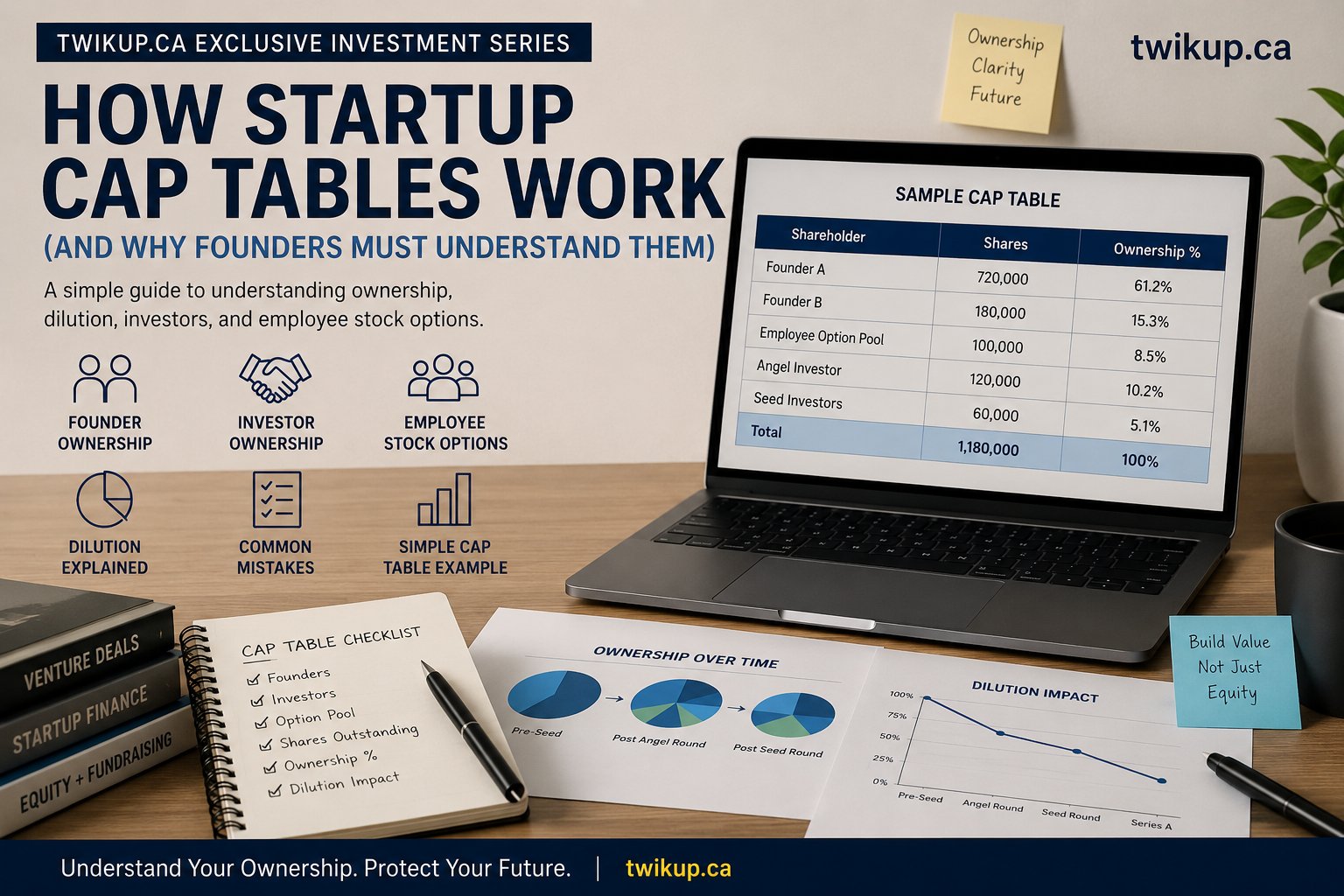
How Startup Cap Tables Work (And Why Founders Must Understand Them)
Part 7 of Twikup.ca's Exclusive Startup Investing & Fundraising Education Series
Most founders spend months building products, acquiring customers, and pitching investors.
Yet one of the most important documents in any startup often receives very little attention until a funding round is underway.
That document is the capitalization table, commonly known as a cap table.
A cap table shows exactly who owns what percentage of a company.
It becomes increasingly important as startups raise capital, grant employee stock options, issue new shares, and experience dilution.
Understanding cap tables is not just important for investors. Every founder should understand how ownership changes over time because small decisions made early can have significant consequences later.
At Twikup.ca, our goal is to help founders, investors, and aspiring entrepreneurs understand how startup finance works in the real world.
Quick Answer
A startup cap table is a document that tracks company ownership.
It shows:
- Founder ownership
- Investor ownership
- Employee stock option allocations
- Total shares outstanding
- Ownership percentages
- Dilution after funding rounds
Think of a cap table as the official scoreboard of who owns the company.
Key Takeaways
- A cap table records every owner's equity stake.
- Investors use cap tables to evaluate ownership structure.
- Employee stock options appear on cap tables.
- New funding rounds often cause dilution.
- Poor cap table management can make future fundraising difficult.
- Every founder should understand how ownership changes over time.
What Is a Cap Table?
A cap table is a spreadsheet or software-generated record that tracks ownership in a company.
It lists:
| Shareholder | Shares Owned | Ownership % |
|---|---|---|
| Founder A | 700,000 | 70% |
| Founder B | 300,000 | 30% |
In the earliest stages, cap tables are often simple.
As a startup grows, however, they become significantly more complex.
Additional entries may include:
- Angel investors
- Venture capital firms
- Advisors
- Employee stock option pools
- Convertible securities
- SAFE agreements
The cap table becomes the single source of truth for ownership.
Why Investors Care About Cap Tables
Before investing, investors almost always review a startup's cap table.
They want to understand:
- Who controls the company
- How much founders own
- Whether ownership is concentrated or fragmented
- Existing investor rights
- Future dilution risks
A messy cap table can become a major red flag during fundraising.
In some cases, investors may walk away from otherwise promising startups because ownership structures have become too complicated.
Founder Ownership
At the beginning, founders typically own 100% of the company.
For example:
| Shareholder | Shares | Ownership |
|---|---|---|
| Founder A | 800,000 | 80% |
| Founder B | 200,000 | 20% |
| Total | 1,000,000 | 100% |
Many startups intentionally create a large number of shares from day one.
The actual number of shares matters less than the ownership percentages.
Whether a company has 1,000 shares or 10 million shares, ownership percentages determine economic ownership.
Investor Ownership
When investors provide capital, they receive shares in return.
Suppose a startup raises money from an angel investor.
Before investment:
| Shareholder | Ownership |
|---|---|
| Founders | 100% |
After investment:
| Shareholder | Ownership |
|---|---|
| Founders | 85% |
| Angel Investor | 15% |
The investor now owns a portion of the company.
The founders still control most of the business, but their ownership percentage has decreased.
This reduction is known as dilution.
Employee Stock Options
Many startups use stock options to attract talented employees.
Instead of paying large salaries, startups often offer employees an opportunity to participate in future growth.
These stock options are typically placed into an Employee Stock Option Pool (ESOP).
A typical cap table may look like this:
| Shareholder | Ownership |
|---|---|
| Founders | 75% |
| Investors | 15% |
| Employee Option Pool | 10% |
The option pool reserves future equity for employees.
Not all option pool shares are immediately granted.
Many remain available for future hires.
How Dilution Appears on a Cap Table
One of the most important purposes of a cap table is tracking dilution.
Imagine a startup begins with:
| Shareholder | Ownership |
|---|---|
| Founders | 100% |
After an angel round:
| Shareholder | Ownership |
|---|---|
| Founders | 85% |
| Angel Investor | 15% |
Later, the company raises a seed round.
The updated cap table becomes:
| Shareholder | Ownership |
|---|---|
| Founders | 68% |
| Angel Investor | 12% |
| Seed Investors | 20% |
Notice something important:
The founders still own millions of shares.
However, their percentage ownership decreases because new shares have been issued.
This is dilution in action.
Dilution is not always bad.
If the company's value grows faster than ownership decreases, founders can still become significantly wealthier.
A Simple Cap Table Example
Let's examine a realistic startup journey.
Stage 1: Company Formation
| Shareholder | Shares |
|---|---|
| Founder A | 800,000 |
| Founder B | 200,000 |
| Total | 1,000,000 |
Stage 2: Employee Option Pool Added
| Shareholder | Shares |
|---|---|
| Founder A | 720,000 |
| Founder B | 180,000 |
| ESOP Pool | 100,000 |
| Total | 1,000,000 |
Stage 3: Angel Investment
| Shareholder | Shares |
|---|---|
| Founder A | 720,000 |
| Founder B | 180,000 |
| ESOP Pool | 100,000 |
| Angel Investor | 176,471 |
| Total | 1,176,471 |
Ownership percentages change even though the founders still hold the same number of shares.
This is why founders must focus on percentages, not just share counts.
Common Founder Mistakes
Many startup founders encounter problems because they do not understand cap table management.
Giving Away Too Much Equity Too Early
Some founders grant large ownership stakes to advisors, early employees, or friends.
These decisions can create fundraising challenges later.
Ignoring Future Dilution
Many founders focus only on the current round.
They fail to model how multiple funding rounds will affect ownership over time.
Not Maintaining Accurate Records
Outdated cap tables create confusion during due diligence.
Investors expect accurate and organized records.
Creating Complex Ownership Structures
Excessive classes of shares, side agreements, and informal equity arrangements can scare away future investors.
Not Understanding Option Pools
Employee stock option pools affect founder ownership.
Many founders underestimate the dilution impact of expanding option pools.
Twikup Insight
One of the biggest misconceptions among first-time founders is that dilution automatically means losing.
In reality, successful startups often go through multiple rounds of dilution.
The important question is not:
"Do I own less?"
The important question is:
"Is the company becoming significantly more valuable?"
Owning 20% of a $500 million company can be far better than owning 100% of a company that never grows.
The smartest founders focus on value creation rather than percentage ownership alone.
Why Cap Tables Become More Important As Startups Grow
Cap tables become increasingly important at every stage of growth.
They help companies:
- Raise capital
- Allocate employee equity
- Prepare for acquisitions
- Plan future funding rounds
- Manage shareholder relationships
- Conduct investor due diligence
As startups mature, professional investors expect clean, accurate, and transparent cap tables.
Frequently Asked Questions
What does a cap table stand for?
Cap table stands for capitalization table, a document that records ownership in a company.
Do all startups need a cap table?
Yes. Even a startup with a single founder should maintain a cap table.
Does dilution always hurt founders?
Not necessarily. Dilution can be beneficial if new investment helps increase company value significantly.
Are employee stock options included in a cap table?
Yes. Option pools and granted options are usually reflected in startup cap tables.
Do investors review cap tables before investing?
Almost always. Reviewing ownership structure is a standard part of startup due diligence.
Final Thoughts
A cap table may look like a simple spreadsheet, but it is one of the most important documents in startup finance.
It tells the story of who owns the company, how ownership changes over time, and how future value may be distributed among founders, employees, and investors.
Founders who understand cap tables make better fundraising decisions, avoid costly equity mistakes, and position their companies for long-term growth.
As startups raise capital and expand, understanding ownership becomes just as important as building the product itself.
Continue the Twikup.ca Exclusive Startup Investing & Fundraising Series
Continue Reading the Series
If you're joining the series for the first time, start here:
Part 1: How First-Time Founders Can Raise Their First Investment https://twikup.ca/money/investing/how-first-time-founders-can-raise-their-first-investment
Part 2: What Investors Look For Before Funding a Startup https://twikup.ca/money/investing/what-investors-look-for-before-funding-a-startup
Part 3: Why Most Startup Pitches Fail Even When the Idea Is Good https://twikup.ca/money/investing/why-most-startup-pitches-fail-even-when-the-idea-is-good
Part 4: How to Build a Pitch Deck That Investors Actually Read https://twikup.ca/money/investing/how-to-build-a-pitch-deck-that-investors-actually-read
Part 5: How Startup Valuations Actually Work Before Revenue https://twikup.ca/money/investing/how-startup-valuations-actually-work-before-revenue
part 6: How Startup Dilution Works: What Happens When Investors Buy Equity https://twikup.ca/money/investing/how-startup-dilution-works-what-happens-when-investors-buy-equity
Next Article (Part 8): SAFE Notes Explained: How Startups Raise Money Before a Valuation