
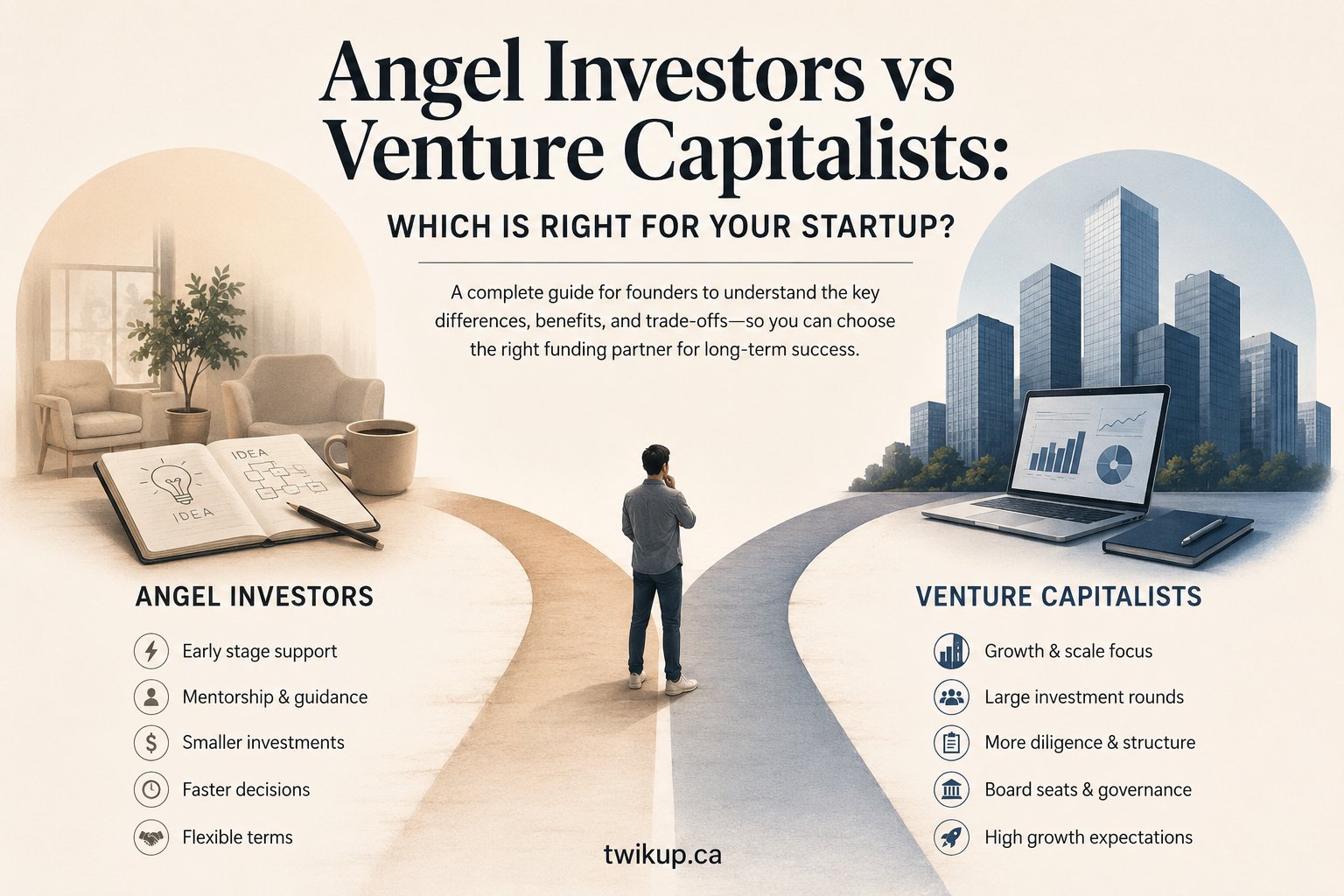
Part 2: Choosing the Right Investor, Founder Scenarios, Canadian Funding Landscape & FAQs
When Should You Choose an Angel Investor?
Choosing the right investor isn't about prestige—it's about finding someone whose expectations align with your company's current stage.
For many founders, angel investors are the best first external investors because they understand that early-stage startups are still experimenting.
An angel investor may be the right choice if:
- You are building your first Minimum Viable Product (MVP).
- You need between $50,000 and $500,000.
- Your product is still being validated.
- Revenue is limited or non-existent.
- You need introductions more than large amounts of capital.
- You want experienced mentorship.
- You prefer a simpler fundraising process.
- You want to retain more ownership.
- Your business may become highly profitable without becoming a billion-dollar company.
Many successful companies spent years growing with only angel funding before ever speaking with venture capital firms.
Remember:
Early-stage funding is about buying time to prove your business—not raising the biggest round possible.
When Should You Choose Venture Capital?
Venture capital isn't simply "more money."
It is fuel designed for businesses capable of extremely rapid growth.
VC funding usually becomes appropriate when your startup has already demonstrated meaningful traction.
Examples include:
- Strong month-over-month revenue growth
- Product-market fit
- Repeatable customer acquisition
- Growing user retention
- Proven unit economics
- A large addressable market
- Clear expansion opportunities
VC funding often makes sense if your startup needs millions—not thousands—to reach its next milestone.
Examples include:
- Expanding internationally
- Building enterprise sales teams
- Manufacturing hardware
- Scaling AI infrastructure
- Acquiring customers rapidly
- Entering multiple markets simultaneously
If your company can realistically become a $500 million or multi-billion-dollar business, venture capital may be the right path.
Advantages of Angel Investors
1. Faster Fundraising
Angel investors usually make decisions quickly.
Many founders can close an angel round within a few weeks.
2. Founder-Friendly Terms
Compared to institutional investors, angels often request:
- Less paperwork
- Simpler agreements
- Smaller ownership stakes
- Fewer governance requirements
3. Personal Mentorship
The best angel investors have already built companies.
They often become advisors who help founders avoid expensive mistakes.
4. Greater Flexibility
Early-stage startups frequently pivot.
Angel investors generally understand this uncertainty better than institutional investors.
5. Easier Access
Many angels invest because they believe in the founder—not only the financial metrics.
This gives first-time founders opportunities that may not exist with VC firms.
Disadvantages of Angel Investors
Angel funding also has limitations.
Smaller Investment Capacity
Most angels cannot continue funding every future round.
You may still need institutional investors later.
Variable Experience
Not every angel has startup experience.
Some offer incredible guidance.
Others unintentionally become distractions.
Smaller Networks
Individual angels often have smaller professional networks than major VC firms.
Limited Resources
Most angels cannot provide dedicated recruiting teams, operating partners, marketing specialists, or growth consultants.
Advantages of Venture Capital
Significant Capital
VC firms can fund aggressive growth.
Instead of raising multiple small rounds, founders may secure enough capital to execute ambitious plans.
Strong Networks
Top VC firms introduce founders to:
- Enterprise customers
- Strategic partners
- Future investors
- Executive talent
- Board advisors
- Industry experts
Hiring Support
Many VC firms help portfolio companies recruit executives and senior leadership.
Hiring great people often becomes easier with reputable investors.
Credibility
Well-known VC firms can increase market credibility.
Potential customers, employees, and future investors often pay closer attention to startups backed by respected firms.
Follow-on Funding
Many VC firms continue investing in successful portfolio companies.
This reduces fundraising uncertainty in later rounds.
Disadvantages of Venture Capital
VC funding isn't right for every startup.
Potential downsides include:
- Greater founder dilution
- Higher expectations
- More reporting requirements
- Board oversight
- Pressure to grow quickly
- Pressure to raise future rounds
- Pressure to pursue large exits
VCs invest expecting substantial returns.
That expectation influences strategic decisions throughout the company's life.
Real Founder Scenarios
Scenario 1: SaaS Startup
A founder has:
- MVP completed
- 25 paying customers
- $8,000 Monthly Recurring Revenue
They need $250,000.
Best fit: Angel investors.
Reason:
The business still needs validation before institutional funding.
Scenario 2: AI Startup
A company has:
- $120,000 MRR
- Growing 20% monthly
- Strong customer retention
- Large enterprise pipeline
They need $4 million.
Best fit: Venture capital.
Reason:
The business has traction and requires capital to scale quickly.
Scenario 3: Local Marketplace
The company serves one province successfully.
Expansion will be gradual.
Projected annual revenue:
$5–10 million.
Best fit: Angel investors or strategic investors.
Reason:
The company may become highly profitable without requiring venture-scale funding.
Scenario 4: Biotech Startup
Developing a new medical technology.
Requires:
- Clinical trials
- Regulatory approvals
- Multi-year development
Funding need:
$15 million.
Best fit: Venture capital.
Reason:
Capital requirements exceed what most angel investors can provide.
Scenario 5: Lifestyle Business
Founder operates:
- Marketing agency
- Software product
- Healthy profits
No plans for global expansion.
Best fit:
Bootstrapping or angel funding.
Reason:
VC expectations may not align with the business goals.
Canadian Startup Funding Landscape
Canada has a strong startup ecosystem supported by both public and private investors.
Founders can often combine multiple funding sources.
Common options include:
Angel Networks
- Angel One Network
- Golden Triangle Angel Network
- Maple Leaf Angels
- York Angel Investors
- Vancouver Angel Forum
These organizations connect founders with experienced angel investors.
Venture Capital Firms
Canada has numerous active VC firms investing across industries including:
- AI
- SaaS
- FinTech
- HealthTech
- ClimateTech
- Clean Energy
Many international VC firms also actively invest in Canadian startups.
Government Support
Canadian founders should also explore:
- IRAP
- SR&ED tax incentives
- Regional innovation grants
- Provincial funding programs
- Accelerator programs
These non-dilutive funding sources can reduce the amount of equity founders need to sell.
How to Approach an Angel Investor
Angel investors often invest in founders before the numbers become impressive.
Focus on telling a compelling story.
Prepare:
- Clear problem statement
- Product demonstration
- Market opportunity
- Business model
- Founder background
- Funding requirements
- Use of proceeds
- Customer validation
Most importantly:
Explain why you are the right person to solve this problem.
How to Approach a Venture Capital Firm
VC firms expect preparation.
Before approaching institutional investors, ensure you have:
- Investor-ready pitch deck
- Financial projections
- KPI dashboard
- Customer metrics
- Growth strategy
- Competitive analysis
- Market sizing
- Cap table
- Data room
Expect multiple meetings and extensive due diligence.
Mistakes That Make Investors Walk Away
Many founders lose investment opportunities before negotiations even begin.
Common mistakes include:
Raising Too Early
Investors want milestones—not just ideas.
Build more traction before fundraising whenever possible.
Raising Too Late
Waiting until only a few weeks of runway remain weakens negotiating power.
Unrealistic Valuations
Asking for an inflated valuation discourages experienced investors.
A fair valuation increases long-term success.
Weak Market Understanding
Founders must demonstrate deep knowledge of:
- Customers
- Competitors
- Pricing
- Industry trends
No Clear Use of Funds
Investors expect founders to explain exactly how new capital creates additional company value.
Ignoring Unit Economics
Growth without sustainable economics eventually becomes a problem.
Investors increasingly focus on efficient growth.
Twikup Insight
One of the biggest misconceptions in entrepreneurship is that fundraising is the goal.
It isn't.
Building a valuable business is the goal.
Investment simply provides resources to accelerate progress.
The best founders raise capital only when:
- It creates more value than dilution.
- It accelerates measurable growth.
- It improves long-term company outcomes.
If outside investment doesn't make your business fundamentally stronger, raising money may not be the right decision.
Remember:
Capital should solve problems—not create new ones.
Frequently Asked Questions
Can a startup raise both angel and VC funding?
Yes.
Many startups begin with angel investors before later raising venture capital.
Do all startups need venture capital?
No.
Many highly successful businesses never raise institutional funding.
Are angel investors easier to convince?
Generally yes, but they still expect capable founders and promising businesses.
Do VCs always require board seats?
Not always, but board representation becomes more common as investment size increases.
Which funding option results in less dilution?
Typically angel funding because investment amounts are usually smaller.
Can founders reject VC funding?
Absolutely.
Not every investment aligns with the founder's long-term goals.
Is bootstrapping better than fundraising?
It depends.
Bootstrapping preserves ownership but limits growth if capital requirements are high.
Can I raise angel funding without revenue?
Yes.
Many angel investors back pre-revenue startups.
Do VCs invest in ideas?
Usually not.
Most prefer evidence of traction.
What's the biggest fundraising mistake?
Raising money without understanding why your business actually needs it.
Final Thoughts
There is no universal answer to the angel investor versus venture capitalist debate.
The right choice depends on your business—not someone else's success story.
If you're still validating your product, refining your business model, and learning from customers, an experienced angel investor can provide both capital and guidance while allowing you to maintain flexibility.
If you've already built a repeatable business with strong growth potential and need significant funding to scale rapidly, venture capital may become the logical next step.
The smartest founders don't chase prestigious investors.
They choose partners whose expectations match the company they're building.
Ultimately, the quality of your business—not the size of your funding round—will determine your long-term success.
Continue Reading the Series
If you're joining the series for the first time, explore the previous guides:
Part 1: How First-Time Founders Can Raise Their First Investment
https://twikup.ca/money/investing/how-first-time-founders-can-raise-their-first-investment
Part 2: What Investors Look For Before Funding a Startup
https://twikup.ca/money/investing/what-investors-look-for-before-funding-a-startup
Part 3: Why Most Startup Pitches Fail Even When the Idea Is Good
https://twikup.ca/money/investing/why-most-startup-pitches-fail-even-when-the-idea-is-good
Part 4: How to Build a Pitch Deck That Investors Actually Read
https://twikup.ca/money/investing/how-to-build-a-pitch-deck-that-investors-actually-read
Part 5: How Startup Valuations Actually Work Before Revenue
https://twikup.ca/money/investing/how-startup-valuations-actually-work-before-revenue
Part 6: How Startup Dilution Works
https://twikup.ca/money/investing/how-startup-dilution-works-what-happens-when-investors-buy-equity
Part 7: How Startup Cap Tables Work
https://twikup.ca/money/investing/how-startup-cap-tables-work-and-why-founders-must-understand-them
Part 8: SAFE Notes Explained
https://twikup.ca/money/investing/safe-notes-explained-how-startups-raise-money-before-a-valuation
Part 9: Convertible Notes vs SAFE Notes
https://twikup.ca/money/mortgages/convertible-notes-vs-safe-notes-which-fundraising-method-is-better-for-startups-in-2026
Part 10: Startup Term Sheets Explained
https://twikup.ca/money/investing/startup-term-sheets-explained-the-investment-agreement-every-founder-must-understand
Part 11: Why Startup Founders Can Get Nothing After Selling Their Company
https://twikup.ca/money/investing/why-startup-founders-can-get-nothing-after-selling-their-company
**Part 12: ** Part 1 https://twikup.ca/money/investing/angel-investors-vs-venture-capitalists-which-is-right-for-your-startup
Helpful References
- National Angel Capital Organization (NACO)
- Business Development Bank of Canada (BDC)
- Innovation, Science and Economic Development Canada (ISED)
- National Venture Capital Association (NVCA)
- Y Combinator Library
- Canadian Venture Capital & Private Equity Association (CVCA)
- Securities Administrators – Startup Crowdfunding Resources