
Quick Answer
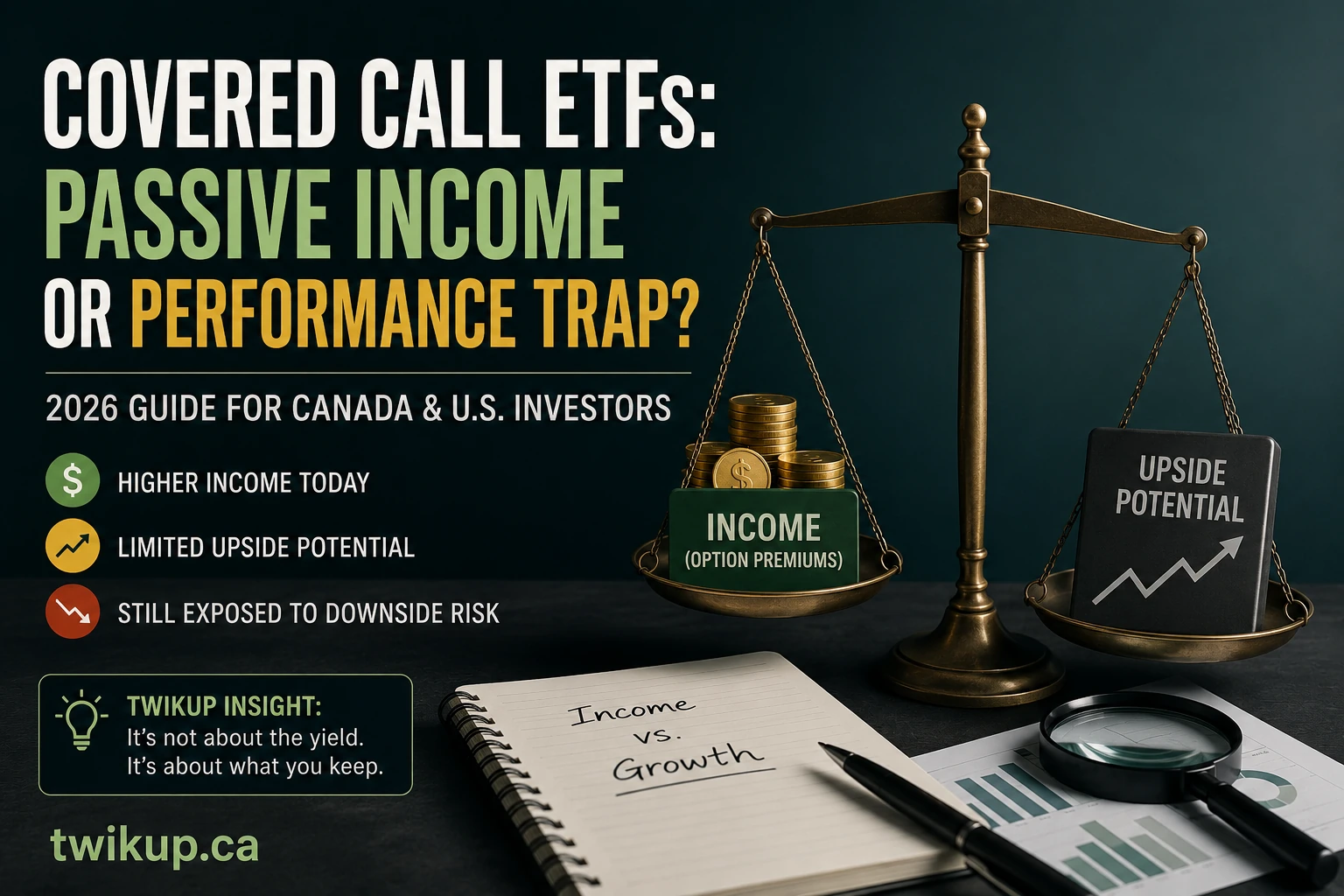
Covered call ETFs can be useful for investors who want regular cash flow from their portfolio, but they are not free income machines. These ETFs usually generate distributions by holding stocks and selling call options, which means investors may receive higher monthly income but give up part of the upside when markets rise strongly.
For Canadian and U.S. investors, the key question is not “Which covered call ETF has the highest yield?” The better question is:
Are you investing for maximum long-term wealth, or are you prioritizing regular cash flow?
Covered call ETFs may fit some income-focused portfolios, especially in sideways or volatile markets. But for younger investors or long-term wealth builders, they can become a performance trap if the high distribution hides weak total returns.
Important: This article is for general education only. It is not financial, tax, legal, or investment advice. Twikup is not recommending that you buy, sell, or avoid any ETF. Always review official fund documents and speak with a registered financial advisor or tax professional before making investment decisions.
Key Takeaways
- Covered call ETFs generate income by selling call options on part or all of a stock portfolio.
- The income is not free. Investors usually trade away some future upside.
- A high distribution yield does not automatically mean a high total return.
- Covered call ETFs may perform better in sideways or choppy markets than in strong bull markets.
- They can still fall during market crashes because investors still own the underlying stocks.
- Canadian investors should understand TFSA, RRSP, non-registered account, return of capital, foreign withholding tax, and adjusted cost base rules.
- U.S. investors should understand ordinary income, qualified dividends, capital gains, and ETF distribution tax treatment.
- The biggest mistake is comparing a 10% covered call ETF yield with a 2% index ETF dividend yield without comparing total return.
What Is a Covered Call ETF?
A covered call ETF is an exchange-traded fund that holds stocks or index exposure and sells call options against some or all of those holdings.
In simple terms:
- The ETF owns stocks.
- The ETF sells call options on those stocks or an index.
- The ETF receives option premiums.
- Those premiums can help fund monthly or regular distributions.
- In exchange, the ETF may give up some upside if the stocks rise above the option strike price.
That is the basic trade-off.
The fund receives income today, but it may sacrifice some growth tomorrow.
Canadian providers describe covered call ETFs as funds that use option premiums to generate higher distributions, while still holding underlying securities. But the exact strategy can vary widely by fund. Some funds write calls on a large portion of the portfolio, while others only write on a smaller percentage.
Twikup Insight: The Income Is Real, But the Trade-Off Is Also Real
Covered call ETFs often look attractive because they can show high monthly distributions.
But investors should remember one simple rule:
Covered call ETFs do not create free money. They convert part of potential future upside into current cash flow.
That can be useful for some investors.
But it can also be dangerous if someone thinks a 10% distribution yield means the ETF is automatically producing a 10% investment return.
It may not be.
Covered Call ETFs vs Regular Index ETFs
A regular index ETF usually tries to capture the long-term return of an index. For example, an S&P 500 ETF gives investors broad exposure to large U.S. companies.
A covered call ETF may hold similar stocks, but it adds an options strategy on top.
That creates a different experience.
| Feature | Regular Index ETF | Covered Call ETF |
|---|---|---|
| Main goal | Long-term growth | Income/cash flow |
| Distribution yield | Usually lower | Usually higher |
| Upside potential | Usually higher | Often capped or reduced |
| Downside risk | Market risk | Market risk, with limited premium cushion |
| Best environment | Long bull markets | Sideways or volatile markets |
| Main risk | Market decline | Underperforming in strong rallies |
This matters because many investors compare covered call ETFs only by yield.
That is incomplete.
A regular index ETF may pay less income but grow more over time. A covered call ETF may pay more income but grow less.
For Canadian investors comparing broad U.S. market exposure, Twikup has already covered important ETF decisions in VFV vs ZSP: Which S&P 500 ETF Makes More Sense for Canadians?
That article is useful because covered call ETFs should not be judged in isolation. They should be compared against the plain index ETF alternative.
The Biggest Misunderstanding: Distribution Yield Is Not Total Return
This is the most important part of the article.
Many investors see something like this:
- ETF A: 2% yield
- ETF B: 10% yield
And assume ETF B is better.
But yield is not the same as total return.
Total return includes:
- price growth;
- dividends;
- option income;
- capital gains;
- return of capital;
- reinvested distributions;
- fees;
- taxes.
A covered call ETF can pay a large distribution while the unit price barely grows or even declines.
That does not automatically make it bad.
But it means investors must look beyond the headline yield.
Simple Example: High Income, Lower Wealth Creation
Imagine two investors each invest $100,000.
| Investment | Price Growth | Distribution | Total Return |
|---|---|---|---|
| Regular ETF | 12% | 2% | 14% |
| Covered Call ETF | 2% | 10% | 12% |
The covered call ETF paid more cash.
But the regular ETF created more total wealth.
That is the trap.
The investor may feel wealthier because they received more monthly income, but the total portfolio may have grown less.
Why Covered Call ETFs Are So Popular
Covered call ETFs are popular because they solve an emotional and practical problem.
Investors like seeing cash arrive every month.
This is especially true for:
- retirees;
- income-focused investors;
- investors tired of low bond yields;
- investors who want passive income;
- investors who dislike selling shares;
- investors who prefer monthly distributions.
There is also a psychological reason.
Many people treat distributions as “income” but treat selling ETF units as “touching capital.”
Economically, the difference is not always as large as it feels.
If a regular ETF grows in value and an investor sells a small portion, that can also create cash flow. But emotionally, many investors prefer income that arrives automatically.
That is one reason covered call ETFs are so appealing.
When Covered Call ETFs Can Make Sense
Covered call ETFs are not automatically bad.
They may make sense for some investors in certain situations.
1. Sideways Markets
Covered call strategies can work well when markets move sideways.
If stocks are not rising strongly, the ETF may collect option premiums without giving up much upside.
2. Volatile Markets
Option premiums can be higher when volatility is higher.
That may help covered call ETFs generate more income.
3. Income-Focused Portfolios
Some investors genuinely need cash flow.
For example, a retiree may care more about monthly income than maximizing long-term growth.
4. Lower Growth Expectations
If an investor believes the market will be flat or moderately rising, a covered call strategy may feel more attractive.
5. Behavioural Comfort
Some investors may stay invested more comfortably when they receive regular distributions.
That behavioural benefit can matter, although it should not replace proper analysis.
When Covered Call ETFs Can Become a Performance Trap
Covered call ETFs become risky when investors expect them to provide:
- high income;
- full stock market upside;
- strong downside protection;
- long-term outperformance;
- low risk;
- tax-free cash flow.
That combination is unrealistic.
1. Strong Bull Markets Can Hurt Relative Performance
Covered call ETFs often underperform in strong bull markets.
Why?
Because the fund sells call options. If the underlying stocks rise sharply, the ETF may not fully participate in that upside.
The investor receives the option premium, but gives up part of the rally.
Over one month, this may not look dramatic.
Over 10 or 20 years, repeatedly missing strong upside can reduce compounding.
This is why covered call ETFs can be dangerous for young investors who are still building wealth.
2. Downside Protection Is Limited
Another misconception is that covered call ETFs are safe because they receive option premiums.
The premiums can provide a small cushion.
But the ETF still owns stocks.
If the stock market falls sharply, the covered call ETF can still fall.
Covered calls are not the same as full downside protection. Investors still carry equity market risk. Some investor education sources warn that covered call ETFs can reduce upside while only partially cushioning losses.
3. High Yield Can Hide NAV Erosion
A covered call ETF may continue paying distributions while its net asset value declines.
That is not always bad, but it is something investors must understand.
If the ETF pays out more than it earns over time, the distribution may be partly supported by return of capital or realized gains.
This is why investors should check:
- NAV history;
- total return;
- distribution breakdown;
- option strategy;
- management expense ratio;
- long-term performance versus the underlying index.
Twikup Insight: A 10% Yield Can Still Be a Bad Deal
A 10% yield sounds attractive.
But the real question is:
What happened to the original investment after receiving that yield?
If a fund pays 10% but loses 8% in price, the result is very different from a fund paying 10% while maintaining or growing its NAV.
Income investors should not only ask, “How much does it pay?”
They should also ask:
“Is my capital growing, stable, or slowly shrinking?”
Covered Call ETFs in Canada
Canada has a large covered call ETF market.
Canadian investors can find covered call ETFs focused on:
- Canadian banks;
- Canadian dividends;
- utilities;
- energy;
- technology;
- U.S. equities;
- Nasdaq exposure;
- S&P 500 exposure;
- global equities;
- enhanced income portfolios.
Canadian covered call ETFs often appeal to investors looking for monthly income.
But Canadian investors need to be especially careful with taxes and account types.
Canadian Tax Considerations
ETF distributions in Canada can include several different types of income:
- eligible Canadian dividends;
- foreign income;
- capital gains;
- return of capital;
- interest income;
- other income.
Canadian ETF providers note that ETF distributions may include dividends, foreign income, capital gains, and return of capital.
This matters because different types of distributions can be taxed differently.
Return of Capital in Canada
Return of capital, or ROC, is especially important for covered call ETF investors.
ROC is not automatically bad.
In taxable accounts, ROC is generally not taxed immediately. Instead, it reduces the investor’s adjusted cost base, or ACB. That can increase the capital gain when the investment is eventually sold.
ETF providers explain that ROC can help maintain stable distributions, but investors must track ACB carefully.
So the better question is not:
“Does this ETF use return of capital?”
The better question is:
“Is the distribution sustainable, and do I understand the tax impact?”
TFSA, RRSP, and Non-Registered Accounts
Canadian investors should think carefully about account location.
TFSA
A TFSA can shelter Canadian tax on investment growth and distributions, but foreign withholding taxes may still apply depending on the ETF structure and holdings.
RRSP
An RRSP may be useful for certain U.S.-listed securities because of treaty treatment on U.S. dividends, but the details depend on the product and structure.
Non-Registered Account
A taxable account requires more attention.
Investors may need to track:
- adjusted cost base;
- return of capital;
- capital gains;
- foreign income;
- Canadian dividends;
- tax slips.
This is where professional tax advice can be valuable.
Covered Call ETFs in the United States
The U.S. market also has many covered call and option-income ETFs.
Some well-known examples include ETFs linked to:
- the Nasdaq-100;
- the S&P 500;
- dividend stocks;
- actively managed income strategies;
- equity-linked note strategies;
- selective covered call strategies.
But U.S. investors should not assume all of these funds work the same way.
Some are traditional covered call ETFs.
Others use more complex option or derivative strategies.
That difference matters.
U.S. Tax Considerations
U.S. ETF investors need to understand how distributions are classified.
ETF distributions may be taxed as:
- qualified dividends;
- ordinary income;
- short-term capital gains;
- long-term capital gains;
- return of capital.
The IRS explains that dividends are distributions paid to shareholders, while ETF tax treatment can depend on the type of distribution and holding period.
U.S. investors should not assume that all ETF income is taxed the same way.
This is especially important with options-based ETFs, where distribution character can vary.
Canada vs U.S.: What Investors Should Compare
| Factor | Canada | United States |
|---|---|---|
| Popular use case | Monthly income, retirement cash flow | Monthly income, option-income strategies |
| Tax issues | ROC, ACB, TFSA/RRSP/non-registered accounts, foreign withholding tax | Qualified dividends, ordinary income, capital gains, ROC |
| ETF choices | Canadian-listed covered call ETFs, U.S. equity covered call ETFs | U.S.-listed covered call and derivative-income ETFs |
| Main investor mistake | Chasing yield without checking total return | Chasing yield without understanding tax treatment and strategy |
| Key comparison | Covered call ETF vs VFV/ZSP/XEQT/regular index ETF | Covered call ETF vs VOO/SPY/QQQ/regular index ETF |
For Canadians specifically, this connects naturally to the broader question of whether a plain S&P 500 ETF is enough.
Twikup has already explored this in Should Canadians Buy VFV or Invest Directly in the S&P 500?
That matters because many Canadian investors are deciding between:
- a simple S&P 500 ETF;
- a U.S.-listed ETF;
- a covered call ETF;
- a high-yield income ETF;
- an all-in-one ETF.
The right comparison is not only yield.
It is total return, taxes, risk, time horizon, and purpose.
Covered Call ETF vs S&P 500 ETF
Let’s compare the basic idea.
Regular S&P 500 ETF
A regular S&P 500 ETF is usually built for long-term growth.
It gives exposure to large U.S. companies and lets the investor participate in market upside and downside.
Covered Call S&P 500 ETF
A covered call S&P 500 ETF may hold similar exposure but sells call options to generate income.
That may increase monthly cash flow but reduce upside.
So the question becomes:
Would you rather have more income now or more potential growth later?
There is no universal answer.
A retiree may prefer cash flow.
A 25-year-old may prefer compounding.
A high-income taxable investor may care about tax efficiency.
A nervous investor may value lower volatility.
A long-term investor may prefer simplicity.
Is a Covered Call ETF Better Than VFV, ZSP, VOO, or a Regular Index ETF?
Not automatically.
A covered call ETF may be better for income.
A regular index ETF may be better for long-term growth.
For Canadians choosing between S&P 500 ETFs, Twikup has already compared important options in VFV vs ZSP: Which S&P 500 ETF Makes More Sense for Canadians?
And for investors wondering whether one S&P 500 ETF is enough, Twikup has covered that broader question here: Is One S&P 500 ETF Enough? VFV vs VOO for Long-Term Wealth
Covered call ETFs should be viewed against that background.
They are not just “higher-yield versions” of regular ETFs.
They are different tools.
The $100,000 Example: Income vs Wealth
Imagine two investors.
Both start with $100,000.
Scenario 1: Strong Bull Market
| Investment | Annual Distribution | Price Growth | Total Result |
|---|---|---|---|
| Regular Index ETF | Lower | Higher | Likely stronger total return |
| Covered Call ETF | Higher | Lower | May underperform |
In a strong bull market, the covered call ETF may lag because it gives up part of the upside.
Scenario 2: Sideways Market
| Investment | Annual Distribution | Price Growth | Total Result |
|---|---|---|---|
| Regular Index ETF | Lower | Flat | Modest return |
| Covered Call ETF | Higher | Flat to modest | May perform well |
In a sideways market, the covered call ETF may look attractive because option premiums contribute to returns.
Scenario 3: Market Crash
| Investment | Annual Distribution | Price Growth | Total Result |
|---|---|---|---|
| Regular Index ETF | Lower | Falls | Negative return |
| Covered Call ETF | Higher | Also falls | May fall slightly less, but still risky |
In a crash, covered call ETFs can still lose money.
The option premium may soften the decline, but it does not eliminate equity risk.
Twikup Insight: Covered Call ETFs Are Not Bad. Misusing Them Is Bad.
The smartest way to understand covered call ETFs is this:
They are income tools, not magic wealth-building machines.
They may fit a portfolio when the investor clearly understands:
- the income goal;
- the upside trade-off;
- the tax treatment;
- the fund structure;
- the role inside the portfolio;
- the alternative investment options.
They become risky when investors buy them only because the yield looks high.
Questions Investors Should Ask Before Buying a Covered Call ETF
This is not a recommendation to buy or avoid any specific ETF.
But before considering a covered call ETF, investors may want to ask:
- What index or stocks does the ETF hold?
- What percentage of the portfolio is covered by call options?
- Is the option strategy active or rules-based?
- What is the management expense ratio?
- What has the total return been, not just the yield?
- Has the NAV grown, stayed flat, or declined?
- What type of distributions does it pay?
- Is any part of the distribution return of capital?
- How does it compare to a regular index ETF?
- Is this for retirement income or long-term growth?
- What account will hold it: TFSA, RRSP, taxable, IRA, 401(k), or brokerage?
- What are the tax consequences?
- Could a simpler ETF meet the same goal?
Who Might Consider Covered Call ETFs?
Covered call ETFs may be worth researching for investors who:
- want regular cash flow;
- understand the upside trade-off;
- are less focused on maximum long-term growth;
- are retired or near retirement;
- want monthly distributions;
- are comfortable with equity risk;
- understand tax consequences;
- compare total return instead of only yield.
Again, this does not mean covered call ETFs are suitable for everyone.
It only means the structure may match certain objectives.
Who Should Be More Careful?
Investors should be especially careful if they:
- are young and focused on long-term compounding;
- assume high yield means high return;
- do not understand options;
- need strong downside protection;
- are investing in a taxable account without understanding ROC;
- are choosing funds only by distribution yield;
- expect covered call ETFs to outperform in every market;
- do not compare against simple index ETFs.
For long-term investors, the biggest risk may not be one bad year.
It may be decades of lower compounding.
Compliance Note: Education, Not Personalized Advice
This article does not recommend any specific ETF.
It does not say that covered call ETFs are better or worse than regular index ETFs.
It does not tell investors what to buy, sell, or hold.
The purpose is educational.
In Canada, securities professionals generally must be registered if they provide investment advice or sell securities. The Canadian Securities Administrators and provincial regulators encourage investors to check registration before relying on investment advice.
In the U.S., investors should review official fund documents, understand risks, and consider professional guidance before making investment decisions.
Twikup’s view is simple:
Do not buy an ETF because of the yield alone. Understand the strategy, total return, risk, fees, and tax treatment first.
Final Verdict: Passive Income Strategy or Performance Trap?
Covered call ETFs can be both.
They can be a passive income strategy when used by investors who understand the trade-off and want regular cash flow.
They can become a performance trap when investors chase high yield without realizing they may be giving up long-term growth.
The best way to evaluate them is not by asking:
“How much does it pay?”
The better question is:
“What am I giving up to receive that payment?”
For Canadian and U.S. investors, that question matters more than the headline yield.
Covered call ETFs are not automatically good.
They are not automatically bad.
They are tools.
And like any investment tool, the outcome depends on how, why, and where they are used.
Disclaimer
This article is for general informational and educational purposes only. It does not provide financial, investment, tax, legal, or retirement advice. Twikup is not a registered investment advisor, securities dealer, tax advisor, or financial planner. The examples in this article are hypothetical and simplified for education. They do not represent guaranteed returns or specific investment recommendations.
Investors should review official ETF documents, including prospectus, fund facts, management reports, tax information, fees, risks, and historical performance. Before making investment decisions, consider speaking with a qualified registered financial advisor or tax professional who understands your personal situation.
Past performance does not guarantee future results. All investing involves risk, including possible loss of principal.