
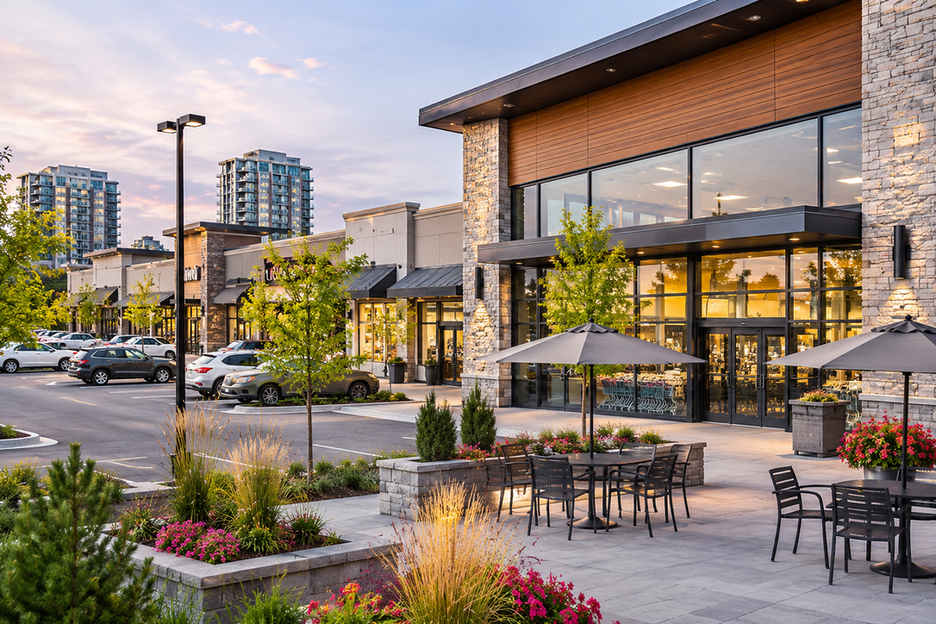
Key Takeaways
- Grocery-anchored shopping centres could benefit from recurring customer visits and demand for everyday services.
- Calgary, Edmonton and selected suburban markets deserve attention, but local property conditions matter more than city-wide predictions.
- Investors should assess lease quality, operating expenses, financing costs and upcoming capital repairs before judging a property's value.
Why Is Canadian Retail Real Estate Attracting Investor Interest?
Canada's retail property market is attracting renewed attention as investors look beyond residential housing and traditional office buildings. Shopping centres with reliable tenants, convenient locations and useful everyday services could become attractive investment opportunities in 2027.
The shift is not simply about the return of shopping malls. It is about identifying properties that remain relevant to local communities. Grocery stores, pharmacies, fitness facilities, restaurants and medical services can generate regular visits, giving certain retail locations a more dependable customer base.
PwC Canada and the Urban Land Institute identified retail as one of the leading Canadian real estate investment opportunities for 2027. However, investors should understand that stronger interest does not make every shopping centre a good purchase.
Which Shopping Centre Types Could Perform Better in 2027?
Grocery-anchored neighbourhood centres deserve close attention. These properties typically combine supermarkets with pharmacies, restaurants, convenience stores and personal services. Customers visit them for regular household needs rather than occasional shopping trips.
Suburban shopping plazas also have potential where residential communities are expanding. Calgary and Edmonton are worth watching because CBRE reported strong suburban retail conditions in both cities during the first half of 2026. Retailers were particularly interested in locations serving growing residential areas.
Service-oriented shopping centres offer another opportunity. Medical clinics, childcare facilities, fitness studios and quick-service restaurants can help landlords attract different customer groups. This mix may reduce dependence on traditional clothing and department-store retailers.
Larger enclosed malls are a more complicated investment. Some have valuable locations and established customer traffic, while others must replace departing anchor tenants or rethink how their space is used.
Could Former Department Store Spaces Create New Opportunities?
The departure of major department-store operators has created a challenge for shopping centre owners. Large vacant units can affect customer movement, leasing income and the overall appearance of a property.
However, these spaces may also create redevelopment opportunities. Owners could divide large units into smaller shops, introduce entertainment facilities or attract retailers requiring substantial floor space.
The outcome depends on the building's layout, renovation costs, local demand and the availability of suitable tenants. A vacant anchor unit is not automatically an investment bargain. Buyers need to calculate how much capital will be required before the space can generate income again.
What Should Investors Check Before Buying a Retail Property?
Purchase price alone cannot establish whether a shopping centre is attractive. Investors should examine its net operating income, lease agreements, tenant concentration and property expenses.
For example, consider a hypothetical retail plaza generating CAD $500,000 in annual net operating income. If its purchase price is CAD $8 million, its capitalization rate would be:
Cap rate = Annual net operating income ÷ Property purchase price × 100
CAD $500,000 ÷ CAD $8,000,000 × 100 = 6.25%
This is an illustrative calculation, not a market benchmark or expected return. Financing costs, taxes, major repairs and future vacancies can change the actual investment outcome.
Buyers should also review lease expiry dates, tenant creditworthiness, maintenance responsibilities, parking capacity, property taxes and environmental conditions. A centre depending on one major tenant may carry more risk than its headline rental income suggests.
What Risks Could Affect Canada's Retail Property Market?
Consumer spending remains an important factor. Statistics Canada's August 2026 retail trade release reported monthly sales growth of 1.2%, bringing total retail sales to CAD $74.6 billion. However, one month's increase does not guarantee stronger spending throughout 2027.
Borrowing costs also matter. Higher financing expenses can reduce the cash flow available to property investors, even when rental income remains stable. Construction and renovation costs may create additional pressure when older centres require upgrades.
Online shopping, changing consumer habits, trade uncertainty and tenant closures also deserve attention. Investors should avoid assuming that low vacancy in one neighbourhood guarantees strong performance in another.
TwikUp's Perspective: Where Could the Better Opportunities Be?
TwikUp's view is that Canadian retail property investment in 2027 should favour useful locations over impressive-looking buildings. A smaller neighbourhood plaza with dependable tenants may offer a more understandable investment case than a large shopping mall requiring expensive repositioning.
Investors should pay particular attention to grocery-anchored centres, growing suburban communities and properties that can accommodate healthcare, food and personal services. Calgary and Edmonton provide interesting examples, but individual neighbourhood demand, lease quality and purchase pricing should guide decisions.
Retail property should also be assessed alongside other Canadian investment options. Readers comparing rental income opportunities can explore Canada's rental property investment outlook for 2027. Those considering a wider property strategy may also find TwikUp's coverage of Canada's housing supply outlook useful.
The central question for 2027 is not whether shopping centres will recover everywhere. It is whether a particular property can retain tenants, attract regular visitors and produce sustainable income after all expenses.
Disclaimer
This article is for general educational and informational purposes only. It does not constitute financial, investment, legal or tax advice. Commercial real estate investments involve risks, including vacancies, tenant defaults, financing costs, unexpected repairs and changes in property values. Readers should conduct independent due diligence and consult qualified professionals before making investment decisions.