
Can the Brain Rewire Itself After Years of Trauma?
The effects of trauma and chronic anxiety do not exist only in memory. Modern neuroscience has revealed that prolonged emotional distress can alter the brain's physical structure, changing how people think, feel, and respond to the world around them.
The remarkable discovery is that the same brain capable of adapting to adversity may also possess the ability to rebuild itself. This capacity is known as neuroplasticity, and it is reshaping how scientists understand recovery from trauma, anxiety, and depression.
When Survival Mode Becomes the Brain's Default Setting
Trauma is not simply an emotional experience. It can influence the architecture of the brain itself.
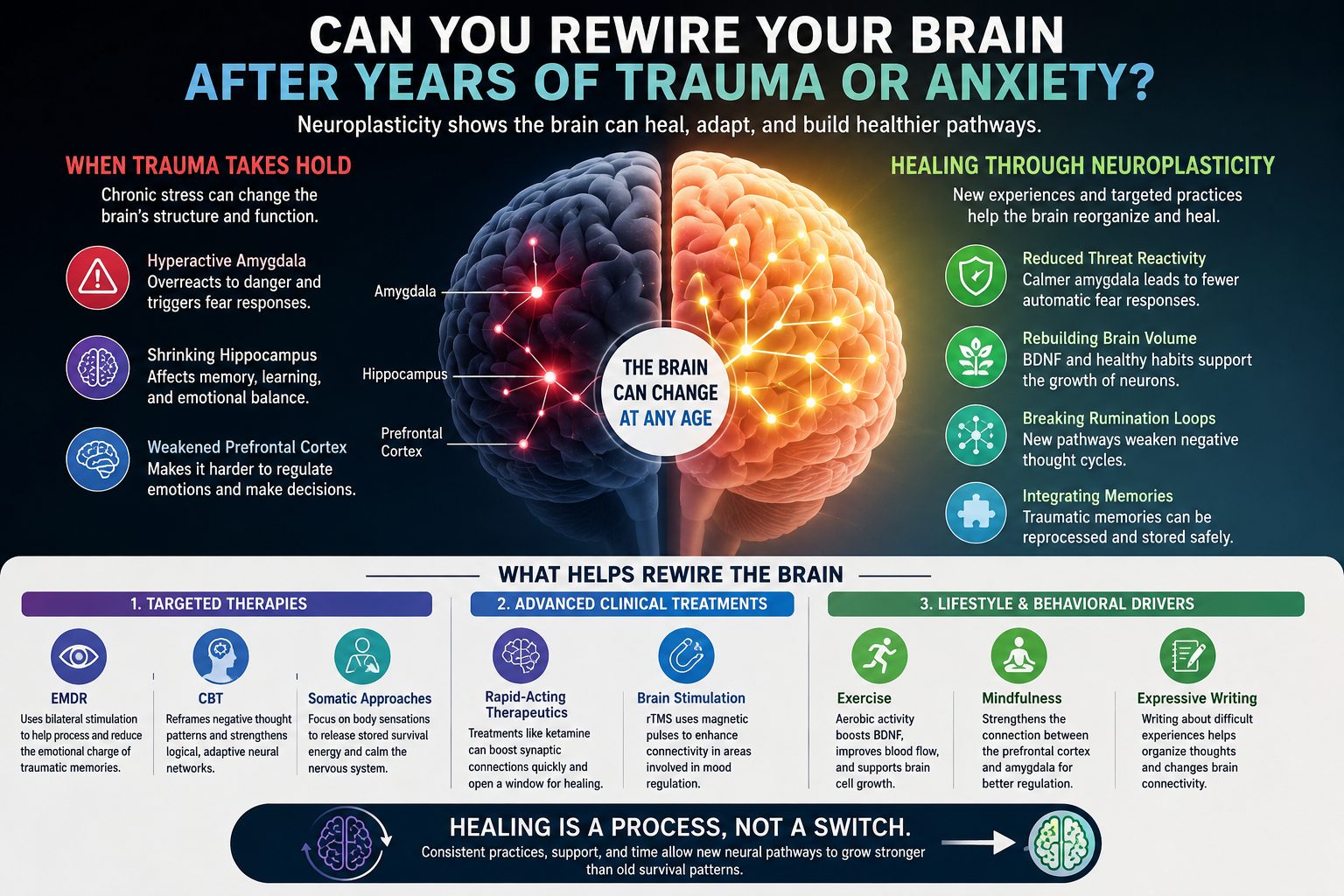
Research has shown that chronic stress and traumatic experiences are associated with measurable changes in several critical brain regions:
- The amygdala may become increasingly reactive, heightening fear responses and threat detection.
- The hippocampus, which helps process memory, can lose volume over time.
- The prefrontal cortex may become less effective at regulating emotions and rational decision-making.
Together, these shifts can create a neurological environment where the brain becomes highly efficient at detecting danger but less effective at distinguishing real threats from perceived ones.
The Discovery That Changed Mental Health Research
For decades, scientists believed the adult brain was largely fixed after development.
That assumption has been overturned.
Researchers now understand that the brain remains adaptable throughout life. Neural pathways can strengthen, weaken, reorganize, and even form entirely new connections in response to experiences, learning, and environmental changes.
This process, known as neuroplasticity, allows the brain to continuously update itself based on repeated patterns of thought, behavior, and experience.
Key mechanisms include:
- Creation of new neural connections.
- Strengthening of frequently used pathways.
- Reduction of underused circuits.
- Adaptation to new emotional and cognitive experiences.
The implication is profound: a brain shaped by trauma is not necessarily trapped by it.
How Neuroplasticity Helps Reverse Trauma's Effects
Recovery involves more than reducing symptoms. It requires the brain to establish healthier patterns of communication.
Several neurological shifts are believed to occur during successful healing:
- Reduced sensitivity within fear-processing networks.
- Improved communication between emotional and rational brain regions.
- Growth-supporting activity stimulated by Brain-Derived Neurotrophic Factor (BDNF).
- Formation of alternative pathways that weaken repetitive negative thinking.
As these changes occur, the brain gradually becomes less dominated by survival responses and more capable of emotional flexibility.
This process does not erase difficult experiences. Instead, it changes how those experiences are stored, interpreted, and responded to.
The Therapies Designed to Trigger Brain Rewiring
Modern mental health treatments increasingly focus on leveraging neuroplasticity directly.
Several approaches have demonstrated potential to encourage adaptive neural change:
Eye Movement Desensitization and Reprocessing (EMDR)
EMDR uses structured bilateral stimulation while revisiting traumatic experiences. The goal is to help the brain process memories in a way that reduces their emotional intensity.
Cognitive Behavioral Therapy (CBT)
CBT encourages individuals to identify distorted thought patterns and replace them with more balanced interpretations.
Repeated practice strengthens neural pathways associated with logical evaluation while reducing reliance on automatic negative responses.
Somatic-Based Approaches
Somatic therapies focus on physical sensations and nervous system responses.
By helping individuals safely process physiological stress reactions, these methods aim to reduce patterns of chronic hypervigilance and stored survival responses.
Why Exercise, Sleep, and Mindfulness Affect the Brain
Neuroplasticity is influenced by more than therapy alone.
Several everyday behaviors have been linked to changes in brain function and connectivity.
Aerobic Exercise
Regular physical activity increases blood flow and supports the production of growth-related proteins associated with neural repair and adaptation.
Deep Sleep
Sleep plays a central role in memory processing, emotional regulation, and neural maintenance.
Without adequate sleep, many of the brain's repair processes become less efficient.
Mindfulness and Meditation
Consistent mindfulness practice has been associated with stronger communication between emotional and regulatory brain regions.
Over time, this may improve resilience and reduce automatic stress responses.
Expressive Writing
Structured journaling allows individuals to organize emotional experiences into coherent narratives.
This process may help reduce emotional fragmentation while supporting healthier cognitive processing.
A New Understanding of Recovery
One of the most important insights from modern neuroscience is that healing does not necessarily require becoming a different person.
Instead, recovery often involves helping the brain develop new pathways that make healthier responses more accessible than older survival patterns.
Neuroplasticity does not promise immediate transformation. The process requires repetition, consistency, and time.
Yet the evidence suggests that the adult brain remains capable of change long after trauma occurs.
For many researchers, that possibility represents one of the most hopeful discoveries in modern mental health science.
FAQ: Brief Insights on Neuroplasticity and Trauma Recovery
Can trauma physically change the brain?
Research indicates that chronic trauma and stress can influence the structure and function of regions involved in memory, fear processing, and emotional regulation.
What is neuroplasticity?
Neuroplasticity refers to the brain's ability to reorganize itself by forming, strengthening, and modifying neural connections throughout life.
Can adults develop new neural pathways?
Yes. The adult brain remains adaptable and continues forming new connections in response to learning, experience, and therapeutic interventions.
Does neuroplasticity erase traumatic memories?
No. Neuroplasticity does not remove memories. It may help alter how those memories are processed, reducing their emotional intensity and impact.
Related Perspectives
- Anxiety and Brain Function
- The Science of Emotional Resilience
- Stress and Cognitive Health
- Modern Approaches to Trauma Recovery
Medical Disclaimer
This article is intended for informational and educational purposes only and should not be considered medical advice. Research on neuroplasticity, trauma, anxiety, and depression describes general neurological patterns and does not predict individual outcomes.
Mental health conditions vary significantly between individuals. Readers experiencing symptoms of anxiety, depression, trauma-related distress, or other psychological concerns should seek guidance from a qualified healthcare professional, licensed therapist, psychiatrist, or other appropriate medical provider.
The information presented here is not intended to diagnose, treat, cure, or prevent any mental health condition.
References
-
National Institute of Mental Health (NIMH) – Coping With Traumatic Events
-
National Institute of Neurological Disorders and Stroke (NINDS) – Brain Basics
-
American Psychological Association (APA) – Understanding Psychotherapy
-
Davidson, R. J., & McEwen, B. S. (2012). Social Influences on Neuroplasticity and Well-Being
-
Pittenger, C., & Duman, R. S. (2008). Stress, Depression, and Neuroplasticity