
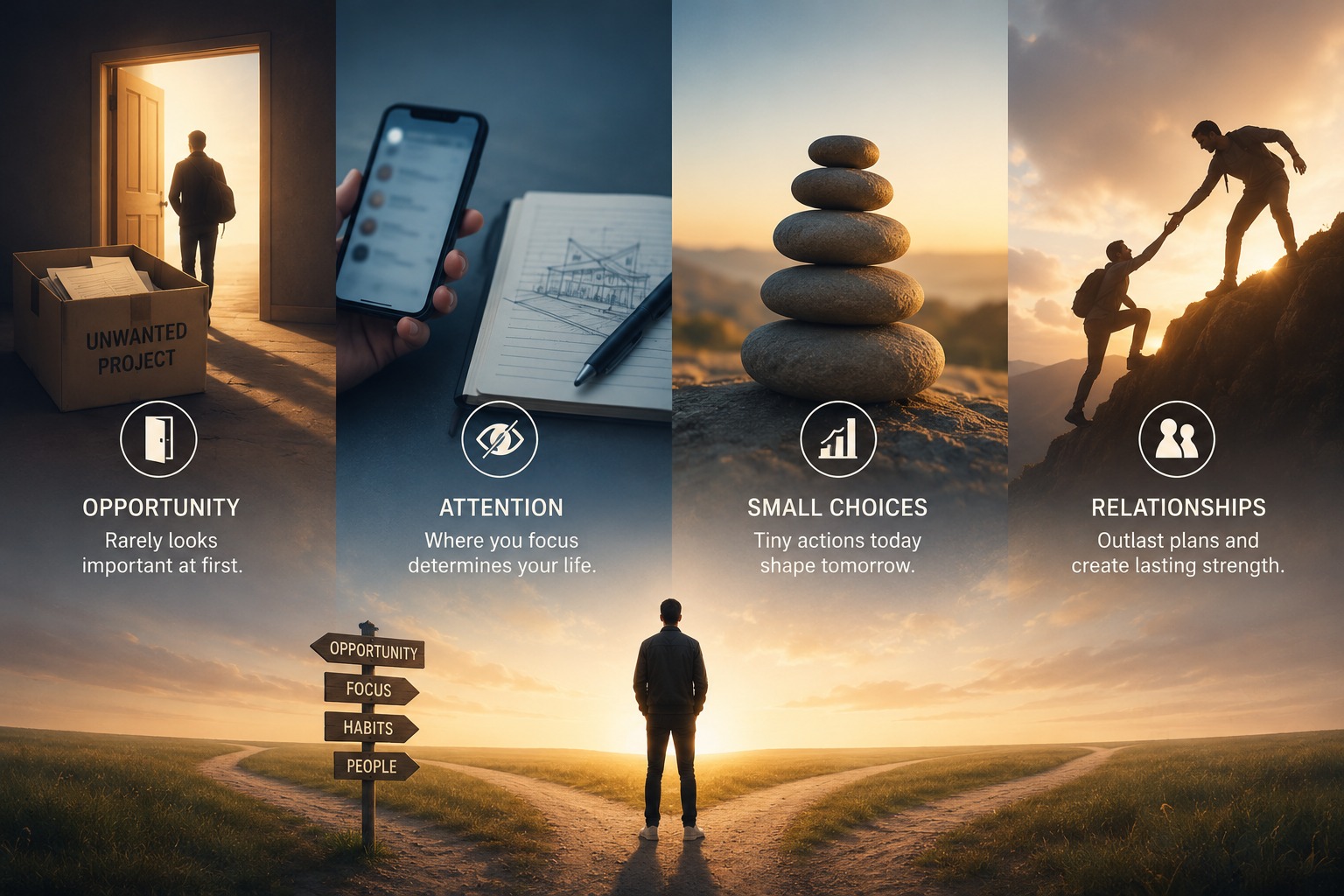
Some of life's most valuable lessons arrive long after they would have been useful. We spend years searching for major breakthroughs, only to discover that many of the forces shaping our future were present all along—quiet, ordinary, and easy to overlook. The irony is simple: by the time we recognize these lessons, they have already influenced our choices.
The Moments That Change Us Rarely Look Important at First
People often imagine opportunity as something obvious.
A promotion. A breakthrough idea. A major investment. A lucky break.
Reality is usually less dramatic.
Consider the fictional story of Aaron, a junior analyst at a growing Canadian technology firm. One winter, management asked for volunteers to help rescue an internal project that had fallen behind schedule. The assignment came with long meetings, uncertain outcomes, and little visibility. Most employees avoided it.
Aaron accepted.
For months, nothing seemed to happen. The project struggled, progress was slow, and there was little recognition for the effort.
Three years later, that same initiative evolved into the company's fastest-growing division. More importantly, the relationships Aaron built during those difficult months became the foundation of future opportunities throughout his career.
The lesson was not hidden in the project's eventual success.
The lesson was hidden inside the unpopular assignment nobody wanted.
Many opportunities arrive disguised as inconvenience.
Why Attention Matters More Than Time
People frequently discuss time management.
Far fewer discuss attention management.
Yet time passes whether we use it wisely or not. Attention determines what we actually experience during that time.
Imagine two architecture graduates leaving the same institution in the same year. They possess similar abilities, similar ambitions, and similar opportunities.
Over the next decade, however, their paths begin to diverge.
One becomes consumed by endless notifications, comparisons, trends, and distractions. The other spends years developing deep expertise in a specific area of design.
Ten years later, both have lived through the same number of days.
Yet they have not lived the same life.
The difference was never the amount of time available.
It was where attention was invested.
Attention is one of the few resources that cannot be recovered once spent.
The Quiet Decisions That Shape Entire Futures
People often remember dramatic turning points.
A new job.
A move to a different city.
A major achievement.
What they rarely notice are the thousands of smaller decisions that quietly built the path leading there.
A book left unread.
A conversation delayed.
A skill never developed.
A friendship allowed to fade.
A healthy habit postponed until tomorrow.
These choices rarely feel important in isolation. Their power comes from accumulation.
Much like a river slowly shaping a landscape, repeated actions create outcomes that appear sudden only to those who were not watching closely.
The most significant changes in life often happen gradually enough to escape our attention.
Why Relationships Outlast Even the Best Plans
Many people devote extraordinary energy to creating detailed plans for the future.
Career plans.
Financial plans.
Five-year plans.
Ten-year plans.
Planning has value. But plans have a weakness: circumstances change.
Industries evolve.
Markets shift.
Unexpected events intervene.
People, however, often remain.
Imagine two professionals beginning their careers at the same time. One focuses exclusively on strategy and personal achievement. The other invests equal effort into building trust, helping colleagues, and maintaining meaningful relationships.
Years later, both encounter setbacks.
The first discovers that even the strongest plan can fail when conditions change.
The second discovers that trusted relationships create resilience that no document or roadmap can replicate.
Plans can guide direction.
People often determine whether the journey continues.
The Strange Nature of Lessons Learned Through Experience
Perhaps these lessons arrive late because they cannot be fully taught.
A person can explain the importance of attention, relationships, patience, or opportunity.
Understanding them intellectually is different from experiencing their consequences.
Life has a way of teaching through results rather than lectures.
That is why many lessons become obvious only in hindsight.
The missed opportunity.
The neglected relationship.
The habit that quietly shaped a future.
The distraction that consumed years.
None of them seemed particularly important in the moment.
Together, they changed everything.
The Real Story Behind Personal Growth
The biggest influences on our lives are often the least visible while they are happening.
Opportunity rarely announces itself.
Attention quietly directs our future.
Small decisions compound beyond what we can easily see.
Relationships endure longer than carefully designed plans.
These truths are not hidden because they are complicated.
They are hidden because they are ordinary.
And perhaps that is the lesson people learn too late: life is shaped less by the dramatic moments we anticipate and more by the quiet choices we barely notice.
FAQ: Brief Insights on Life Lessons
Why do important life lessons often arrive late?
Because many lessons require lived experience. Understanding an idea and experiencing its consequences are rarely the same thing.
Why are small decisions so powerful?
Individual choices seem insignificant, but their effects accumulate over months and years, eventually creating outcomes that appear much larger.