
The foundations of human intelligence, movement, sensation, and survival are built astonishingly early. During the first trimester, a baby's brain transforms from a tiny cluster of cells into a rapidly organizing nervous system that already communicates with the body.
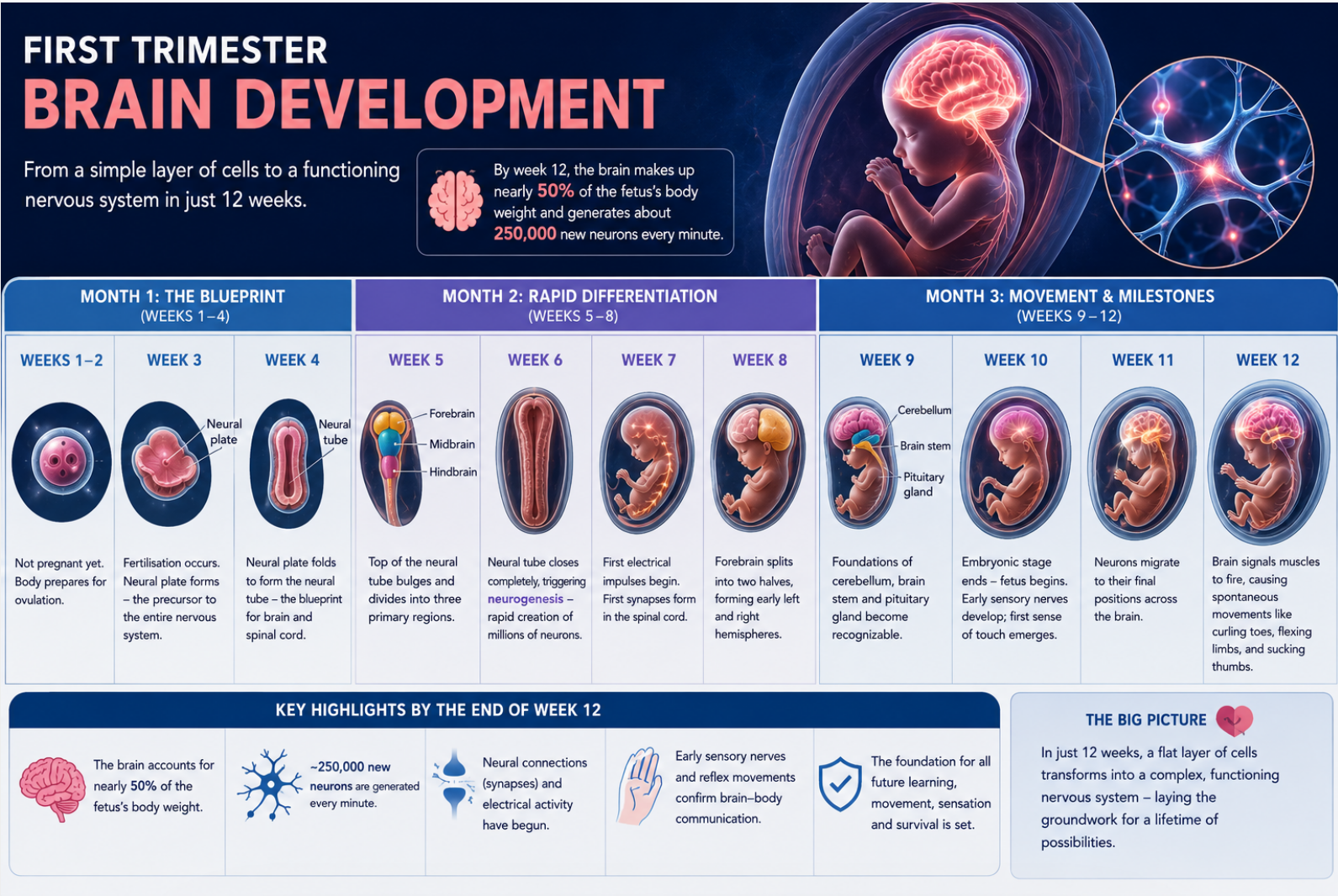
By the end of week 12, the brain represents nearly half of the fetus's total body weight and is generating approximately 250,000 new neurons every minute. Most parents cannot yet feel movement, but neurological construction is already operating at full speed.
Twelve Weeks That Build the Nervous System's Framework
The first trimester is less about growth in size and more about creating the infrastructure that every future brain function will depend upon.
The process begins before most pregnancies are confirmed and accelerates through a series of precisely timed developmental milestones.
Month 1: From Conception to the Neural Blueprint
During the first two weeks, the body prepares for ovulation and conception.
By week three, fertilization has occurred and the embryo develops a specialized structure called the neural plate. This small, oval-shaped layer of tissue serves as the earliest foundation of the entire nervous system.
Week four marks a major transition.
The neural plate folds inward and elongates to create the neural tube. This structure becomes the master blueprint for the central nervous system, with its upper region forming the brain and its lower section developing into the spinal cord.
The Brain Begins Dividing Into Specialized Regions
The second month introduces rapid structural differentiation. What was once a simple tube starts organizing into distinct neurological territories.
Key developments between weeks five and eight include:
- Week 5: The upper neural tube expands into three primary brain regions—the forebrain, midbrain, and hindbrain.
- Week 6: The neural tube completes its closure, triggering a surge in neuron production known as neurogenesis.
- Week 7: Early electrical activity appears within the developing nervous system, while the first synaptic connections emerge inside the spinal cord.
- Week 8: The forebrain separates further, creating the earliest versions of the brain's left and right hemispheres.
This period establishes the organizational map that future learning, memory, vision, hearing, and survival functions will rely on.
When Structure Gives Way to Function
The third month marks a shift from construction to coordination.
By week nine, several critical neurological structures become visibly recognizable:
- The cerebellum, which will later support balance and coordination.
- The brain stem, responsible for automatic life-sustaining functions.
- The pituitary gland, a key regulator of hormonal activity.
Week ten represents another milestone. The embryo officially becomes a fetus, and the nervous system's core architecture is largely established. Early sensory nerves begin forming, allowing the first primitive experiences of touch.
Week eleven introduces a massive migration event.
Newly created neurons travel throughout the brain, moving into highly specific locations where they will eventually support specialized functions.
The First Brain-to-Body Conversations Begin
By week twelve, neurological communication becomes increasingly sophisticated.
Signals originating in the brain start activating muscles, producing spontaneous fetal movements such as:
- Curling toes
- Flexing limbs
- Moving tiny fingers
- Sucking thumbs
These actions are still involuntary reflexes and typically remain too subtle for a mother to detect. Yet they provide powerful evidence that the brain and body have successfully established communication pathways.
This milestone transforms the nervous system from a developing structure into an active control network.
Why the First Trimester Is a Developmental Turning Point
The remarkable aspect of first-trimester development is not simply how much growth occurs, but how quickly complexity emerges.
Within just twelve weeks:
- A neural plate becomes a functioning nervous system.
- The brain divides into specialized regions.
- Electrical activity begins.
- Synapses start forming.
- Sensory pathways emerge.
- Brain signals trigger movement.
The foundations for every future milestone—from a baby's first word to adult decision-making—trace back to this intense period of neurological construction.
What Comes Next After Week 12?
While the nervous system's blueprint is largely established by the end of the first trimester, development is far from complete.
The second and third trimesters will focus on expanding neural networks, refining communication pathways, strengthening sensory systems, and preparing the brain for life outside the womb.
The pace remains extraordinary, but the first twelve weeks represent the moment when the brain's core architecture is first brought to life.
FAQ: Brief Insights on First-Trimester Brain Development
When does brain development actually begin during pregnancy?
Brain development begins around the third week after fertilization with the formation of the neural plate, the earliest precursor to the nervous system.
What is the neural tube and why is it important?
The neural tube is the structure that eventually develops into both the brain and spinal cord. It serves as the central blueprint for the entire nervous system.
When does the fetal brain start showing activity?
Early electrical impulses begin appearing around week seven, alongside the formation of the first synaptic connections.
Can a baby move during the first trimester?
Yes. By week twelve, brain signals can trigger reflexive movements, although they are usually too faint for the mother to feel.
Related Perspectives
- Prenatal Nutrition and Brain Growth
- Neural Tube Formation During Pregnancy
- Fetal Sensory Development
Medical Disclaimer
This article is intended for informational and educational purposes only and should not be considered medical advice. Research on fetal brain development describes general developmental patterns and does not predict individual outcomes.
Fetal growth and neurological development can vary between pregnancies. Readers should consult a qualified healthcare professional regarding pregnancy-related concerns, diagnosis, treatment decisions, or personalized medical guidance.