
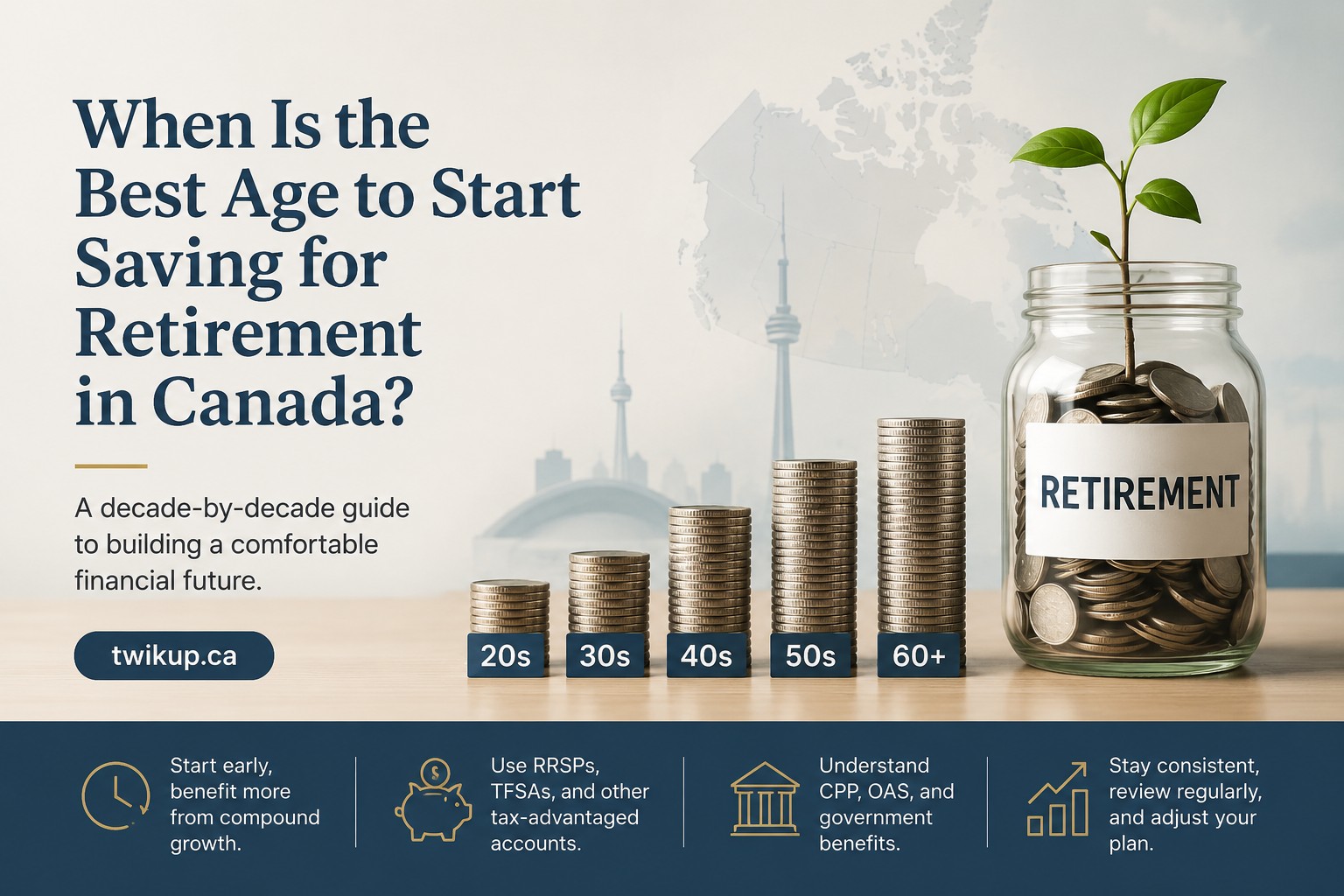
When is the best age to start saving for retirement in Canada? The short answer is as early as possible. The longer answer requires understanding how compound growth, government benefits, employer programs, and tax-advantaged accounts interact across different life stages. Whether you are 22 and just entering the workforce or 45 and wondering if you have started too late, this guide provides the framework to understand where you stand and what to do next.
We have covered the mechanics of retirement savings at every decade of life, Canada's public pension system, the RRSP and TFSA landscape, catch-up strategies, and the specific numbers Canadians need to understand to retire comfortably.
Quick Answer
The best age to start saving for retirement in Canada is as early as possible.
A Canadian who begins investing at age 22 can potentially accumulate more than $1 million by age 65 with consistent contributions, while someone starting at age 50 may accumulate less than $120,000 using the same monthly savings amount.
Even if you start later, RRSPs, TFSAs, CPP, OAS, and catch-up contributions can still help build a comfortable retirement.
Key Takeaways
- Starting retirement savings in your 20s provides the greatest advantage through compound growth.
- RRSPs and TFSAs remain the most important retirement accounts for Canadians.
- CPP and OAS should supplement retirement income, not replace personal savings.
- Canadians in their 40s and 50s can still make meaningful catch-up contributions.
- Retirement income needs vary significantly by province and lifestyle.
The Case for Starting Early: Compound Growth
The most powerful argument for starting retirement planning young is compound growth. Compound growth occurs when investment returns generate their own returns over time, creating an exponential rather than linear accumulation curve.
The Numbers at Different Starting Ages
Assume a monthly contribution of $500, an average annual return of 6%, and a retirement age of 65:
| Starting Age | Total Contributions | Final Value at 65 | Investment Growth |
|---|---|---|---|
| 22 | $258,000 | $1,014,000 | $756,000 |
| 30 | $210,000 | $600,000 | $390,000 |
| 35 | $180,000 | $416,000 | $236,000 |
| 40 | $150,000 | $284,000 | $134,000 |
| 45 | $120,000 | $188,000 | $68,000 |
| 50 | $90,000 | $119,000 | $29,000 |
The 22-year-old who contributes the same monthly amount as the 50-year-old ends up with more than eight times the final balance, despite contributing less than three times the total amount. The difference is entirely the result of compound growth operating over a longer time horizon.
Retirement Planning by Decade
In Your 20s: Build the Foundation
Your twenties are the most powerful decade for retirement saving because contributions made now have 40 or more years to compound. Even small amounts invested consistently in your twenties create a foundation that significantly shapes your retirement outcome.
Priority Actions:
-
Open a TFSA immediately: The Tax-Free Savings Account is the single best first step for young Canadians. Contributions are not tax-deductible, but all growth and withdrawals are completely tax-free. Room accumulates at $7,000 per year (2026 limit), and unused room carries forward indefinitely.
-
Contribute to your employer RRSP matching program: If your employer offers matching contributions to a Group RRSP or Pension Plan, contribute at least enough to receive the full match. Employer matching is an immediate 50% to 100% return on your investment that no market can replicate.
-
Start an RRSP if your income is above $55,000: RRSP contributions reduce your taxable income. At lower incomes, the tax benefit is smaller. As your income grows, the RRSP becomes increasingly valuable.
-
Establish an emergency fund first: Before investing for retirement, build three to six months of living expenses in a liquid savings account. Without an emergency fund, you may be forced to withdraw retirement savings early, triggering taxes and penalties.
Common 20s Mistakes:
- Waiting until you earn more to start saving
- Withdrawing TFSA or RRSP funds for short-term goals
- Ignoring employer matching programs
- Prioritizing lifestyle inflation over savings rate
In Your 30s: Accelerate Your Contributions
Your thirties typically bring higher income, greater financial stability, and competing financial demands including mortgages, childcare, and family expenses. The challenge is maintaining retirement savings momentum alongside these other priorities.
Priority Actions:
-
Maximize RRSP contributions: By your mid-thirties, your income is likely high enough to make RRSP contributions highly valuable from a tax perspective. The RRSP contribution limit is 18% of the previous year's earned income, up to a maximum of $32,490 in 2026.
-
Continue TFSA contributions: If you have accumulated TFSA room from previous years, work toward filling it. TFSA flexibility makes it particularly valuable as you navigate life changes in your thirties.
-
Define your retirement number: Calculate how much money you will need at retirement. A common rule of thumb is 25 times your expected annual expenses (the 4% withdrawal rule). If you expect to spend $80,000 per year in retirement, your target is $2,000,000.
-
Review and adjust your investment allocation: In your thirties, you have 30 or more years until retirement. Your portfolio should reflect this long horizon with a higher equity allocation (typically 80% to 90% equities, 10% to 20% fixed income) to maximize growth.
Registered Accounts Summary:
| Account | 2026 Contribution Limit | Tax Treatment | Best For |
|---|---|---|---|
| TFSA | $7,000 per year | Tax-free growth and withdrawals | All income levels |
| RRSP | 18% of income, max $32,490 | Tax-deductible contributions, taxable withdrawals | Higher income earners |
| FHSA | $8,000 per year, $40,000 lifetime | Tax-deductible contributions, tax-free withdrawals for home purchase | First-time home buyers |
| Group RRSP/DPSP | Varies by employer | Same as RRSP | Employer matching programs |
In Your 40s: Peak Earning and Serious Catch-Up
Your forties are typically your peak earning years. Children may be approaching independence, your mortgage may be significantly paid down, and your income is likely higher than it has ever been. This is the decade where retirement savings can accelerate most dramatically.
Priority Actions:
-
Maximize both RRSP and TFSA: If you have not maximized contributions in previous years, your forties are the time to accelerate. Use your higher income to fill accumulated contribution room in both accounts.
-
Model your CPP and OAS income: Use the My Service Canada Account to review your CPP Statement of Contributions. This shows your projected CPP benefit at different retirement ages. Factor this income into your retirement plan.
-
Consider income splitting strategies: If your spouse or partner has a lower income, spousal RRSP contributions can reduce your combined tax burden in retirement. A spousal RRSP allows the higher earner to contribute to an RRSP in the spouse's name, attributing future withdrawals to the lower-income spouse.
-
Review your insurance coverage: Life insurance, disability insurance, and critical illness insurance are most affordable when purchased in your thirties and forties. Ensure adequate coverage is in place.
Key Question for Your 40s: If you are behind on retirement savings, calculate the monthly contribution needed to reach your retirement target by 65. Even catching up in your forties produces meaningful results, particularly if CPP, OAS, and any employer pension are factored into the total retirement income picture.
In Your 50s: The Final Acceleration Phase
Your fifties mark the transition from accumulation to preservation. You are close enough to retirement to see the finish line but still have time to make meaningful contributions. This decade is about maximizing contributions, managing risk, and beginning to plan the structure of your retirement income.
Priority Actions:
-
Make catch-up contributions: If your RRSP or TFSA room is not fully used, your fifties are your last opportunity to close the gap.
-
Shift your investment allocation gradually: As retirement approaches, begin reducing equity exposure and increasing fixed income and stable assets. A common guideline is to hold your age as a percentage in fixed income (so a 55-year-old holds 55% fixed income), but this is a conservative approach. Many financial planners now recommend higher equity allocations even into retirement given longer life expectancies.
-
Model your retirement income: Build a detailed model of your expected retirement income from all sources: CPP, OAS, employer pension (if any), RRSP/RRIF withdrawals, and TFSA withdrawals. Identify any gap between projected income and desired spending.
-
Plan your CPP start date: You can start CPP as early as 60 (with a reduction) or as late as 70 (with an enhancement). Each year you delay after 65 increases your CPP benefit by 8.4%. Delaying CPP to 70 can increase your lifetime benefit significantly if you are in good health.
In Your 60s: Transition to Retirement
Your sixties are the decade of transition. You may retire during this decade or continue working, but your financial focus shifts from accumulation to income generation and tax-efficient withdrawal.
Priority Actions:
-
Convert your RRSP to a RRIF by age 71: Canadian law requires you to convert your RRSP to a Registered Retirement Income Fund (RRIF) by December 31 of the year you turn 71. RRIF withdrawals are subject to mandatory minimum amounts and are fully taxable as income.
-
Plan your OAS start date: Old Age Security begins at age 65 but can be deferred to age 70, with a 7.2% increase per year of deferral. If you have adequate income before 70, deferring OAS can increase your lifetime benefit.
-
Optimize your withdrawal sequence: The order in which you draw from different accounts (taxable, RRSP/RRIF, TFSA) significantly affects your lifetime tax burden. A financial planner can model the optimal sequence for your specific situation.
-
Consider your estate: Update your will, powers of attorney, and beneficiary designations on all registered accounts and insurance policies.
Canada's Public Pension System
Retirement planning in Canada is built on a three-pillar system:
Pillar 1: Old Age Security (OAS)
OAS is a universal monthly benefit paid to most Canadians aged 65 and older. It is funded from general government revenues and does not require any employment history.
| Benefit | Monthly Amount (2026) | Annual Amount |
|---|---|---|
| OAS (65 to 74) | $727.67 | $8,732 |
| OAS (75 and older) | $800.44 | $9,605 |
| Guaranteed Income Supplement (GIS) | Up to $1,065.47 | Up to $12,786 |
OAS is clawed back for higher-income recipients. In 2026, the clawback begins at individual net income of $90,997 and eliminates OAS entirely at approximately $148,000.
Pillar 2: Canada Pension Plan (CPP)
CPP is an earnings-based pension that provides retirement, disability, and survivor benefits. The amount you receive depends on your contributions over your working life.
| CPP Benefit | Maximum Monthly Amount (2026) |
|---|---|
| Retirement pension at 65 | $1,364.60 |
| Disability pension | $1,537.04 |
| Survivor's pension (under 65) | $739.31 |
| Combined retirement and survivor | $1,364.60 (maximum) |
The average CPP retirement pension is significantly below the maximum. Most Canadians receive approximately 40% to 60% of the maximum benefit based on their actual contribution history.
CPP2, introduced in 2019, has been progressively enhancing CPP benefits. Workers who contributed to CPP2 between 2019 and 2026 will receive higher retirement benefits than previous generations.
Pillar 3: Private Savings (RRSP, TFSA, Employer Pensions)
The third pillar comprises personal savings through registered accounts and employer-sponsored pension plans. This is the pillar most directly within your control.
How Much Do You Need to Retire in Canada?
The amount you need depends on your expected lifestyle, where you plan to live, your health, and the other income sources available to you.
Common Rules of Thumb
| Rule | Description | Example |
|---|---|---|
| 25x expenses | Save 25 times your expected annual spending | $70,000/year × 25 = $1,750,000 |
| 70% rule | Aim for 70% of pre-retirement income | $120,000 income × 70% = $84,000/year |
| $1 million benchmark | Broad general target for a comfortable middle-class retirement | — |
These rules of thumb are starting points, not precise targets. Your specific situation requires a personalized analysis that accounts for CPP, OAS, employer pensions, and your expected spending patterns.
Regional Cost of Living Considerations
Retirement costs vary significantly by location:
| City | Estimated Annual Cost for Comfortable Retirement (Couple) |
|---|---|
| Toronto | $95,000 to $115,000 |
| Vancouver | $90,000 to $110,000 |
| Calgary | $80,000 to $95,000 |
| Ottawa | $75,000 to $90,000 |
| Halifax | $65,000 to $80,000 |
| Moncton | $55,000 to $70,000 |
| Charlottetown | $55,000 to $68,000 |
Retiring in a smaller city or secondary market can significantly reduce the savings required. Some Canadians choose to retire outside Canada entirely in lower-cost countries, though this introduces tax and healthcare complexity.
Common Retirement Planning Mistakes
Starting Too Late
The most common and costly mistake is delaying the start of retirement savings. Every year of delay has a compounding cost that grows over time.
Relying Entirely on CPP and OAS
CPP and OAS combined provide approximately $2,100 per month for the average Canadian. For most Canadians, this is not sufficient to maintain their pre-retirement lifestyle. Private savings are essential.
Withdrawing Registered Savings Early
Withdrawing RRSP funds before retirement triggers withholding tax and permanently eliminates the contribution room, which cannot be re-contributed.
Underestimating Life Expectancy
A 65-year-old Canadian woman has a life expectancy of approximately 87 years. A 65-year-old man has a life expectancy of approximately 84 years. Retirement savings must last 20 to 30 years or more. Many Canadians underestimate how long their money must last.
Ignoring Inflation
A retirement income of $60,000 per year in 2026 will have the purchasing power of approximately $44,000 in 2046 assuming 2% annual inflation. Retirement plans must account for the erosion of purchasing power over time.
Frequently Asked Questions
Is it too late to start retirement planning at 45? No. While starting at 22 produces significantly better outcomes, starting at 45 still allows 20 years of growth. Maximize RRSP and TFSA contributions, factor in CPP and OAS, and consider working two to three years longer to significantly improve your retirement outcome.
Should I pay off my mortgage or contribute to my RRSP? This depends on your mortgage rate and marginal tax rate. If your mortgage rate is lower than your expected investment return and your marginal tax rate is high, RRSP contributions typically win. If your mortgage rate is high, paying it down first may be preferable.
What is the best age to take CPP? This depends on your health, other income sources, and financial needs. Delaying CPP to 70 maximizes the benefit but requires adequate income from other sources between 65 and 70. If you are in poor health or need income before 65, starting early may be appropriate.
How much can I contribute to my RRSP in 2026? The 2026 RRSP contribution limit is 18% of your 2025 earned income, up to a maximum of $32,490. Any unused contribution room from previous years carries forward and can be used in addition to the current year limit.
What happens to my RRSP when I turn 71? You must convert your RRSP to a Registered Retirement Income Fund (RRIF) or annuity by December 31 of the year you turn 71. RRIF withdrawals are subject to mandatory minimum amounts that increase each year with age.
Related Perspectives
- [Emergency Room Wait Times in Canada: What You Need to Know in 2026]
- [Remote Work vs Office Work: What Canadians Prefer in 2026]
- Provinces Offering the Most Immigration Opportunities in 2026
- Is Canada's Immigration Boom Making Life Harder for Canadians?
- Top 10 Fastest Immigration Pathways to Canada Right Now
Sources
- Government of Canada: Old Age Security Payment Amounts — https://www.canada.ca/en/services/benefits/publicpensions/cpp/old-age-security/payments.html
- Government of Canada: Canada Pension Plan — https://www.canada.ca/en/services/benefits/publicpensions/cpp.html
- Canada Revenue Agency: RRSP Contribution Limits — https://www.canada.ca/en/revenue-agency/services/tax/individuals/topics/rrsps-related-plans/contributing-a-rrsp-prpp/whats-your-rrsp-contribution-limit.html
- Canada Revenue Agency: TFSA Contribution Room — https://www.canada.ca/en/revenue-agency/services/tax/individuals/topics/tax-free-savings-account/contributions.html
- Statistics Canada: Life Expectancy at Various Ages — https://www150.statcan.gc.ca/n1/pub/82-625-x/2021001/article/00001-eng.htm
- Financial Consumer Agency of Canada: Retirement Planning — https://www.canada.ca/en/financial-consumer-agency/services/retirement-planning.html
- Investment Industry Regulatory Organization of Canada (CIRO) — https://www.ciro.ca/
- The Globe and Mail: Canadian Retirement Cost of Living Analysis 2026 — https://www.theglobeandmail.com/