
Canadians Lost Over $704 Million to Fraud in 2025 — And Most Victims Never Report It
Quick Answer
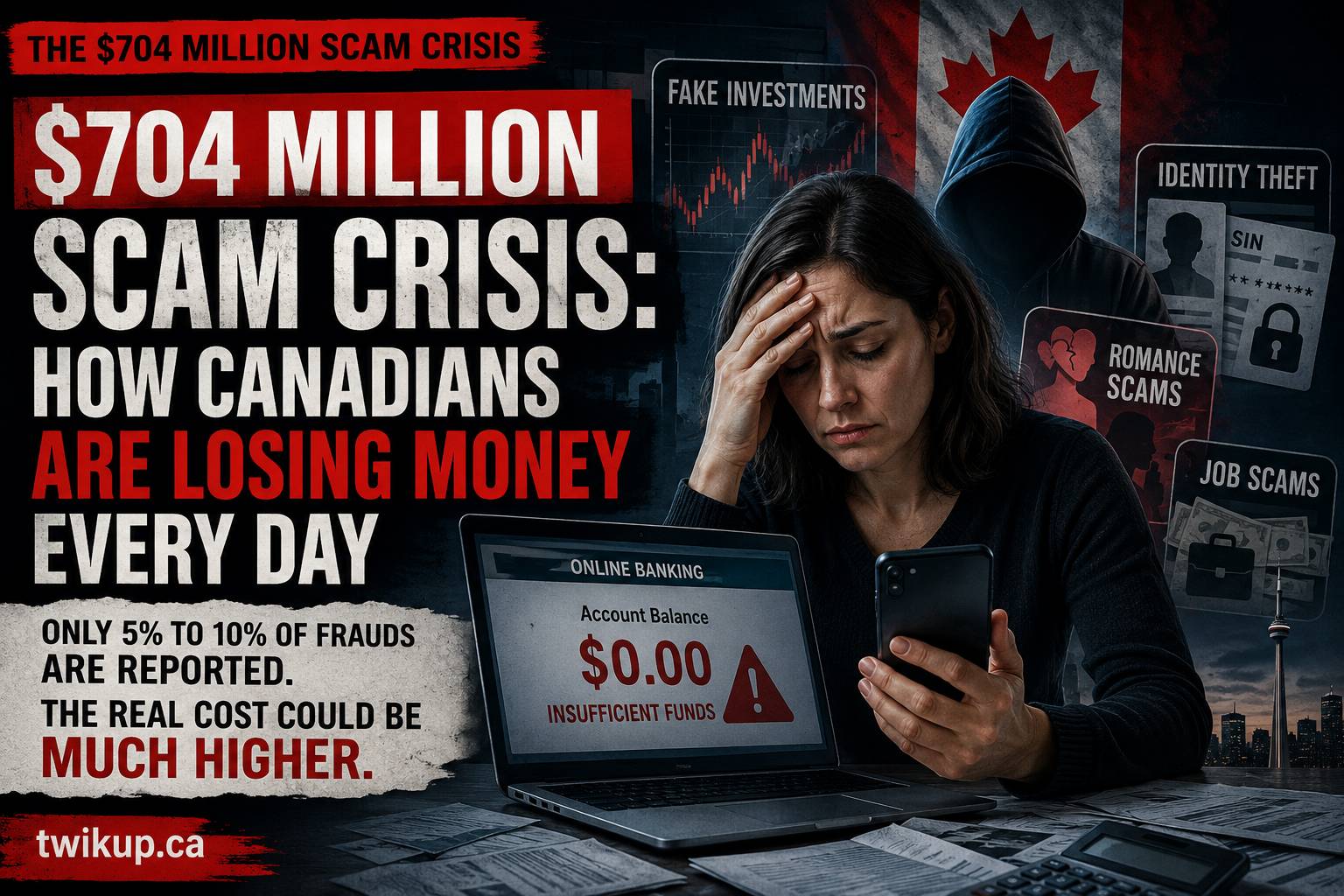
Canadians lost more than $704 million to fraud in 2025, according to data from the Canadian Anti-Fraud Centre (CAFC). The most common scams include identity theft, investment scams, service scams, romance scams, job scams, government impersonation scams, and AI-powered fraud schemes.
Authorities estimate that only 5% to 10% of fraud cases are reported, meaning the real financial damage could be several billion dollars annually.
Key Takeaways
✅ Canadians reported losing over $704 million to fraud in 2025
✅ Reported fraud losses since 2022 now exceed $2.4 billion
✅ Only 5%–10% of fraud incidents are reported
✅ Identity fraud, investment fraud, and service fraud were the most commonly reported scams
✅ Investment fraud, romance scams, and job scams caused the largest financial losses
✅ AI-generated voice cloning and impersonation scams are rapidly increasing
✅ Fraudsters are becoming harder to identify due to technology and international scam networks
✅ Reporting fraud helps authorities identify patterns and stop future victims
Why Canada's Fraud Problem Is Much Bigger Than Most People Realize
Many Canadians assume fraud only happens to people who are careless online.
The reality is very different.
Today's scams are highly sophisticated. Criminals use:
- Artificial intelligence
- Caller ID spoofing
- Fake websites
- Deepfake voices
- Social media manipulation
- Professional-looking investment platforms
- Impersonation tactics
Victims now include:
- Students
- Seniors
- Small business owners
- New immigrants
- Professionals
- Retirees
- Experienced investors
Fraud has evolved into a highly organized industry.
According to the Competition Bureau, fraud is now one of Canada's fastest-growing crimes.
The Hidden Number Nobody Is Talking About
The headline figure is alarming:
$704 million lost in 2025.
But the more shocking statistic is this:
Authorities estimate only 5% to 10% of frauds are actually reported.
That means the real losses could potentially be many times higher.
For every victim who reports a scam:
- Many feel embarrassed
- Some don't realize they've been scammed
- Others believe authorities cannot help
- Many fear judgment from family or employers
As a result, Canada's fraud crisis may be significantly larger than official statistics suggest.
The Most Common Fraud Types Reported in Canada
1. Identity Fraud
Identity fraud remains one of the most widespread scams.
Fraudsters attempt to obtain:
- Social Insurance Numbers (SIN)
- Banking information
- Credit card details
- Passwords
- Government credentials
Common tactics include:
- Fake CRA calls
- Phishing emails
- Fake banking websites
- Text message scams
Once criminals obtain personal information, they may:
- Open credit accounts
- Apply for loans
- Commit tax fraud
- Access online accounts
2. Investment Fraud
Investment fraud continues to cause the largest financial losses.
Typical scams include:
Cryptocurrency Investments
Fraudsters promise:
- Guaranteed returns
- Insider opportunities
- Exclusive crypto trading systems
Fake Trading Platforms
Victims often see fake profits on professional-looking websites before being unable to withdraw funds.
Ponzi Schemes
Early investors receive payouts funded by newer investors until the scheme collapses.
AI Investment Scams
Fraudsters increasingly use AI-generated advertisements featuring fake celebrity endorsements.
3. Service Fraud
Service fraud often targets consumers seeking help with:
- Home repairs
- Renovations
- Appliance services
- Moving services
- Online marketplace purchases
Warning signs include:
- Upfront payment requests
- No physical business address
- Pressure to act immediately
- Unusually low prices
The Most Financially Damaging Scams
According to the Canadian Anti-Fraud Centre, the three fraud categories causing the highest financial losses were:
Investment Fraud
Often involves losses ranging from thousands to hundreds of thousands of dollars.
Romance Scams
Fraudsters build emotional relationships online before requesting money.
Common platforms include:
- Dating apps
- Messaging apps
Victims are frequently manipulated over weeks or months before money is requested.
Job Scams
As remote work grows, job fraud has exploded.
Common signs include:
- High pay for little work
- Requests to purchase equipment
- Fake cheque schemes
- Requests for banking information
Many victims are students, newcomers, and job seekers under financial pressure.
How Artificial Intelligence Is Supercharging Fraud
One of the biggest concerns raised by Canadian authorities in 2026 is the growing role of AI.
According to Competition Bureau Acting Commissioner Jeanne Pratt:
"AI has armed fraudsters with powerful tools to create highly convincing impersonations and deceptive marketing schemes."
AI now allows criminals to create:
Voice Cloning
Fraudsters can replicate someone's voice using only a short audio sample.
A victim may receive what sounds like a call from:
- Their child
- Their spouse
- Their employer
- A government official
Deepfake Videos
Fake videos can make public figures appear to endorse fraudulent investments.
Hyper-Personalized Phishing
AI can generate messages that look remarkably convincing and personalized.
Traditional scam warning signs are becoming harder to spot.
The Scam Psychology That Traps Smart People
Many victims ask themselves:
"How did I fall for this?"
Fraudsters don't succeed because victims are unintelligent.
They succeed because they exploit human emotions.
The most common triggers include:
Fear
Examples:
- CRA threats
- Deportation threats
- Arrest warnings
Greed
Examples:
- Guaranteed investment returns
- Crypto riches
- Limited-time opportunities
Urgency
Examples:
- "Act now"
- "Your account will be closed"
- "Offer expires today"
Trust
Examples:
- Fake government representatives
- Bank impersonation
- Family emergencies
10 Red Flags Every Canadian Should Know
If you encounter any of the following, stop immediately:
🚩 Pressure to act quickly
🚩 Requests for gift cards
🚩 Requests for cryptocurrency payments
🚩 Unsolicited investment opportunities
🚩 Requests for passwords or verification codes
🚩 Unexpected calls claiming to be government agencies
🚩 Poorly verified online job offers
🚩 Requests for remote computer access
🚩 Emotional pressure tactics
🚩 Guarantees of profit with no risk
What To Do If You Have Been Scammed
If you suspect fraud:
Step 1: Stop Communication
Do not continue engaging with the scammer.
Step 2: Contact Your Bank
Immediate action may reduce losses.
Step 3: Change Passwords
Update all affected accounts.
Step 4: Report The Incident
Contact:
- Your local police
- Canadian Anti-Fraud Centre (CAFC)
Phone:
1-888-495-8501
Report online through Canada's cybercrime and fraud reporting system.
Even if you lost no money, authorities encourage reporting.
Every report helps investigators identify larger criminal networks.
Why Reporting Fraud Matters
Many Canadians never report fraud because they assume nothing will happen.
However, fraud reports help authorities:
- Identify emerging scams
- Connect criminal networks
- Warn the public
- Prevent future victims
- Improve law enforcement investigations
One report may be the missing piece that helps stop a larger fraud operation.
Twikup Insight
The most dangerous scam in 2026 isn't necessarily the one you've never heard of.
It's the scam that looks completely legitimate.
Fraudsters no longer rely on obvious spelling mistakes or suspicious emails. Many now operate sophisticated websites, AI-generated customer service systems, cloned voices, fake investment dashboards, and highly targeted social media campaigns.
The future of fraud is not about hacking technology.
It's about hacking trust.
The best defense is slowing down before acting. Any message demanding immediate action, money, passwords, or personal information deserves verification through an independent source.
As fraud becomes smarter, skepticism becomes one of the most valuable financial skills Canadians can develop.
Final Thoughts
The $704 million lost to fraud in 2025 represents more than a financial statistic.
It represents retirement savings lost, families impacted, businesses damaged, and trust exploited.
With reported fraud losses exceeding $2.4 billion since 2022—and most incidents never reported—the true scale of Canada's fraud crisis may be far larger than official numbers suggest.
The good news is that awareness remains one of the most effective defenses.
Before clicking, investing, sharing personal information, or sending money:
Pause. Verify. Report.
That simple habit could save thousands of dollars—and help protect other Canadians as well.
Source
Government of Canada – Competition Bureau Canada Fraud Prevention Month 2026 https://www.canada.ca/en/competition-bureau/news/2026/03/fraud-prevention-month-to-bring-hidden-crime-into-the-spotlight.html