
Key Takeaways
- A collection of small instalments can become a significant monthly commitment when payment dates overlap.
- BNPL credit-report treatment depends on the provider, product structure and whether unpaid debt reaches collections.
- Consumer complaint options and regulatory protections are not identical in Canada and the United States.
Your $25 Payment Looked Harmless. Then Five More Bills Arrived.
A $100 pair of shoes, split into four payments of $25, can feel like a simple choice. It is easy to forget that the same reasoning applies to every other purchase you split. By the time the first payments are due, the total can quietly add up to more than you expected.
Buy Now, Pay Later — BNPL — lets you take a purchase home today and pay for it in instalments. Many plans advertise four interest-free payments, which can make a $100 purchase feel like a $25 decision. But the cost of the purchase does not change just because the payment is divided.
This matters because most BNPL decisions are not made in isolation. A payment plan for shoes is followed by one for a jacket, then one for headphones. Each one feels manageable on its own, until the combined instalments become a regular claim on your paycheque.
Why $25 Doesn't Stay $25
A single $25 instalment is not the problem. The problem is that the amount of BNPL debt grows faster than people notice because each new purchase adds another schedule.
Imagine three recent purchases:
- Shoes — $120, split into four payments of $30
- A household appliance — $240, split into four payments of $60
- Electronics — $160, split into four payments of $40
The combined first instalments are $130, and the same amount is due again for the next three payment rounds. That is $130 coming out of your account four times, even though no single purchase seemed unaffordable at checkout.
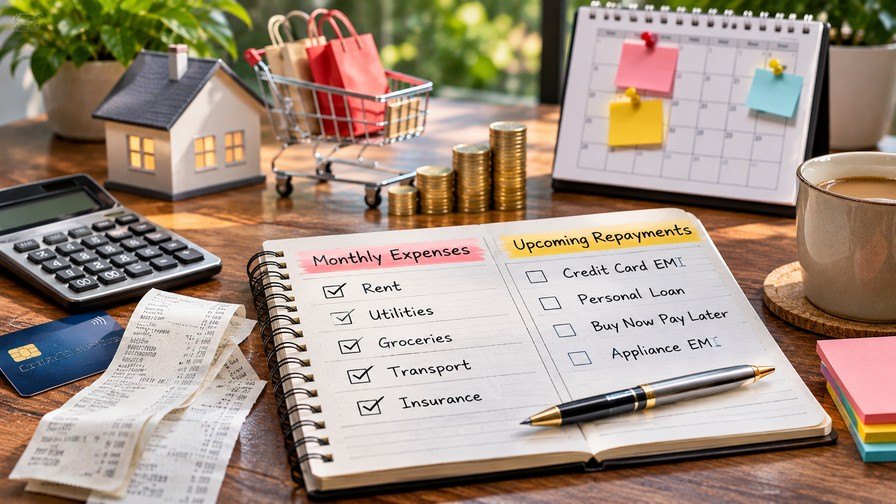
That pattern is why BNPL can quietly become a debt trap. People often judge whether they can afford something by looking at the first payment alone. A more accurate test is to add up every instalment due before your next payday and ask whether the total still leaves enough for rent, groceries, transport, and other bills.
A similar principle applies to businesses that borrow. Investors use the interest coverage ratio to check whether a company earns enough to cover its interest payments. The scale is different, but the idea is the same: one payment is not the whole picture.
The Hidden Costs Behind 'Interest-Free'
Many BNPL plans are interest-free when payments are made on time. That does not mean they are free of risk.
A missed payment can lead to a late fee. Some providers can restrict future purchases, refer an unpaid balance to collections, or report it in a way that affects your credit file. Automatic payments can also cause a bank overdraft or a non-sufficient-funds charge if the account balance is too low when the payment is taken.
Longer-term instalment plans can carry interest, administration charges, or processing fees, and their terms are often different from short pay-in-four offers. Before accepting any plan, check the total amount to be repaid, the payment dates, the late-payment rules, and what happens if you return the item.
Does Buy Now, Pay Later Affect Your Credit Score?
There is no single answer, because it depends on the provider, the product, and where you live.
Some short pay-in-four providers do not routinely report regular payments to credit bureaus, so paying on time may not help build a credit history. That does not mean a missed payment has no consequences. If an unpaid balance is sent to collections and reported, it can appear on a credit report. Longer-term instalment products are also more likely to involve a credit check and to report account activity.
Do not assume a BNPL plan is invisible just because it does not appear on your current credit report. Read the provider's terms and check your credit reports for unfamiliar or incorrect entries.
What Canadian Consumers Should Know
In Canada, the Financial Consumer Agency of Canada (FCAC) explains that BNPL is financing, not simply a different way to check out. Depending on the plan, it may involve a retailer, a financial service provider, or a credit-card issuer.
The FCAC's pilot study shows why affordability still matters. Among the small group of users who had paid their purchases on time and in full, 15% still reported unfavourable financial trade-offs, including delaying another bill or cutting back on essentials. The pilot involved only 66 users, so it is not a national estimate — but it is a useful warning that even people who never miss a payment can feel the strain.
If a problem arises, start with the provider and, where relevant, the retailer. Complaint routes can depend on the type of financial institution and the province or territory. Federally regulated institutions must have complaint-handling processes. Other arrangements may fall under provincial or territorial consumer authorities.
What US Consumers Should Know
In the United States, BNPL terms and protections vary by lender, product, and applicable federal or state law. The Consumer Financial Protection Bureau (CFPB) provides guidance on missed payments, fees, and possible credit-report consequences.
The CFPB also withdrew its 2024 BNPL interpretive rule on May 12, 2025. Consumers should not rely on that withdrawn guidance as a current blanket guarantee of credit-card-style protections.
If a lender or collector reports information, consumers can review their credit reports and dispute inaccurate entries through the relevant credit reporting company. State financial regulators may also offer complaint channels for certain providers.
The Twikup Take
BNPL is not automatically a bad choice. It can work for a planned purchase when the total cost fits your budget and you know exactly when every payment is due.
The risk is not the first payment. It is the habit of judging affordability by the size of one instalment, while several plans quietly stack up behind it. Add up every BNPL payment due before your next payday before you accept a new plan. If the total leaves too little for essentials, the purchase is not affordable right now — even if the checkout screen says it is.
And a smaller payment doesn't make the original purchase cheaper.
Disclaimer This article is for general educational purposes and is not personalised financial or legal advice. BNPL terms, credit-reporting practices and consumer protections vary by provider, product and jurisdiction. Review your agreement and consult the relevant regulator if you need help with a specific dispute.