
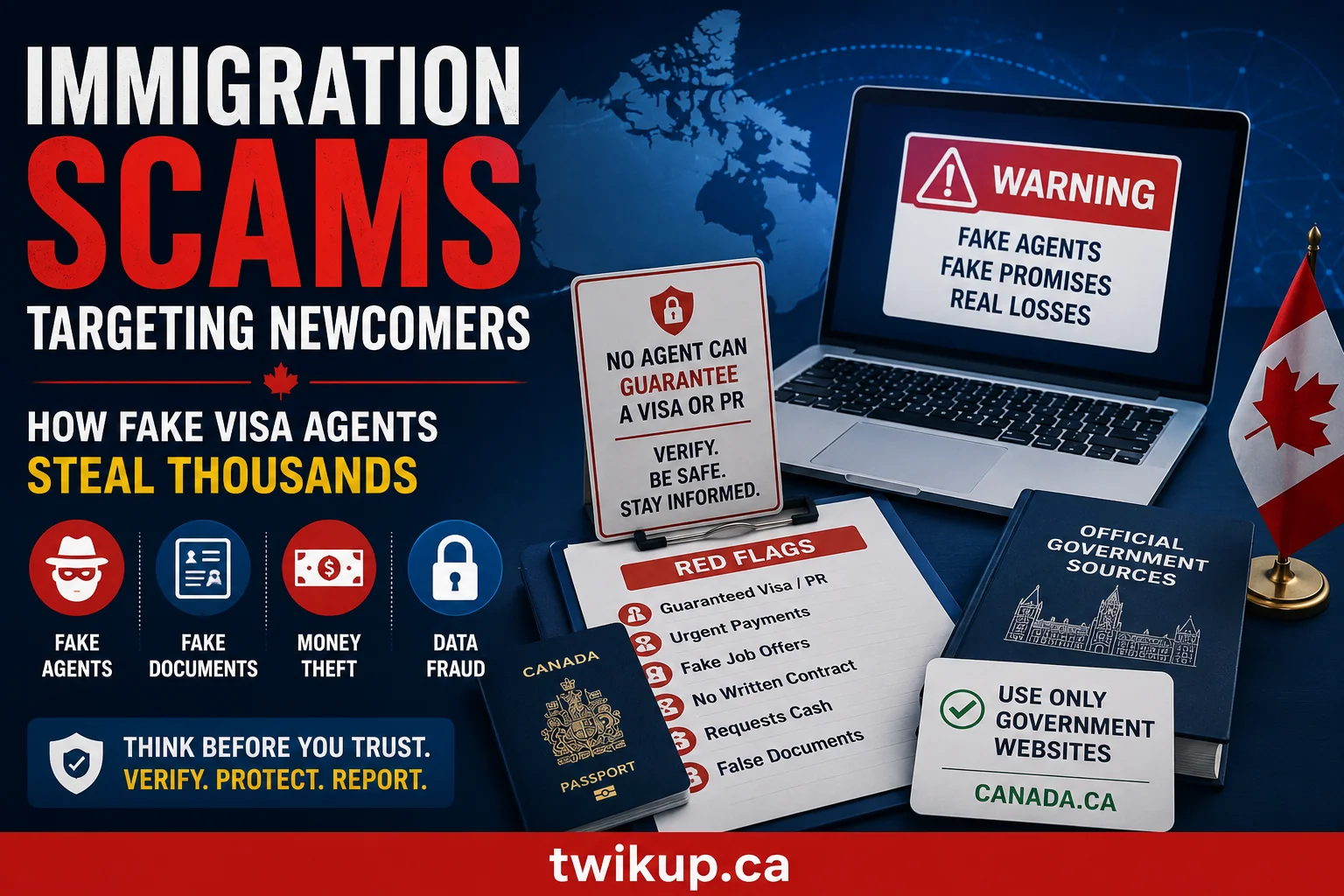
Immigration Scams Targeting Newcomers: How Fake Visa Agents Steal Thousands
Quick answer
Immigration scams in Canada usually work because fraudsters create urgency. They pretend to be visa agents, immigration consultants, government officers, police, CRA, CBSA, or IRCC staff and tell newcomers they must pay immediately, submit documents fast, or risk deportation, arrest, visa refusal, or application cancellation.
The safest rule is simple: no real immigration representative can guarantee a visa, guarantee PR, secretly speed up your file, or ask you to lie on an application. Paid immigration representatives must be authorized, and IRCC says applicants are responsible for the information submitted in their application, even if a representative completes it for them.
Twikup insight
For newcomers, the scam is not always obvious. Many victims are not careless — they are scared, new to the system, under pressure, and trying to protect their future in Canada.
That is exactly why fake visa agents use words like “urgent,” “guaranteed,” “inside connection,” “limited slot,” “cash discount,” “LMIA approved,” “PR package,” “file stuck,” or “pay now or your status will be cancelled.”
A real Canadian immigration process may be stressful, but it should still be traceable through official portals, receipts, licensed representatives, written contracts, and government websites.
Why newcomers are targeted
Newcomers, international students, work permit holders, visitors, and PR applicants are attractive targets because immigration decisions affect their job, family, study plans, and future in Canada.
IRCC warns that newcomers may not be used to how Canadian companies or government offices do business, which can make fake calls, fake emails, fake websites, and fake representatives more convincing.
Scammers often rely on fear. They may say:
- Your visa will be cancelled.
- Your file has a problem.
- You submitted wrong information.
- You owe government money.
- Police or CBSA will come to your home.
- Your PR can be approved faster if you pay.
- A job offer or LMIA is ready, but only if you pay today.
Common immigration scams in Canada
1. Fake visa agents
This is one of the most dangerous scams because it can look professional.
A fake agent may create a website, WhatsApp profile, office setup, social media page, fake reviews, or fake success stories. They may claim they can get you a study permit, work permit, visitor visa, LMIA job, or PR approval.
IRCC says paid immigration representatives must be licensed if they give immigration advice or represent you. Authorized paid representatives include lawyers, some paralegals, Quebec notaries, and consultants registered with the College of Immigration and Citizenship Consultants.
2. Guaranteed visa or guaranteed PR scam
No agent can guarantee approval.
IRCC clearly warns that using a representative will not guarantee approval or give your application special attention.
Be careful when someone says:
- “100% visa guaranteed”
- “PR guaranteed”
- “No refusal”
- “Government connection”
- “Embassy contact”
- “Special quota”
- “Pay after approval, but deposit now”
These are major red flags.
3. Fake job offer or LMIA scam
Some scammers sell fake job offers or fake LMIA documents to people who want to come to Canada or stay in Canada.
This can become extremely serious. If false documents are submitted, the applicant can face refusal, removal, or future inadmissibility issues.
IRCC warns people not to give false information in an application and says it can lead to refusal, deportation, or being denied entry to Canada.
4. Fake IRCC email or website scam
Fake immigration websites may look official, use Canada-related wording, or copy government-style designs.
IRCC says a website may be a scam if it asks for personal or financial information before the application process even starts, lacks proper security signs, or looks suspicious.
IRCC also says it does not ask for banking or credit card information by email to collect payments.
5. Fake consultant asking you to lie
This is one of the biggest danger signs.
If someone tells you to hide information, create fake documents, adjust employment history, fake bank statements, or submit false education/work details, stop immediately.
IRCC warns that applicants are responsible for all information in their application, even if a representative completes it for them.
Red flags of immigration fraud
Be careful if someone:
- Guarantees visa, PR, work permit, study permit, or LMIA approval.
- Says they have special IRCC, embassy, or government contacts.
- Pressures you to pay immediately.
- Asks for cash, gift cards, crypto, or personal transfers.
- Refuses to give a written agreement or receipt.
- Tells you not to contact IRCC directly.
- Uses only WhatsApp and avoids official email.
- Asks you to sign blank forms.
- Keeps your original documents.
- Tells you to lie or submit fake documents.
- Says they can speed up biometrics or processing for a fee.
IRCC specifically warns about representatives who promise guaranteed approval, claim they can expedite biometrics for a fee, advertise as free and later demand payment, or advise applicants to lie.
How to check if an immigration agent is real
Before paying anyone, check whether the person is authorized.
A paid immigration representative must be one of these:
- A lawyer or paralegal licensed by a Canadian provincial or territorial law society
- A Quebec notary
- A consultant registered with the College of Immigration and Citizenship Consultants
IRCC says paid representatives must be licensed to represent you or give advice.
What to do if you already paid a fake agent
If you think you were scammed:
- Stop sending money.
- Save all chats, receipts, contracts, emails, phone numbers, and payment proof.
- Report the situation to IRCC if your application is involved.
- Report to CBSA’s Border Watch Line where relevant.
- Report to the Canadian Anti-Fraud Centre.
- Contact local police if money was stolen.
- Contact your bank immediately if you shared payment or banking details.
IRCC says suspected representative fraud can be reported to IRCC, CBSA, the College of Immigration and Citizenship Consultants, a law society, the Canadian Anti-Fraud Centre, and local police depending on the situation.
Immigration scam vs government call scam
Immigration scams and fake government call scams often overlap.
A fraudster may first pretend to be from IRCC, CBSA, CRA, or police. Then they may transfer you to a fake “agent” who claims they can fix your file for a fee.
For fake government calls, read Twikup’s full guide here:
You can also read:
The $704 Million Scam Crisis: How Canadians Are Losing Money Every Day in 2026
Final takeaway
If someone promises guaranteed immigration success, asks for urgent payment, says they have inside government access, or tells you to submit false information, treat it as a serious warning sign.
Canada’s immigration system may be complicated, but real help should be licensed, traceable, documented, and honest.
Before paying anyone, verify the representative. Before submitting anything, check the information. Before panicking, go to official government sources.
A real opportunity should not require fear, secrecy, or lies.