
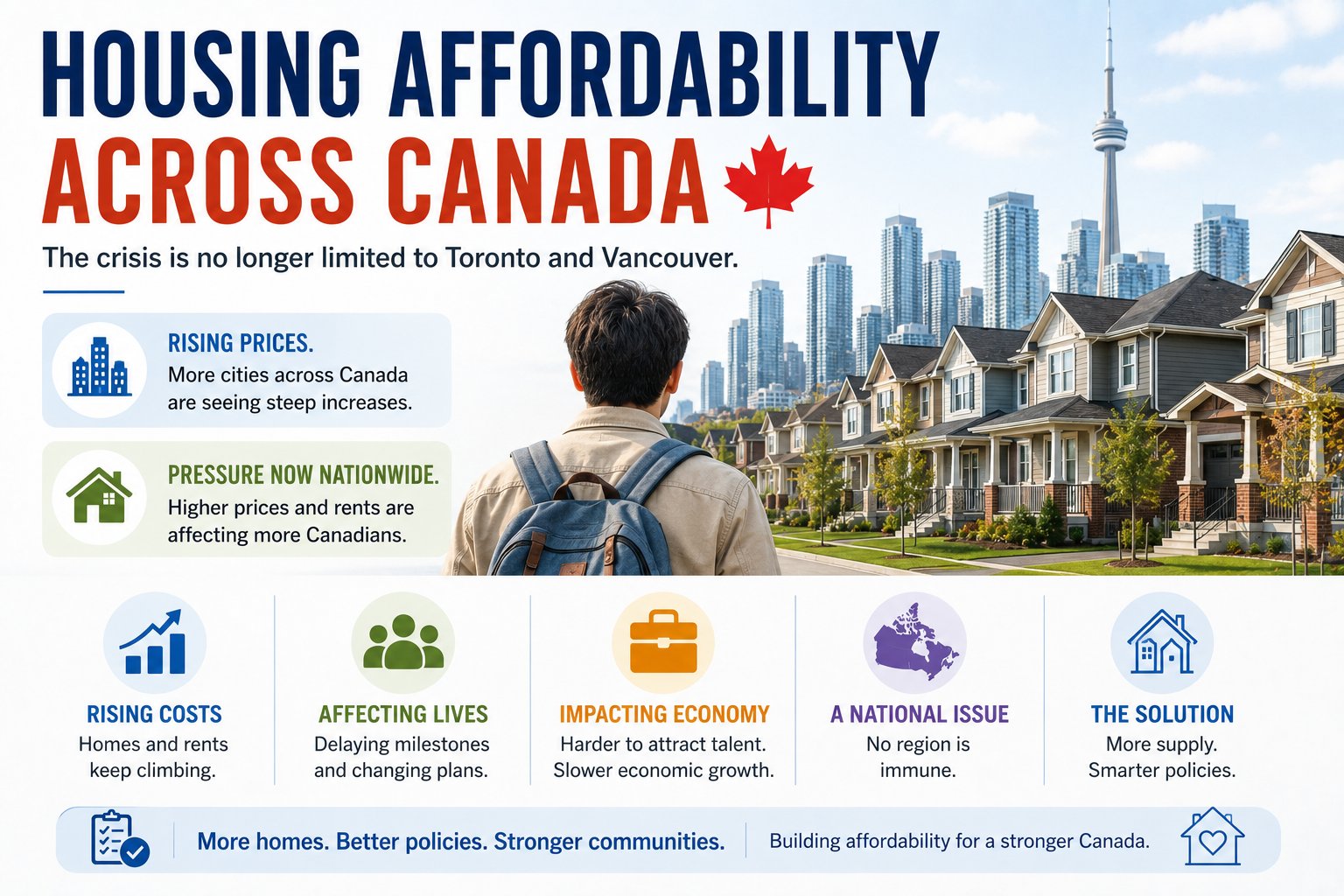
Housing affordability in Canada has become a national issue rather than a problem limited to Toronto and Vancouver. While these two cities continue to rank among the country's least affordable markets, rising prices and rents have spread the pressure to regions that were once viewed as accessible alternatives.
For many Canadians, the question is no longer where they want to live. It is where they can realistically afford to live.
Affordability pressures have spread far beyond Canada's largest cities
For years, Toronto and Vancouver dominated conversations around housing costs. Their combination of strong population growth, limited land supply and intense demand pushed prices to levels that placed homeownership out of reach for many households.
Today, similar pressures are emerging elsewhere.
Cities such as Halifax, Calgary, Ottawa and Montreal have witnessed significant increases in both home prices and rental costs. Population growth and constrained housing supply have intensified competition across multiple markets.
The affordability challenge has become increasingly national in character.
A comparison of Canada's least affordable cities
| City | Home Affordability | Rental Pressure | Overall Stress |
|---|---|---|---|
| Vancouver | Very High | High | Severe |
| Toronto | Very High | High | Severe |
| Halifax | High | High | Significant |
| Ottawa | High | Moderate | Growing |
| Calgary | Rising | Moderate | Increasing |
| Montreal | Rising | Moderate | Increasing |
Although affordability varies between cities, the common thread is the imbalance between housing demand and available supply.
Why previously affordable cities are becoming expensive
Several forces have transformed housing markets across the country.
-
Population growth has increased housing demand.
-
Limited homebuilding has restricted supply.
-
High construction costs have slowed new developments.
-
Elevated interest rates have increased financing costs.
-
Strong migration toward smaller cities has intensified local competition.
These trends have reduced the number of regions that Canadians can consider genuinely affordable.
Housing affordability is influencing migration patterns
The cost of housing increasingly affects where Canadians choose to live and work.
Some households are relocating to smaller communities in search of lower costs. Others are leaving expensive provinces altogether.
This migration creates a paradox.
As people move toward more affordable regions, housing demand rises there as well, eventually placing upward pressure on prices and rents.
Affordable cities can quickly become expensive cities.
The crisis has become a challenge for economic growth
Housing affordability is not only a social issue.
Businesses face difficulties attracting workers when employees cannot afford to live near employment centres. Young adults delay household formation and families reconsider long-term financial plans.
Economists increasingly view housing supply as a key factor influencing productivity and economic growth.
Without sufficient housing, population growth and labour market needs become harder to sustain.
What could determine which cities become more affordable
Future affordability will depend on several factors:
-
The pace of housing construction.
-
Interest rate trends.
-
Population growth patterns.
-
Municipal zoning reforms.
-
Investments in infrastructure and transit.
Cities that can increase housing supply more rapidly may be better positioned to restore affordability over time.
FAQ: Brief Insights on Housing Affordability
Which city is considered the least affordable in Canada?
Vancouver and Toronto continue to rank among the country's most expensive housing markets.
Are smaller cities still affordable?
Some remain relatively less expensive, but affordability pressures have spread to many regions.
Why are rents rising in so many cities?
Strong demand and insufficient supply have tightened rental markets across Canada.
Can moving to another province solve affordability problems?
It may provide temporary relief, but rising demand has begun affecting many previously affordable regions.
Why does housing affordability matter for the economy?
Housing influences labour mobility, family formation and business competitiveness.
Related Perspectives
Why Young Canadians Can't Afford a Home in 2026
Rent vs Buy in Canada 2026
How Housing Shortages Affect Families
Sources
-
Canada Mortgage and Housing Corporation (CMHC)
-
Statistics Canada
-
Housing, Infrastructure and Communities Canada