
Key Takeaways
- LEO satellites at ~550 km deliver ~25 ms latency, versus 600+ ms for geostationary satellites at 35,786 km
- Only 59.5% of rural households and 42.9% of First Nations households had 50/10 service at the Auditor General's audit
- Telesat's 225-satellite Lightspeed network targets Arctic and northern service around the end of Q1 2028
The whole story is distance
Imagine making a video call where every response takes more than half a second to arrive. You speak, wait, and then the other person finally hears you.
That's the problem with traditional satellite internet.
For years, satellite internet meant one enormous satellite parked 35,786 km above the equator. It appears fixed in the sky, but every signal makes a 600-millisecond round trip. That's fine for loading a web page, painful for a video call and practically unusable for gaming.
Now comes the alternative: satellites much closer to Earth.
Low-Earth-orbit (LEO) constellations completely change the equation. Starlink's satellites fly at about 550 km, and the company puts latency at around 25 milliseconds.
That's a massive difference.
But there's a catch. At that height, a satellite crosses your sky in minutes. You can't depend on one satellite to keep your connection alive. Instead, you need thousands of them, handing your connection from one to the next, linked by laser.
Each Starlink satellite carries three optical inter-satellite links running at up to 200 Gbps.
Canada's regulator has a benchmark for this. The CRTC's quality criteria call for round-trip latency of at most 50 ms.
Geostationary service cannot meet it. LEO is built to.
What does a home actually need?
Here's where satellite internet gets interesting: you don't need traditional internet infrastructure running to your property.
No tower. No cable. No phone line.
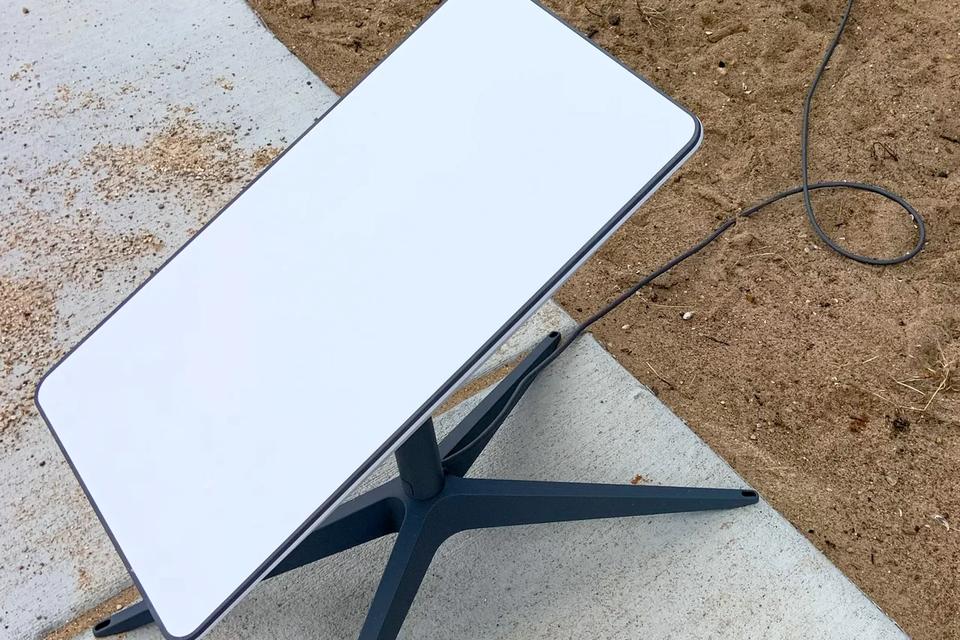
You need a flat-panel terminal with a clear view of the sky, power and a router.
Starlink documents its terminal as rated from −30°C to +50°C and able to melt snow off itself.
But satellite internet isn't immune to bad weather.
Moderate to heavy rain, snow and hail can cause short dropouts. Extreme weather can also slow service, although a full outage is rare.
For homes far from conventional infrastructure, that's a very different proposition from waiting for cables or fibre to reach the neighbourhood.
Why Canada cares: the last 4%
This is where satellite internet stops being a technology story and becomes a Canadian infrastructure story.
The federal target, set by the CRTC, is 50 Mbps down / 10 Mbps up, with an unlimited-data option.
The goal is to connect 98% of households by the end of 2026 and 100% by 2030.
Canada reached 96.4% coverage by the end of 2024.
That sounds encouraging. But there's a much bigger problem hiding behind the national average.
The Auditor General found that only 59.5% of rural households, and 42.9% of First Nations households, had 50/10 service at audit time.
In other words, the remaining gap isn't evenly spread across the country.
It's concentrated in rural, remote and northern communities — precisely the places where fibre may never reach and where satellite internet has a market to serve.
For those households, this isn't about getting faster internet. It's about getting connected in the first place.
Canada's own constellation: Telesat Lightspeed
Starlink isn't the only player looking at Canada's connectivity problem.
Ottawa-based Telesat is building Lightspeed, a constellation of 225 satellites at about 1,300 km, built by MDA Space.
Its stated latency is 30–50 ms.
The financing behind the project is substantial: a $2.14 billion federal loan, a $400 million Quebec loan, and a $2.3 billion defence contract for Arctic satellite communications, worth up to $2.7 billion with options.
And there's a distinctly Canadian priority: the North.
The first two pathfinder satellites are expected to launch no earlier than June 2027.
Telesat targets high-latitude service — including the Arctic and northern communities — around the end of Q1 2028, with full global service by the end of Q2 2028.
But Lightspeed isn't designed to work like Starlink's consumer service.
Unlike Starlink, Lightspeed is aimed at governments, telecom carriers and enterprises. Northern community broadband will be delivered through partners rather than a dish you buy yourself.
That makes it a different kind of satellite internet business, with a different customer and a different role in Canada's connectivity strategy.
The Twikup Take
Satellite internet is easy to dismiss if you already have reliable fibre or cable at home.
But for Canada's North and rural communities, the equation is completely different. When traditional infrastructure can't reach, orbit becomes the connection.
And by 2028, Canada expects to have a Canadian-built option, financed by Canadian governments and designed high-latitude-first.
The 50/10 promise for 2030 effectively runs through orbit.
Image: A flat-panel Starlink satellite dish outside a home, by Wikideas1, CC0, via Wikimedia Commons.