
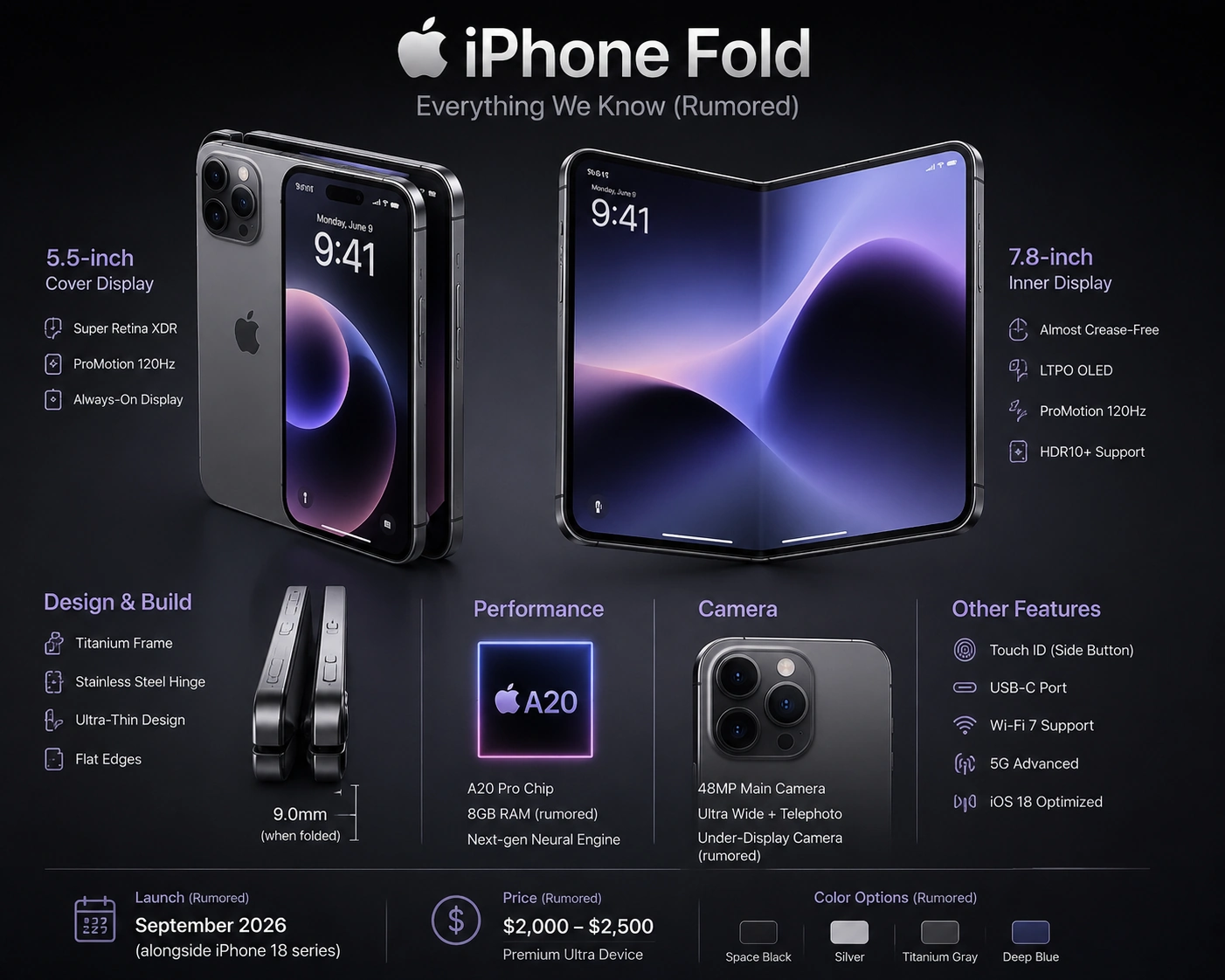
Editorial note: This article is based on industry reports, leaks, analyst expectations, and rumours available in 2026. Apple has not officially announced a foldable iPhone, and the final product, specifications, price, and release date could differ significantly from current reports.
Quick Answer
Apple’s first foldable iPhone could become one of the biggest smartphone launches in years — but for now, almost everything about the device remains unofficial.
Current rumours suggest Apple is developing a book-style foldable iPhone that opens horizontally into a larger, tablet-like display, similar in concept to Samsung’s Galaxy Z Fold series.
The device is widely expected to feature a premium design, a large inner display, a smaller outer screen, powerful next-generation hardware, and an extremely high price.
Some reports have pointed toward a possible 2026 launch window, although delays remain possible. Apple has not confirmed the device, its specifications, its name, or when it could arrive.
The short version: Apple appears increasingly likely to enter the foldable smartphone market, but buyers should treat every specification and release-date prediction as a rumour until Apple makes an official announcement.
TwikUp Insight
Apple rarely tries to be first.
It usually tries to enter an established product category after competitors have already exposed its biggest weaknesses.
That could be exactly what is happening with the foldable iPhone.
Samsung, Google, OnePlus and other smartphone manufacturers have already spent years improving foldable displays, hinges, software and durability. Apple has had the opportunity to watch the market evolve without releasing a first-generation product of its own.
Our view is that Apple’s biggest challenge is not simply making an iPhone that folds.
It is making a foldable phone that feels unmistakably like an Apple product.
That means the screen crease needs to be less distracting. The hinge needs to feel durable. Apps need to work naturally across different screen sizes. Battery life needs to remain competitive. And the device cannot feel like an expensive technology experiment.
If Apple believes those problems are finally close to being solved, 2026 could be the year the foldable smartphone market changes dramatically.
Is Apple Really Making a Foldable iPhone?
Apple has not officially announced a foldable iPhone.
However, rumours surrounding an Apple foldable device have circulated for years, supported by reports about display development, supply-chain activity, patents and industry analysts.
The important difference in 2026 is that the conversation appears to have moved beyond the simple question of whether Apple is interested in foldable technology.
The bigger questions are now:
- When could the foldable iPhone launch?
- What will it look like?
- How large will the displays be?
- Can Apple minimize the visible screen crease?
- How expensive will it be?
None of those questions has an official answer yet.
However, the growing number of reports suggests Apple’s foldable ambitions may be becoming more serious.
When Could the Apple Foldable iPhone Be Released?
The most closely watched rumour is that Apple could introduce its first foldable iPhone as early as 2026.
A launch later than 2026 also remains possible.
Apple is known for delaying products until the company believes the hardware, software and overall experience are ready for consumers. Foldable devices present additional challenges because of their complex displays, hinges, durability requirements and manufacturing costs.
That means even if Apple is targeting a specific launch window internally, the release schedule could still change.
Expected Release Timeline
| Question | Current Expectation |
|---|---|
| Has Apple officially announced a foldable iPhone? | No |
| Could it launch in 2026? | According to current rumours, possibly |
| Is the release date confirmed? | No |
| Could the launch be delayed? | Yes |
| Is September 2026 guaranteed? | No |
For now, buyers should consider 2026 a possible launch window rather than a confirmed release date.
What Could Apple Call Its Foldable iPhone?
The official name remains unknown.
Online discussions and media reports frequently use names such as:
- iPhone Fold
- Foldable iPhone
- iPhone Ultra
- iPhone Fold Pro
However, none of these names has been officially confirmed by Apple.
“iPhone Fold” is currently the easiest way to describe the rumoured product, but Apple could ultimately introduce an entirely different name.
The company has previously changed its product naming strategies, so predicting the final branding this early would be highly speculative.
What Will the Foldable iPhone Look Like?
One of the biggest questions surrounding Apple’s first foldable smartphone is whether it will use a book-style design or a smaller flip-phone design.
Current rumours increasingly point toward a book-style device.
That would mean the phone could have a smaller external display for everyday tasks and unfold horizontally to reveal a much larger internal screen.
Think of it as a device positioned somewhere between an iPhone and an iPad mini.
When closed, users could:
- Check notifications
- Send messages
- Make calls
- Use navigation
- Take photos
- Access everyday apps
When opened, the larger display could provide more space for:
- Watching videos
- Reading
- Gaming
- Multitasking
- Editing photos
- Working with documents
- Using multiple apps
This design could make the foldable iPhone much more than a traditional smartphone with a flexible screen.
It could become a new type of portable Apple device.
How Big Could the Foldable iPhone Display Be?
Current rumours suggest Apple could use two displays.
The external screen could reportedly measure around 5.5 inches, while the larger internal display could be approximately 7.8 inches when unfolded.
These numbers are not confirmed.
If accurate, however, the dimensions would make Apple’s first foldable noticeably different from many traditional smartphones.
| Display | Rumoured Size |
|---|---|
| Outer display | Around 5.5 inches |
| Inner foldable display | Around 7.8 inches |
| Officially confirmed? | No |
A wider internal display could create an experience closer to a small tablet than an oversized smartphone.
And that may be exactly what Apple is trying to achieve.
Could Apple Solve the Foldable Screen Crease Problem?
The visible crease running through the centre of a foldable display remains one of the technology’s biggest weaknesses.
Modern foldable phones have improved significantly, but the crease can still be visible from certain angles and noticeable when users move their fingers across the screen.
Apple may be trying to minimize this problem before releasing its first foldable device.
Reports have suggested the company is focused heavily on developing a display and hinge system that could make the crease significantly less noticeable.
Whether Apple can actually create a truly crease-free foldable display remains unknown.
But this could be one of the most important features of the entire device.
Why the Crease Matters
A less visible crease could:
- Make videos more immersive
- Improve reading experiences
- Make the device feel more premium
- Reduce one of the biggest complaints about current foldable phones
TwikUp believes the screen crease could be one of Apple’s biggest opportunities.
Apple does not need to invent the foldable phone.
It needs to improve the parts of the foldable experience that still feel unfinished.
How Thin Could Apple’s Foldable iPhone Be?
Thickness is another major challenge.
A foldable smartphone essentially places two sections of a device on top of each other when closed. That can make foldables noticeably thicker than traditional smartphones.
Apple is reportedly working toward an extremely thin design.
The challenge will be balancing:
- Battery capacity
- Camera hardware
- Structural strength
- Display durability
- Hinge technology
- Heat management
Making the phone thinner could improve portability, but Apple cannot sacrifice too much battery life or durability to achieve it.
This could be one of the most difficult engineering compromises behind the device.
Will the Foldable iPhone Have Face ID or Touch ID?
One of the more interesting rumours involves biometric security.
Instead of placing Face ID hardware inside the foldable display, Apple could reportedly use Touch ID integrated into the side button.
Apple already uses side-button Touch ID on some iPad models, so the technology itself would not be new.
Using Touch ID could potentially help Apple reduce the amount of hardware required around or beneath the display.
However, this remains unconfirmed.
Apple could ultimately use:
- Touch ID
- Face ID
- A combination of biometric technologies
- Another authentication system
Until the device is officially announced, its biometric security system remains speculation.
What Chip Could Power the Foldable iPhone?
If the foldable iPhone launches as an ultra-premium device, it would likely use one of Apple’s most advanced mobile processors available at the time.
The exact chip remains unknown.
Performance will be especially important because the larger display could encourage more demanding use cases, including:
- Multitasking
- Gaming
- Video editing
- Artificial intelligence features
- Productivity apps
- Running multiple applications simultaneously
Apple’s biggest advantage could be its ability to control both the hardware and software.
The company designs its own chips, operating systems and major services, potentially allowing it to optimize the foldable experience more deeply than manufacturers that rely on software developed by another company.
What Could the Cameras Be Like?
The foldable iPhone’s camera system remains another major unknown.
A premium price would create expectations for premium cameras.
However, extremely thin foldable designs create engineering challenges because advanced smartphone camera systems require physical space.
Apple may have to choose between:
- A thinner device
- Larger camera sensors
- More camera lenses
- Longer battery life
The final camera configuration will reveal a lot about how Apple positions the device.
Will it be the company’s ultimate flagship iPhone?
Or will it be a separate experimental category focused more on display technology and productivity?
We do not know yet.
What Operating System Could the Foldable iPhone Use?
The hardware may attract the most attention, but software could determine whether Apple’s foldable strategy succeeds.
A larger screen creates new possibilities.
Apple could introduce features such as:
- Advanced multitasking
- Multiple apps on screen
- Drag-and-drop between applications
- Expanded gaming experiences
- Tablet-style layouts
- Improved video viewing
- Better productivity tools
The company already has experience designing software for different screen sizes through the iPhone and iPad.
The real challenge will be creating an interface that transitions smoothly between the smaller outer screen and larger internal display.
For example, a user could open an app on the external display, unfold the phone, and expect that application to immediately adapt to the larger screen.
That experience needs to feel seamless.
If Apple gets the software right, it could become one of the foldable iPhone’s biggest advantages.
How Much Could the Apple Foldable iPhone Cost?
Do not expect Apple’s first foldable smartphone to be cheap.
Current industry speculation has placed the potential price somewhere around US$2,000 to US$2,500, although no official pricing information exists.
That would make it significantly more expensive than mainstream iPhones.
Rumoured Price Expectations
| Market | Possible Price Range |
|---|---|
| United States | Around US$2,000–US$2,500 |
| Canada | Potentially well above C$3,000 after currency conversion and pricing adjustments |
| Official Apple price | Not announced |
The final Canadian price could vary significantly based on exchange rates, taxes and Apple’s regional pricing strategy.
If these estimates prove accurate, the first foldable iPhone would likely target:
- Technology enthusiasts
- Early adopters
- Apple power users
- Premium smartphone buyers
- Professionals who want a phone-tablet hybrid
For most consumers, price could be the biggest reason to wait for future generations.
Why Has Apple Waited So Long to Make a Foldable Phone?
Apple’s competitors have sold foldable smartphones for years.
So why has Apple waited?
The simplest answer may be that foldable technology still involves compromises.
These can include:
- Visible display creases
- High prices
- Durability concerns
- Thick designs
- Complex hinges
- Battery limitations
- App optimization challenges
Apple has historically entered some product categories after competitors.
The company did not invent the smartphone, smartwatch, tablet or wireless earbuds.
Instead, Apple often focuses on combining hardware, software and services into a more polished consumer experience.
The foldable iPhone could follow the same strategy.
How Could the Apple Foldable Compare With Samsung Galaxy Z Fold?
Samsung is currently one of the most established manufacturers in the foldable smartphone market.
That makes comparisons inevitable.
| Feature | Rumoured Apple Foldable | Samsung Galaxy Z Fold Series |
|---|---|---|
| Design | Expected book-style foldable | Book-style foldable |
| Operating system | Expected Apple software experience | Android |
| Inner display | Rumoured around 7.8 inches | Large foldable display |
| Screen crease | Apple reportedly focused on minimizing it | Improved across generations |
| Price | Expected to be extremely premium | Already positioned as premium |
| Release status | Unannounced | Established product line |
Samsung has one major advantage: experience.
It has already released multiple generations of foldable smartphones and learned from years of real-world customer feedback.
Apple’s advantage could be ecosystem integration.
A foldable iPhone could potentially work closely with:
- Mac
- iPad
- Apple Watch
- AirPods
- iCloud
- Apple services
The competition may ultimately come down to Samsung’s foldable experience versus Apple’s ecosystem and software integration.
Could the Foldable iPhone Replace the iPad Mini?
Probably not immediately.
But the question is worth asking.
A foldable iPhone with a large internal display could potentially handle many tasks people currently use smaller tablets for.
That includes:
- Reading
- Watching videos
- Browsing the web
- Gaming
- Light productivity
However, the iPad mini would likely remain larger, potentially more affordable and better suited to extended tablet use.
The foldable iPhone could instead create a new middle category.
It could be an iPhone when closed and a small tablet when opened.
That flexibility may become its biggest selling point.
Should You Wait for the Apple Foldable iPhone?
That depends on what you need from your next smartphone.
You may want to wait if:
- You are interested in foldable technology
- You already use multiple Apple products
- You want a phone with a much larger screen
- You are willing to pay for first-generation technology
- Your current iPhone still works well
You may not want to wait if:
- You need a new phone immediately
- You prefer traditional smartphone designs
- You want the best value for money
- You are concerned about first-generation hardware
- You do not want to spend potentially thousands of dollars on a smartphone
Remember that Apple has not officially confirmed the product.
Waiting indefinitely for an unannounced device may not make sense for everyone.
What Is Confirmed and What Is Still a Rumour?
This is the most important distinction for anyone following Apple foldable news.
| Claim | Current Status |
|---|---|
| Apple has officially announced a foldable iPhone | No |
| A foldable iPhone could be in development | Widely reported |
| The device could use a book-style design | Rumoured |
| The inner screen could be around 7.8 inches | Rumoured |
| The outer display could be around 5.5 inches | Rumoured |
| Apple is working to minimize the display crease | Reported but unconfirmed |
| The phone could use Touch ID | Rumoured |
| The price could exceed US$2,000 | Industry speculation |
| The device will definitely launch in 2026 | Not confirmed |
| The official name will be iPhone Fold | Not confirmed |
Until Apple announces the device, readers should treat all specifications, prices and release dates as subject to change.
Why Apple’s First Foldable iPhone Could Matter
The significance of an Apple foldable goes beyond a single smartphone.
Apple’s entry could bring millions of new consumers into the foldable market.
It could also push competitors to improve:
- Display durability
- Hinge designs
- Software experiences
- Battery efficiency
- Device thickness
- Pricing
Developers could also have a stronger incentive to optimize applications for foldable displays.
In other words, Apple does not necessarily need to become the first company to make a foldable phone successful.
It could help make foldable phones mainstream.
Frequently Asked Questions
Is Apple releasing a foldable iPhone in 2026?
Apple has not officially confirmed a foldable iPhone or a 2026 release date. Current industry reports and rumours suggest a 2026 launch may be possible, but delays could occur.
What will Apple’s foldable iPhone be called?
The official name is unknown. “iPhone Fold” and “Apple Foldable iPhone” are commonly used unofficial names.
Will the foldable iPhone open like a book?
Current rumours suggest Apple is developing a book-style foldable device that opens horizontally to reveal a larger internal display.
How big could the Apple foldable iPhone screen be?
Reports have suggested an outer display of around 5.5 inches and an internal foldable display of approximately 7.8 inches. These specifications are not official.
How much could the Apple foldable iPhone cost?
Current speculation suggests a price of approximately US$2,000 to US$2,500. Apple has not announced official pricing.
Will Apple’s foldable iPhone have a screen crease?
Apple is reportedly working to minimize the visible crease found on foldable displays. It remains unknown whether the company can completely eliminate it.
Will the foldable iPhone have Face ID?
Some rumours suggest Apple could use side-button Touch ID instead of Face ID. The final biometric system has not been confirmed.
Should I wait for the foldable iPhone?
Waiting may make sense for Apple users interested in foldable technology who do not need a new phone immediately. However, the device remains unannounced, and its release date, specifications and price are uncertain.
Final Verdict
Apple’s first foldable iPhone could become one of the most important smartphone launches of the decade.
But expectations need to remain realistic.
Apple has not officially announced the device. There is no confirmed release date, official name, final design, specification sheet or price.
What we currently have is a growing collection of industry reports and rumours pointing toward a potentially ultra-premium, book-style foldable iPhone.
TwikUp’s view is simple: Apple does not need to create the world’s first foldable phone. It needs to create the first foldable iPhone that millions of existing Apple users genuinely want to own.
If Apple can deliver a thinner design, a less noticeable screen crease, seamless software and meaningful advantages from its ecosystem, the device could reshape the premium smartphone market.
If it cannot, the first foldable iPhone may become an extremely expensive experiment for early adopters.
For now, the biggest question is no longer whether a foldable iPhone sounds possible.
It is whether Apple can make waiting this long worth it.
This article is part of TwikUp’s Apple News and technology coverage. Details about unannounced products can change, and readers should rely on official Apple announcements for confirmed product information.