
Key Takeaways
- Model simulations put today's boreal fire season about two weeks longer than in pre-industrial conditions.
- The season lengthens by roughly 12 ± 2 days per degree Celsius of global warming, driven by higher temperatures and reduced snow cover.
- Above 2°C of warming, much of the boreal forest faces fire seasons outside anything in the pre-industrial range.
The Fire Season Is Stretching at Both Ends
Imagine a wildfire season that starts earlier in spring and refuses to end when autumn arrives.
That's increasingly the reality across the world's boreal forests. And according to new research, the average fire season is already approximately two weeks longer than it was before industrialisation.
The boreal forest is the enormous northern belt of spruce, pine and wetlands stretching across North America and Eurasia. It stores enormous amounts of carbon and includes regions that have experienced devastating wildfires, including Fort McMurray and Jasper in Canada.
A study published November 17 in Scientific Reports by researchers from the University of Victoria, Environment and Climate Change Canada's climate modelling centre and Thompson Rivers University has measured just how much warming is changing the calendar for these forests.
The researchers used 5,000 years of Earth-system model simulations to isolate the effects of global warming on boreal fire-season length.
The result is striking: under present-day warming, the mean boreal fire season is already approximately two weeks longer than under pre-industrial conditions.
And that's not where the trend stops.
The study estimates that every additional degree Celsius of global warming extends the average boreal fire season by roughly 12 days, plus or minus 2.
Why Is Fire Season Getting Longer?
The answer lies at both ends of the calendar.
Higher near-surface temperatures and reduced snow cover are shifting the conditions that determine when forests become susceptible to fire.
Spring arrives with less snow cover, allowing the fire season to begin earlier. Autumn temperatures remain higher, pushing its end further into the year.
The changes aren't equally distributed.
The largest proportional increases are happening in high-latitude regions, where fire seasons were historically the shortest. In other words, some of the farthest-north forests are experiencing some of the biggest changes relative to their historical fire-season length.
And the researchers identify an important threshold.
Above 2°C of global warming, much of the boreal forest faces fire seasons longer than anything within the pre-industrial range of variability.
Keeping global warming below 2°C could significantly limit how much of the forest enters this unprecedented territory.
What the Two-Week Finding Actually Means
There is an important distinction here.
The two-week increase comes from climate-model simulations comparing present-day warming with pre-industrial conditions. It is not a direct measurement showing that every Canadian forest now experiences exactly 14 additional fire-season days.
The research covers the wider boreal zone across North America and Eurasia, rather than Canada alone.
But the implications are difficult to ignore.
A longer fire season means a longer window in which conditions can favour wildfires. It also raises the potential pressure on firefighting resources and increases the period during which communities may face wildfire smoke.
The study doesn't predict that every additional fire-season day will produce a fire. But it shows that warming is expanding the period in which the conditions for fire can develop.
The Twikup Take
Two extra weeks might sound like a small calendar change. For a forest, it's a much bigger deal.
More time for fire-conducive conditions means a longer period of exposure for forests, communities and the people responsible for protecting them.
And the uncomfortable part? Every additional degree of warming adds roughly 12 more days.
The fire season isn't just getting worse. It's getting longer.
Health note: During wildfire smoke events, follow local public-health air-quality advisories and take precautions to reduce smoke exposure.
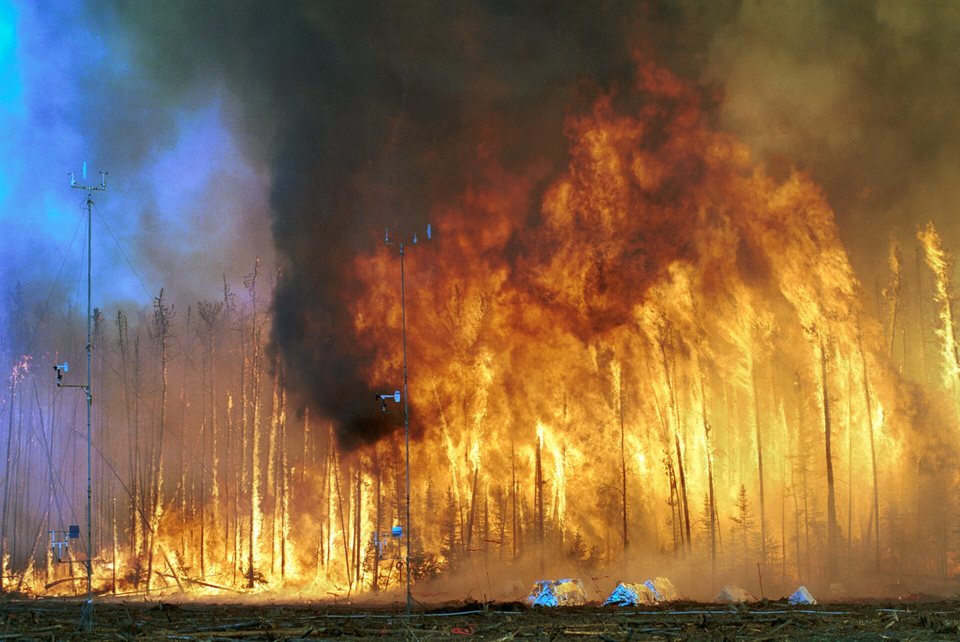
Photo: Northwest Crown Fire Experiment, USDA Forest Service, CC BY 2.5.