
Key Takeaways
- Telomeres — protective caps of repeated TTAGGG DNA — shorten with every cell division, and after roughly 40–60 divisions a cell permanently stops dividing.
- Senescent cells accumulate with age and release inflammatory signals (the SASP) linked to age-related disease.
- About 85–90% of cancers reactivate telomerase to divide indefinitely, and no treatment is proven to extend human life by lengthening telomeres.
Why can't our cells just keep dividing forever?
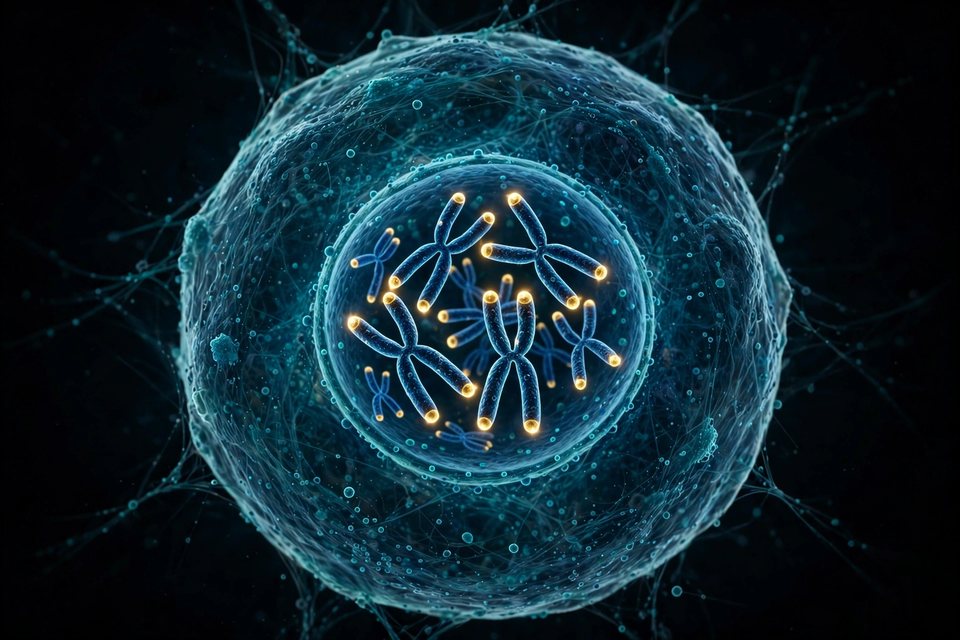
Inside almost every cell in your body sits a countdown clock. Each of your chromosomes ends in a protective cap called a telomere — a stretch of the same short DNA sequence, TTAGGG, repeated over and over, like the plastic tip on a shoelace. Its job is to stop the chromosome end from being mistaken for broken DNA.
The problem is built into how DNA copies itself. The copying machinery cannot quite reach the very end of a chromosome, so every time a cell divides, the telomere gets a little shorter — in human blood cells, roughly 50 to 60 DNA letters a year. Divide, shorten. Divide, shorten. When the cap wears down to a critical length, the cell reads its own chromosome end as damage and does something drastic: it stops dividing, permanently.
The 50-division limit
In 1961, Leonard Hayflick showed that normal human cells in a dish divide only about 40 to 60 times before they stop — a ceiling now called the Hayflick limit. The cells do not die. They enter a state called senescence: alive, metabolically active, but never able to copy themselves again.
One enzyme can rewind the clock. Telomerase rebuilds telomeres, extending them so division can continue. But in the human body, telomerase is switched on in only a select few places — embryonic cells, reproductive cells and some stem cells. In the ordinary cells that make up most of you, it is off. That is why most of our cells age on schedule.
The zombie cells that inflame us
Senescent cells would be harmless if they just sat quietly. They do not. They broadcast a cocktail of inflammatory signals — a mix scientists call the SASP — including molecules like IL-6 and IL-8 that call in immune cells and remodel surrounding tissue. In youth, that broadcast is useful: it helps heal wounds and clears damaged cells. With age, senescent cells accumulate faster than the immune system removes them, and their constant inflammatory chatter becomes a slow burn scientists call "inflammaging," linked to many of the diseases of old age.
DNA damage piles on from the other side. Everyday hits — from normal metabolism, sunlight, and simple copying errors — trigger the same emergency stop as short telomeres, locking more cells into senescence. It is this accumulation, of worn-out cells that will not die and will not stop signalling, that researchers now see as one of the core engines of aging.
Aging's built-in trade-off: cancer
Here is the twist. Senescence is not a design flaw — it is a defence. A cell with damaged DNA that kept dividing would be a cancer risk, so the body retires it. The same machinery that ages us protects us, early in life, from tumours.
Cancer cells have to defeat that machinery to grow. To divide forever, a tumour must solve the telomere problem — and about 85 to 90% of cancers do it by switching telomerase back on, regaining the immortality normal cells are denied. Most of the rest use a backup copying trick called ALT. Aging and cancer, in other words, are two sides of the same coin: one is the price of stopping the other.
So can we just lengthen telomeres and live longer?
That is the honest question, and the honest answer is: nobody has shown that we can. No supplement, drug or treatment has been proven to extend human life by lengthening telomeres. Telomere length is a marker that tracks with age and disease risk — but a marker is not a lever, and mice are a warning here: laboratory mice have telomeres five to ten times longer than ours, yet live about thirty times shorter lives. Deliberately switching telomerase on throughout the body also means handing every precancerous cell the very tool cancers use to become immortal. Drugs that kill senescent cells — senolytics — are a genuinely promising research direction, but they remain experimental, tested for specific diseases, not sold as anti-aging therapy.
Health note: This article explains basic aging research. Products marketed as "telomerase activators" or telomere-lengthening supplements are not proven to extend lifespan or prevent age-related disease. Be skeptical of any clinic or supplement that promises otherwise.
The Twikup Take
We age, in large part, because our cells are programmed to stop — and that stopping is also what keeps most of us cancer-free for decades. The science of telomeres and senescent cells is real and advancing fast, but anyone selling you a longer life from a bottle is running far ahead of the evidence.
Image: Illustrative image.