
Key Takeaways
- Each kidney filters blood through about a million nephrons — roughly half a cup of blood per minute, with only 1–2 quarts a day becoming urine
- eGFR estimates filtration from blood creatinine; below 60 may mean kidney disease, and 15 or below is kidney failure
- The urine albumin ratio (uACR) often shows damage earliest; people with diabetes or high blood pressure should be tested regularly
Two organs, five jobs — and the two numbers that tell you how they're doing
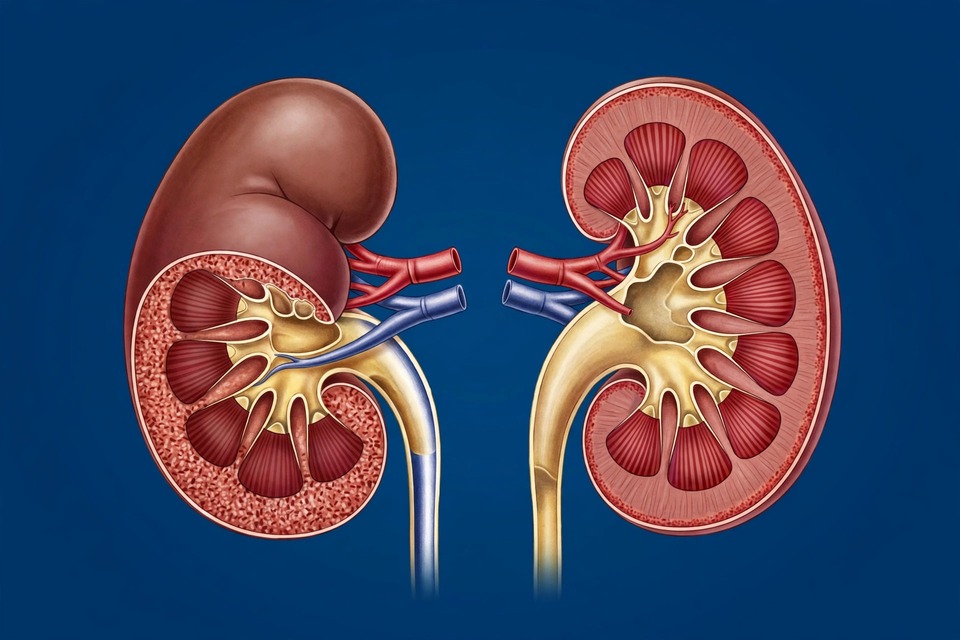
Each kidney holds roughly a million nephrons — microscopic filtering units, each built from a ball of capillaries (the glomerulus) feeding a long tubule.
Blood enters under pressure. Water, salts and waste are pushed out into the tubule, and then the tubule reclaims almost everything the body still needs — water, glucose, minerals — returning it to the blood. What is left becomes urine.
The scale is hard to picture. Your kidneys filter about half a cup of blood every minute — around 150 quarts a day — and turn only one to two quarts of that into urine. The rest is reabsorbed.
But filtration is only the first job. The kidneys also remove acids the body produces, balance water, sodium, calcium, phosphorus and potassium, and release hormones that control blood pressure, make red blood cells, and keep bones strong.
That is why kidney failure is never just a plumbing problem: it shows up as anemia, bone disease and runaway blood pressure.
The two numbers that matter
Kidney damage is usually silent, so doctors track two tests.
The first is eGFR — estimated glomerular filtration rate. It starts from a blood test for creatinine, a waste product of normal muscle breakdown, and converts it into an estimate of how much blood your kidneys filter per minute. The "e" matters: it is a calculated estimate, not a direct measurement.
The scale clinicians use (the KDIGO categories) runs: G1 at 90 or above (normal filtration, though damage can still be present), G2 60–89, G3a 45–59, G3b 30–44, G4 15–29, and G5 below 15 — kidney failure.
The U.S. National Institute of Diabetes and Digestive and Kidney Diseases frames the same scale simply: a GFR of 60 or higher is in the normal range, below 60 may mean kidney disease, and 15 or below is kidney failure.
The second test catches what eGFR misses. The urine albumin-to-creatinine ratio (uACR) measures albumin — a protein that healthy kidneys keep in the blood — leaking into urine. Categories run A1 below 3 mg/mmol (normal to mildly increased), A2 3–30 (moderately increased), and A3 above 30 (severely increased). Albumin in the urine is often the earliest sign of damage, appearing while eGFR still looks normal.
Chronic kidney disease means a kidney abnormality — a low eGFR, albumin in the urine, or both — that persists for at least three months. One odd result is a prompt to retest, not a diagnosis.
Who should actually be tested
The Kidney Foundation of Canada points testing at people with risk factors, above all diabetes and high blood pressure — the two leading causes of kidney failure — along with heart disease and a family history of kidney failure. For people with diabetes, kidney screening is a yearly routine: an eGFR blood test and a uACR urine test.
The reason for the push is the disease's silence. Kidneys can lose much of their function before symptoms appear, which means the two cheap tests above usually find the problem years before a person feels it.
Health note: This article explains how the kidneys work and how their standard tests are interpreted. It is educational information, not medical advice — an eGFR or uACR result only means something in the context of your own health, and any abnormal result should be reviewed with a clinician.
The Twikup Take
The kidneys are the body's quiet infrastructure: a million filters per organ, a half-cup of blood a minute, and a hormone side-business running your pressure and red cells. Their failure mode is silence — which is why two numbers, eGFR and uACR, matter more than any symptom. If you have diabetes or high blood pressure, those two tests are the whole early-warning system.
Image: Illustrative image.