
Key Takeaways
- The immune system detects and destroys abnormal cells every day — cancers that grow are the ones that learned to hide, disguise themselves or switch the attack off.
- Tumours exploit the T cell's own brakes: PD-L1 on a cancer cell binds PD-1 on a T cell and delivers an "off" signal; CTLA-4 is a second brake.
- Immunotherapy answers by releasing the brakes, engineering a patient's own T cells (CAR T), or marking cancer cells for destruction — but only a small portion of patients respond.
Your immune system kills cancer cells routinely — the cancers you hear about are the ones that beat it
The National Cancer Institute states the starting fact plainly: the immune system "detects and destroys abnormal cells and most likely prevents or curbs the growth of many cancers." Every day, mutated cells appear and are removed before they become anything. A tumour is what happens when one of them finds a way past the guards. Cancer immunotherapy — the field that won the 2018 Nobel Prize — is the effort to take those escape routes away.
How the guards normally work
T cells patrol the body reading identity documents. Cells display fragments of their internal proteins on surface molecules (the MHC system), and a T cell whose receptor matches a foreign-looking fragment attacks. The Nobel Committee's account adds the control system: T cells carry both accelerators, which push an attack, and brakes, which restrain one — a balance that lets the system destroy invaders without destroying the body itself. Finding tumour-infiltrating T cells inside a cancer is generally a sign the immune system noticed something; the question is why noticing was not enough.
Escape route one: pull the brake
The most consequential trick is also the simplest. T cells carry an off switch called PD-1. When it binds its partner, PD-L1, the T cell stands down — a safeguard against autoimmunity that healthy tissue uses legitimately. In the NCI's words, "some tumors turn down the T cell response by producing lots of PD-L1": coat yourself in the off signal, and the guard walks past. A second brake, CTLA-4, restrains T cells earlier in their activation. Cancers do not invent these brakes; they steal them.
Escape route two: become invisible
An attack requires recognition, and recognition can be dismantled. The NCI notes that cancer cells can carry "genetic changes that make them less visible" to the immune system. The research literature itemises the sabotage: losing the abnormal proteins (antigens) that flagged the cell in the first place, deleting parts of the machinery that loads those fragments for display — the TAP transporters, or beta-2 microglobulin, a structural piece of the display molecule itself — or silencing the display molecules. No documents, no inspection.
Escape route three: corrupt the neighbourhood
Tumours also remodel their surroundings into friendly territory. The NCI describes cancer cells changing the normal cells around the tumour; reviews of the evidence add the supporting cast — regulatory T cells and other suppressive cells recruited to calm the immune response, and signalling molecules such as TGF-beta that dampen attack. Immunologists call the long standoff phase "equilibrium": the immune system contains the tumour but cannot finish it, while the tumour keeps mutating under the pressure — editing itself, over time, into a version that can break out. Add exhaustion — T cells that have been fighting too long change their behaviour and lose killing power — and the defence is beaten on every front at once.
The counterattack, class by class
Checkpoint inhibitors block the stolen brakes: antibodies that cover PD-1, PD-L1 or CTLA-4 so the off signal cannot be delivered, freeing T cells to attack. This is the Nobel work — James Allison's on CTLA-4, Tasuku Honjo's on PD-1 — honoured "for their discovery of cancer therapy by inhibition of negative immune regulation." The Committee noted PD-1 therapy has proven the more effective of the two, and combining both brakes' release works better still in melanoma.
CAR T-cell therapy stops asking permission. A patient's own T cells are collected, genetically engineered to produce a synthetic receptor (a chimeric antigen receptor) aimed at their cancer, multiplied into the hundreds of millions, and infused back — a process of roughly three to five weeks, often called a "living drug." The first approval came in 2017, for children with acute lymphoblastic leukemia; approved CAR T products so far treat blood cancers, and progress in solid tumours has lagged.
Monoclonal antibodies can mark cancer cells for destruction or deliver the attack directly, and treatment vaccines aim to train the system on the tumour's identity documents rather than prevent infection.
The honesty beat
None of this is a cure-all, and the NCI does not pretend otherwise: "Only a small portion of people who receive immunotherapy will respond to the treatment." A revved-up immune system can also attack healthy tissue — inflammation of the colon, lungs, liver and hormone glands is the characteristic price — and the Nobel release itself notes the side effects "can be serious and even life threatening," though usually manageable. CAR T therapy adds its own hazards, including the cytokine release syndrome storm and neurological effects. Immunotherapy works best where the tumour still shows its documents and the brakes are the main problem; where the cancer has gone fully invisible, releasing brakes alone cannot restore sight.
Health note: This article explains how immunotherapy works in general terms. Whether any immunotherapy is an option depends on the specific cancer, its markers and a patient's overall health — questions for the treating oncology team, not for an explainer.
The Twikup Take
Cancer's deepest trick is not growing fast — it is persuading the body's own defence force to stand down, hide the evidence, or look the other way. Immunotherapy's insight was to stop poisoning the tumour and start un-fooling the immune system instead. It does not work for everyone, and pretending otherwise would betray the science. But for patients whose cancers once had no answer, releasing a brake their own cells already carried has turned a death sentence into a remission — and that is why this idea got a Nobel.
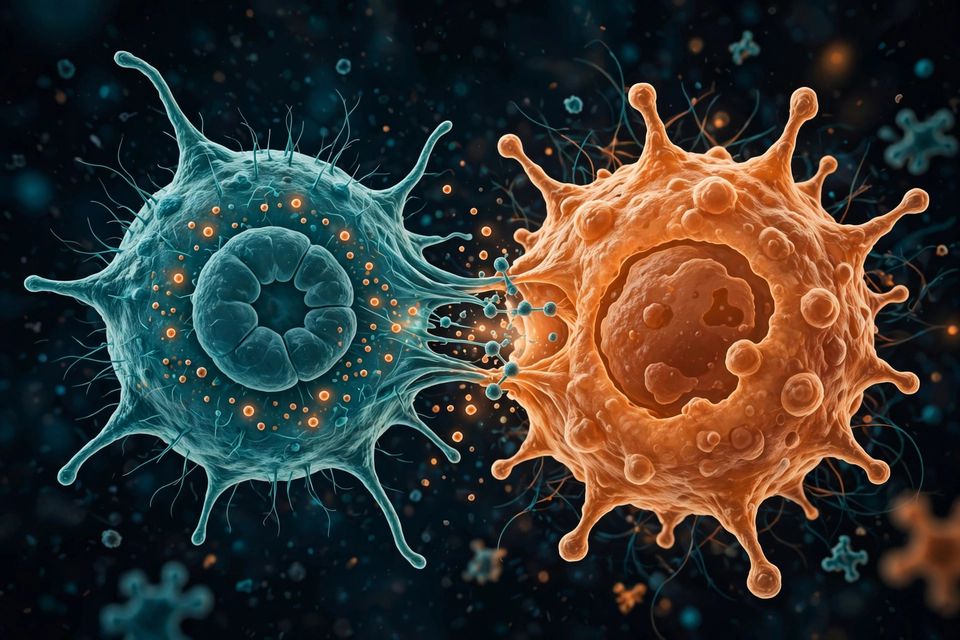
Image: Illustrative image.