
Key Takeaways
- Fourteen patients whose adrenal glands overproduce aldosterone stayed in remission up to two years after a 6–12 month course of tablets ended
- Their blood pressure averaged 25 points lower than before treatment, and about a quarter needed no other blood-pressure medication
- The result comes from a tiny follow-up study with no control group; a larger trial, ELIXIR, is now being organized
A "cure" for one kind of high blood pressure has always meant surgery — until this hint
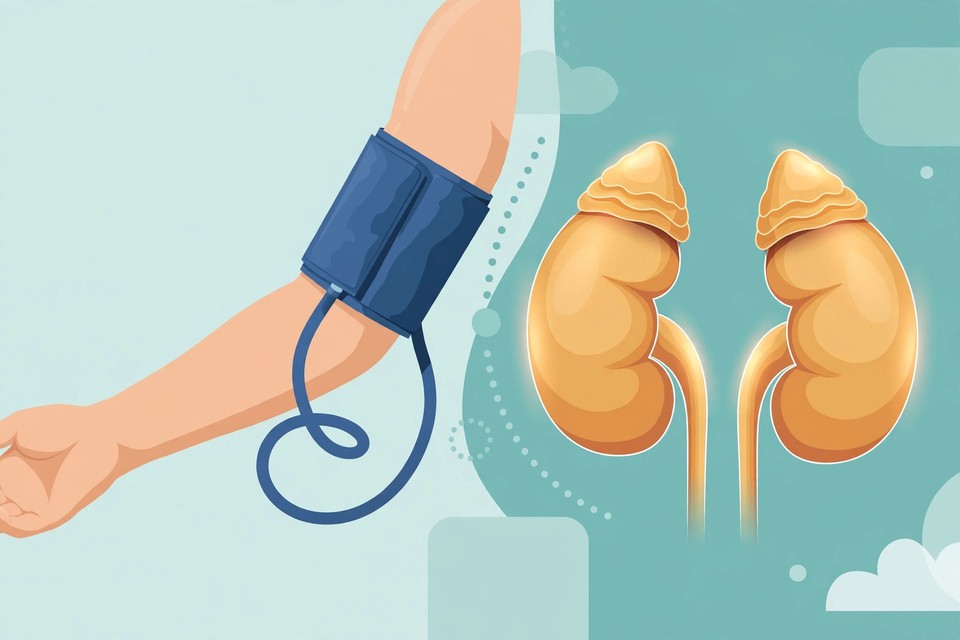
For an estimated 5–10% of everyone with high blood pressure, the cause is a specific hormone problem: benign nodules on the adrenal glands pump out too much aldosterone, a hormone that makes the body hold onto salt and water. It is called primary aldosteronism, and until now the only cure was an operation to remove an entire adrenal gland.
Researchers at Queen Mary University of London have now reported something no drug has done before: after a 6–12 month course of tablets that block the enzyme the glands use to make aldosterone — an approach they call EASI — patients stayed better long after the pills stopped.
What happened to the 14 patients
The team followed 14 people, treated at eight centres in the United States, who had taken the drug in an earlier study. Up to two years after treatment ended, the blood marker of excess aldosterone production remained 99% lower than before treatment, and blood pressure averaged 25 points lower. About a quarter of the patients had normal blood pressure while taking no other medication at all — though most still needed some.
The theory, first suggested by a 2005 mouse experiment, is that blocking the enzyme for long enough makes the overactive aldosterone-producing cells themselves fade away — removing the cause instead of managing it.
Why "14 patients" is doing heavy lifting in this headline
Now the honesty this story demands. Fourteen people is a very small group. There was no control group and no placebo — this was an analysis of routine follow-up measurements, not a purpose-built trial, and even lead researcher Professor Morris Brown described the study as "pragmatic" and urged caution. Nobody knows yet whether the remission lasts beyond two years, or whether it holds in a larger, more varied group. A bigger prospective trial, called ELIXIR, is now being organized to find out — including scans to check whether the aldosterone-producing cells really do disappear.
Health note: Most high blood pressure is not primary aldosteronism, and nobody should change medication based on an early study. If your blood pressure stays high despite treatment, asking your doctor whether hormone causes have been checked is a reasonable conversation.
The Twikup Take
A finite course of tablets that might do a surgeon's job is, in Brown's words, close to a "holy grail" for this condition. But a grail glimpsed by 14 people is a lead, not a cure — ELIXIR is the trial that will decide which one this is.
Image: Illustrative image.