
Key Takeaways
- In the REACT study, 57.1% of 16,808 adults with no known cardiovascular disease had plaque in at least one of the carotid, femoral or coronary arteries.
- Plaque was already present in 8.7% of men and 6.7% of women aged 18–29, and grew exponentially with age.
- The study is a one-time imaging snapshot — it shows how early silent plaque appears, but does not prove that population screening prevents heart attacks.
The disease is there long before the symptoms
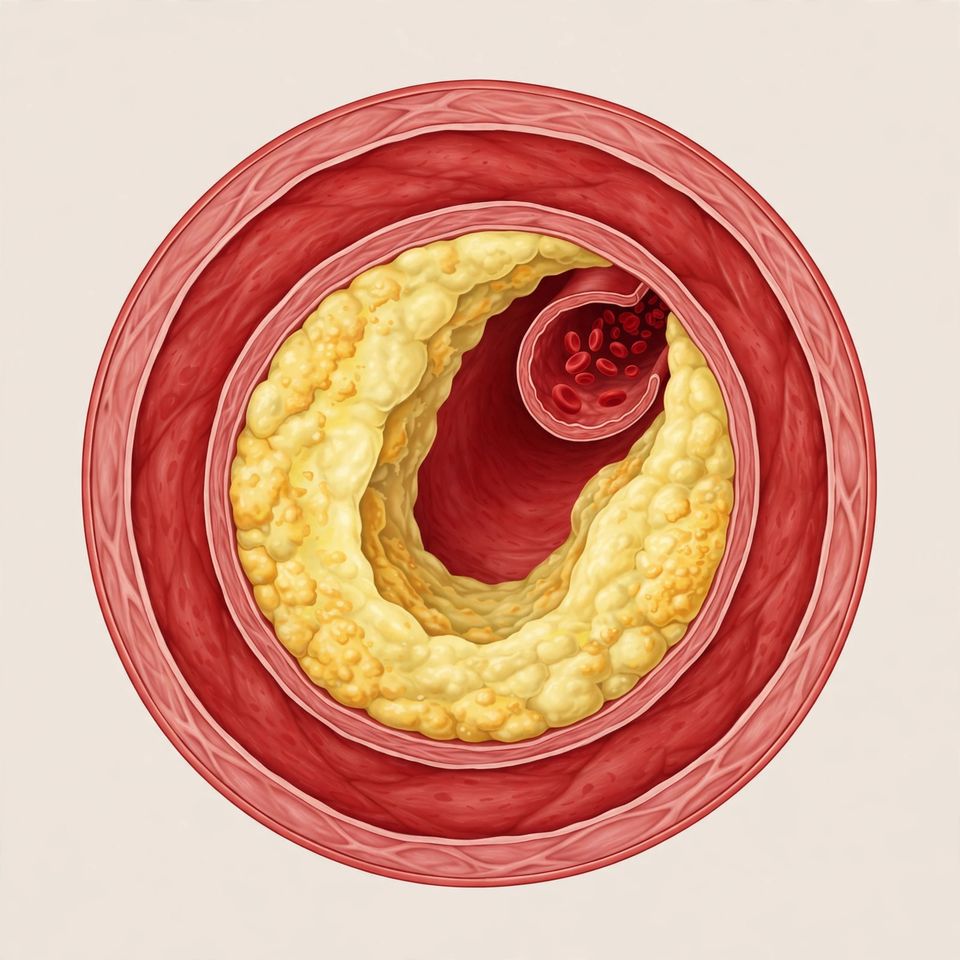
Atherosclerosis — plaque building up inside arteries — is usually discovered the hard way: a heart attack, a stroke, a diagnosis in midlife. A major study published in the New England Journal of Medicine suggests that by then, the disease has typically been present for decades. In the REACT study, researchers in Denmark and Spain imaged 16,808 adults aged 18 to 70 who had no known cardiovascular disease, using 3D ultrasound of the neck and leg arteries plus CT scans of the coronary arteries.
Plaque in at least one of those three territories was found in 57.1% of them.
It starts startlingly young
Even in the youngest group, aged 18 to 29, atherosclerosis was already present in 8.7% of men and 6.7% of women — roughly one in 13 young adults with no symptoms and no diagnosis. From there, prevalence climbed with age, and plaque volume grew exponentially; in younger people the disease was usually confined to a single territory, most often the peripheral arteries rather than the heart — isolated coronary plaque was uncommon in every age group (no more than 9.3% of men and 5.0% of women).
The uncomfortable implication sits in the study's premise: silent atherosclerosis is associated with heart attacks and death independently of traditional risk factors — cholesterol, blood pressure and the usual checklist do not fully capture who has plaque. In the paper's full results, the standard European risk calculator classified only a small fraction of the 40-to-69-year-olds who actually had plaque as high-risk.
What this does not prove
The honest limits matter. This study is a snapshot — one imaging visit per person, no follow-up yet — so it proves how early and how common silent plaque is, not that scanning everyone and treating what you find prevents heart attacks. That question belongs to the program's next phase, a randomized trial of imaging-guided prevention planned for later this decade. The study was funded by the Novo Nordisk Foundation.
For now, the takeaway is narrower and still significant: the arteries of a "healthy" 30-year-old may already carry the beginnings of the disease that kills more people than any other — decades before any symptom would send them to a doctor.
Health note: This study measured plaque in research volunteers; it does not mean everyone should seek artery imaging. If you are concerned about cardiovascular risk, talk to your doctor about the standard, proven steps — blood pressure, cholesterol, smoking, activity and family history — rather than requesting scans on the basis of one study.
The Twikup Take
We tend to date heart disease from its first symptom. REACT's images date it from young adulthood: more than half of healthy adults already carry plaque, most of it invisible to the risk scores doctors rely on. Whether medicine should go looking for it is the next — much harder — question.
Image: Illustrative image.