
Key Takeaways
- The 2026-27 cap is $104.0 million with a $76.9 million floor, built from a 50/50 split of hockey-related revenue (midpoint ±15%)
- A cap hit is the contract's average annual value — salary plus signing bonuses divided by years — not the cash paid in any single season
- LTIR relief for a player expected back is now capped at $3,973,228, and a playoff salary cap has applied since the 2026 playoffs
Start with the number itself
This season, every NHL team must keep its payroll between a floor of $76.9 million and a ceiling of $104.0 million (all figures U.S.). Last season the ceiling was $95.5 million. In 2027-28 it is projected to reach $113.5 million.
The number is not negotiated year to year. It is calculated. The NHL and its players split hockey-related revenue — tickets, broadcast rights, sponsorships, merchandise — 50/50. Take the players' half, subtract the cost of player benefits, divide by 32 teams, and you get the midpoint: $90.4 million this season. The ceiling is the midpoint plus 15%; the floor is the midpoint minus 15%.
Because contracts are signed before the season's revenue is known, the split is trued up afterwards through escrow: a percentage of every paycheque is withheld during the season and settled once final revenue is audited. Under the 2020 agreement the withholding was capped on a glide path that reached 6% by 2023-24 through 2025-26.
Two more boundaries matter. No player can be paid more than 20% of the ceiling in any year — $20.8 million on a contract signed under this season's cap. And the league minimum salary is $850,000.
A cap hit is not a salary
A player's cap hit is his contract's average annual value: total salary plus signing bonuses, divided by the years of the deal. A player paid $14 million in year one and $6 million in year five counts exactly the same against the cap in both years.
That is why the structure of a contract matters as much as its size. The new collective agreement, in force since September 2026, tightens the anti-abuse rules: adjacent years of a contract can differ by no more than 20% of the first year, the lowest year must be at least 71% of the highest, signing bonuses are capped at 60% of the total value, deferred salary is banned, and the maximum term is now seven years to re-sign with your own team, six to sign elsewhere.
LTIR: the loophole, and the fix
Long-term injured reserve never removed an injured player's cap hit. It gave the team a relief pool to spend above the ceiling on replacements — and the pool equals the injured player's cap hit minus the cap space the team already had when he was placed on LTIR. A $3 million player placed on LTIR by a team with $100,000 of space creates a $2.9 million pool, not $3 million. That is why smart teams get as close to the ceiling as possible before making the move. The player must miss at least 24 days and 10 games, and a team using LTIR stops accruing new cap space.
For two decades, the famous play was legal: park an injured star on LTIR, spend the pool at the trade deadline, then activate the star for Game 1 of the playoffs — because the playoffs had no cap. Tampa Bay, Vegas and Florida all won with versions of it.
That loophole is now closed, in two steps. If a player is expected back at any point in the season, LTIR relief is capped at the previous season's average league salary — $3,973,228 this season. Full relief requires a season-ending LTIR designation: the player is out for the rest of the regular season and the playoffs, no return possible. And since the 2026 playoffs, there is a playoff salary cap: the 18 skaters and two goaltenders dressed for each playoff game must fit under the regular-season ceiling, with no pro-rating.
Trades, retentions and buyouts
A selling team can retain up to 50% of a traded player's cap hit and salary — on at most three contracts at once, totalling no more than 15% of the ceiling. A contract can be retained on twice, so two teams can stack retention and cut a player's cost to a contender to a quarter of the original. Under the new agreement, a second retention must wait at least 75 regular-season days after the first, which kills the old deadline-day three-team laundering deal.
A buyout pays a player aged 26 or older two-thirds of his remaining base salary over twice the remaining term — but signing bonuses are paid in full and count in full, which is why bonus-heavy contracts are effectively buyout-proof. The savings come early; the dead cap lingers for years.
The Twikup Take
The cap looks like one number, but it is really three systems stacked together: a revenue formula that sets the ceiling, an averaging rule that turns contracts into cap hits, and a set of relief valves — LTIR, retention, buyouts — that contenders exploit and the league keeps tightening. The teams that win the cap game are not the ones that spend the most. They are the ones that understand the pool math, the bonus cushion and the calendar better than everyone else.
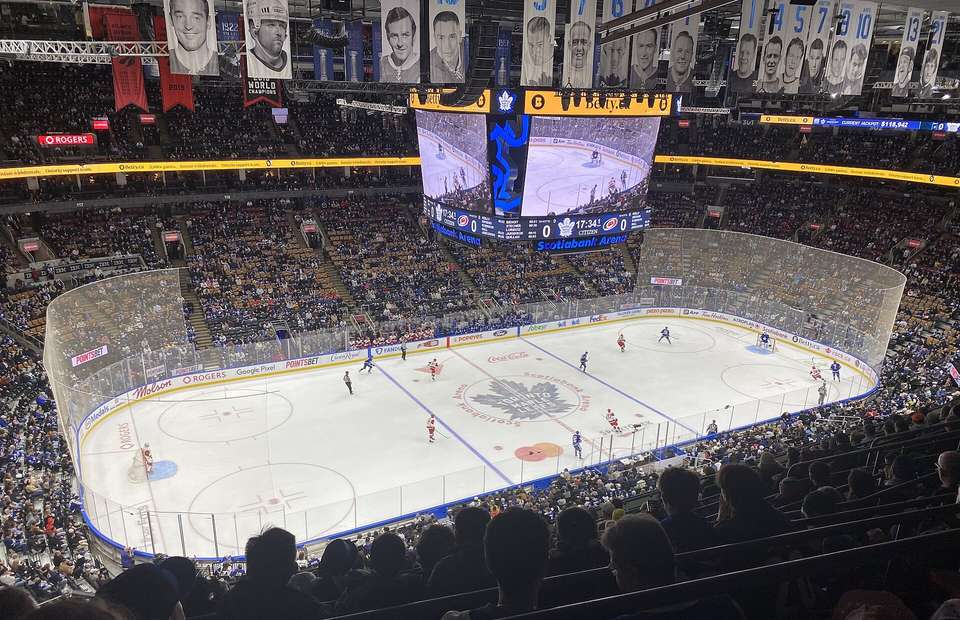
Image: Toronto Maple Leafs vs. Carolina Hurricanes at Scotiabank Arena, March 20, 2026, by Adam Bishop, CC BY-SA 4.0, via Wikimedia Commons.